
Symbolic play is a key step in developing your child’s ability to think abstractly and imagine beyond what they see. When they use objects, actions, or words to represent other things, they learn to connect concrete experiences with ideas and concepts. This type of play promotes creativity, problem-solving, and social skills, helping your child understand emotions and social norms. Keep exploring, and you’ll discover how symbolic play builds the foundation for lifelong learning and emotional growth.
Key Takeaways
- Symbolic play fosters the development of abstract thinking by encouraging children to use objects and actions to represent other concepts.
- Engaging in pretend scenarios helps children connect concrete experiences with higher-level cognitive processes.
- Through role-playing and storytelling, children learn to create and interpret symbols, foundational for reading and mathematical reasoning.
- Symbolic play enhances problem-solving skills by allowing children to imagine and navigate complex, hypothetical situations.
- It serves as a critical step in cognitive development, bridging tangible experiences with abstract thought and reasoning abilities.

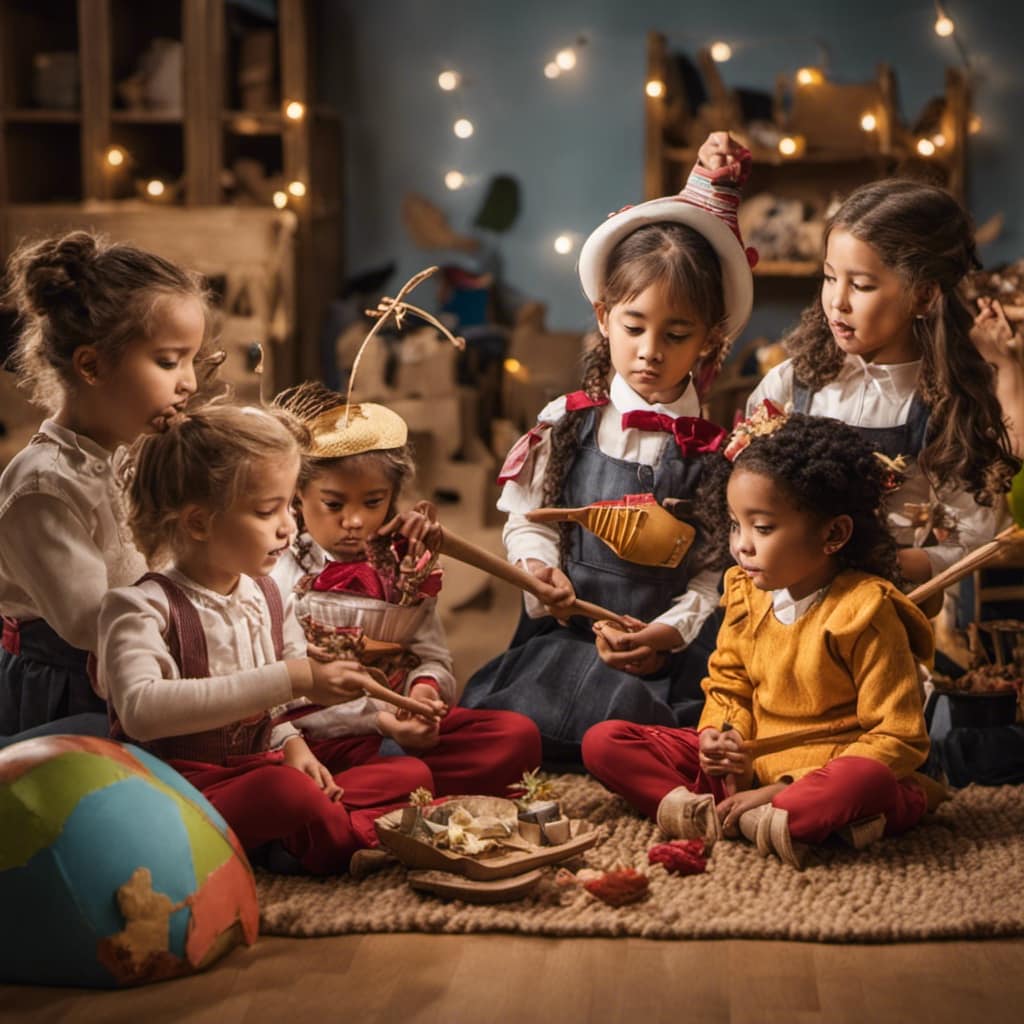
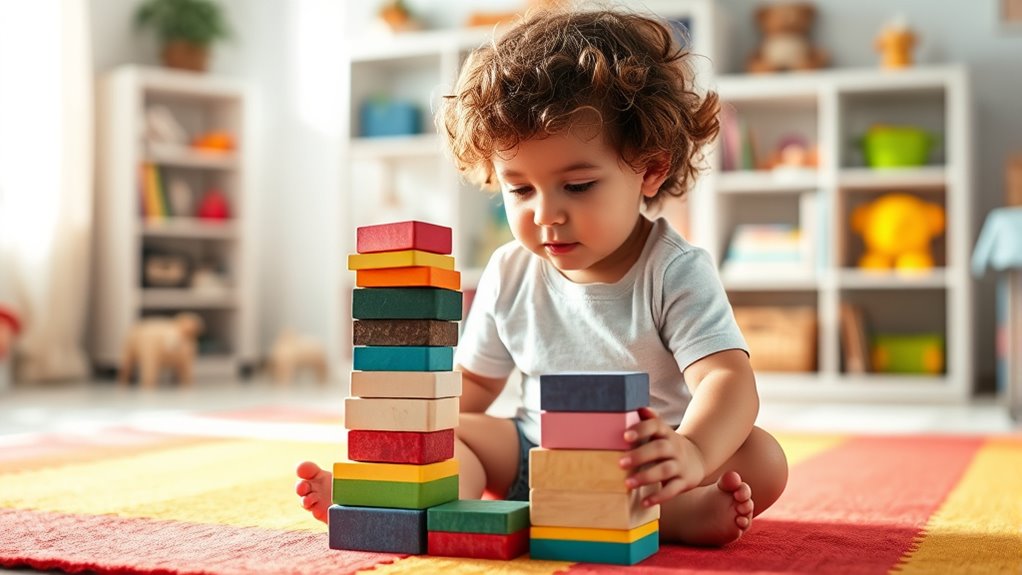
Have you ever watched a young child pretend that a block is a phone or a toy car is a real vehicle? That moment is more than just adorable; it’s a powerful example of symbolic play in action. This type of play involves using objects, actions, or words to represent something else, and it’s a essential stage in a child’s development. When children engage in symbolic play, they’re not just having fun—they’re developing essential skills that set the foundation for future learning and growth.
One of the most significant educational benefits of symbolic play is how it fosters cognitive development. As kids assign new roles and meanings to objects, they practice abstract thinking, which is indispensable for problem-solving and creativity. For example, when a child uses a stick as a sword or a box as a spaceship, they’re imagining possibilities beyond the immediate physical environment. This ability to think symbolically helps children understand that symbols can stand for real things, a skill that’s key for reading, writing, and mathematical reasoning later on.
Symbolic play boosts cognitive growth by fostering abstract thinking and problem-solving skills essential for future learning.
Symbolic play also plays an important role in helping children reach developmental milestones. During this stage, children begin to develop language skills as they narrate their actions or assign names to their pretend scenarios. They learn to communicate their ideas, desires, and emotions more clearly, which enhances social interaction. Additionally, engaging in pretend scenarios enhances their ability to understand different perspectives, a crucial social skill that supports empathy and cooperation. As children imitate roles—like a parent, teacher, or superhero—they gain insight into social norms and expectations, which aid in their overall social-emotional development.
Beyond the cognitive and social benefits, symbolic play encourages emotional regulation. When children act out scenarios involving feelings, such as comforting a doll or playing doctor, they process their own emotions and learn to manage them. This form of play provides a safe space for children to explore fears, hopes, and relationships, fostering resilience and emotional intelligence.
Furthermore, understanding the importance of merchant services and modern transactional tools can help caregivers and educators integrate technology in a way that supports developmental play and learning.
In essence, symbolic play isn’t just about fun—it’s a indispensable part of childhood that bridges concrete experiences with abstract thinking. It nurtures educational benefits by enhancing critical thinking, language, and social skills. It also marks important developmental milestones, guiding children toward greater independence, creativity, and understanding of the world around them. Recognizing and supporting this form of play helps set children on a path toward lifelong learning and emotional well-being, making it a cornerstone of healthy childhood development.
Frequently Asked Questions
How Does Symbolic Play Differ Across Various Cultures?
You’ll notice that symbolic play varies across cultures due to cross-cultural differences in social norms and play symbolism. In some cultures, children engage in elaborate pretend scenarios that reflect local stories and traditions, while others focus on practical or community-based activities. These differences influence how children develop abstract thinking, as play symbolism adapts to cultural values, shaping their understanding of the world and enhancing their cognitive skills through culturally relevant symbolic representations.
At What Age Does Symbolic Play Typically Begin?
You might be surprised to learn that symbolic play typically begins around age 2, a key developmental milestone. As you observe your child’s creative imagination blossoming, play interventions can support this growth, encouraging them to explore make-believe scenarios. This stage is vital for developing abstract thinking, and engaging in symbolic play helps your child connect real-world concepts to their imaginative world, paving the way for future cognitive skills.
Can Symbolic Play Be Encouraged in Children With Developmental Delays?
Yes, you can encourage symbolic play in children with developmental delays by fostering their role of pretend and creative storytelling. Provide open-ended toys and space for imagination, join their play to model ideas, and gently introduce new scenarios. Your involvement helps them practice abstract thinking, making play more meaningful. With patience and support, you enable them to develop cognitive skills and enjoy the benefits of symbolic and imaginative activities.
What Are Common Signs of Delayed Symbolic Play Development?
You’ll notice delayed symbolic play when children struggle with toy substitution and role enactment, like using a block as a phone or not engaging in pretend scenarios at all. They may focus solely on physical actions rather than imaginative ones, showing limited creativity. If play remains very literal and they don’t imitate or assign roles, it’s a sign their symbolic play development might be behind, potentially impacting their abstract thinking skills.
How Does Symbolic Play Influence Language Acquisition?
Symbolic play boosts your child’s language development by encouraging them to use words, gestures, and facial expressions to represent objects and ideas. This active engagement fosters cognitive growth, helping them understand abstract concepts and improve communication skills. As they practice role-playing and storytelling, they learn new vocabulary and sentence structures, making language learning more natural and meaningful. Consequently, symbolic play serves as a crucial foundation for overall language and cognitive development.
Conclusion
So, next time your little one is “feeding” a banana to a stuffed animal, remember—they’re not just being adorable—they’re secretly developing the complex abstract thinking skills that will someday help them run the world—or at least their own messy rooms. Embrace the chaos of symbolic play; it’s the magical bridge from make-believe to mind-blowing ideas. Who knew that tiny tea parties and toy cars were actually the secret keys to genius?