📊 Full opportunity report: How Parents Build Negotiation Skills With IEP Rehearsal Simulators on IdeaNavigator AI — validation score, market gap, and execution plan.

Turn the school run and nap time into listening time
- Thousands of audiobooks, podcasts and originals
- Listen on your phone, tablet or Echo — also offline
- Cancel anytime
TL;DR
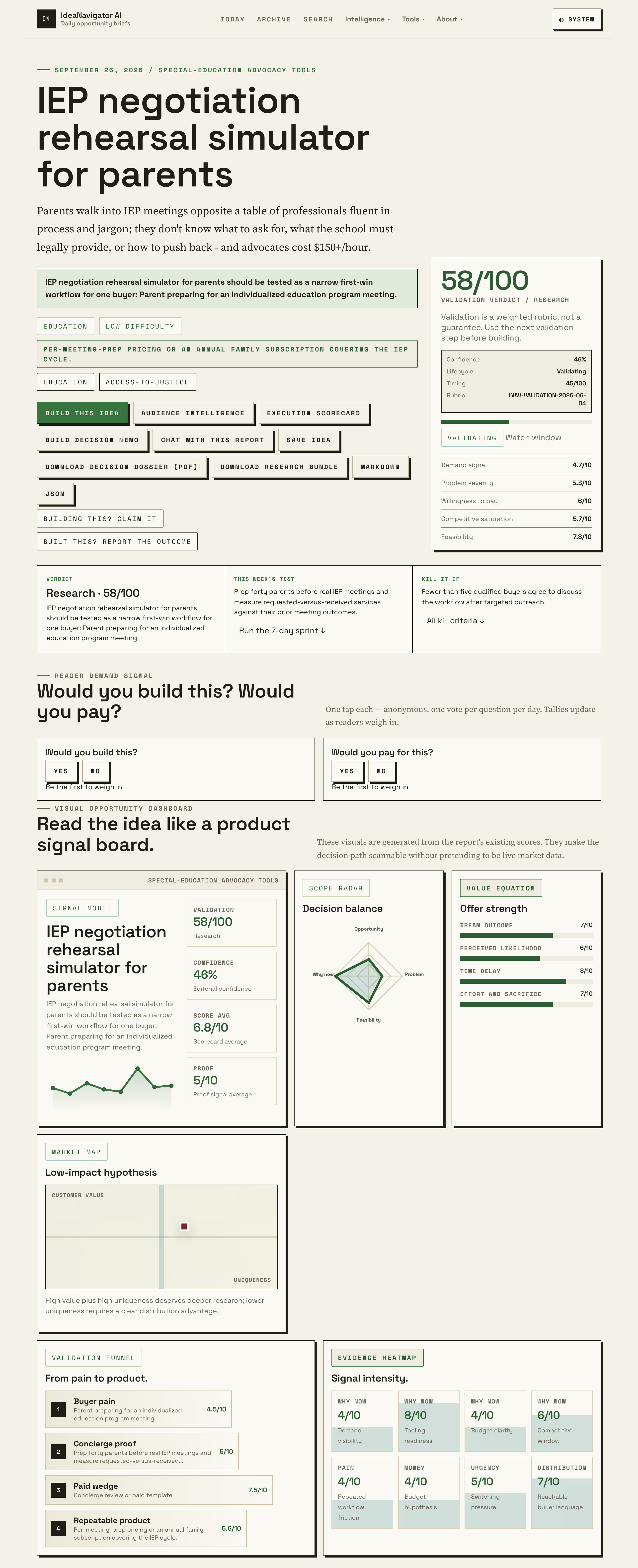
IdeaNavigator AI’s proposal outlines an IEP meeting rehearsal simulator for parents, with document review, plain-language explanations and role-play. The proposal reports no test results; its legal guidance, effectiveness and pricing remain unverified.
IdeaNavigator AI has proposed an IEP meeting rehearsal simulator for parents preparing for school planning meetings, combining review of education documents with practice responding to school staff. The concept is aimed at families who may struggle with process jargon or the cost of private advocacy, but the proposal reports no product launch, trial results or measured outcomes.
According to the proposal, a parent would be able to upload a child’s current individualized education program (IEP) and evaluation reports. The tool would explain provisions in plain language, produce a list of possible requests with legal grounding and simulate a meeting, including realistic pushback, so the parent could rehearse holding their positions.
The outline frames this as a narrow first-use workflow: one buyer, a parent preparing for one IEP meeting. It suggests charging per preparation session or offering an annual family subscription covering an IEP cycle. These are proposed business models; the proposal gives no prices or subscription terms and does not identify an operating company.
To test demand and usefulness, the proposal recommends preparing 40 parents before actual meetings and comparing the services they request with the services they receive, alongside outcomes from their earlier meetings. The proposal includes no recruitment details, study protocol, results or comparison data.
Preparing Parents for IEP Meetings
IEP meetings can shape the educational supports a student receives, while parents may have to evaluate recommendations and make requests in a process that uses specialized terminology. A rehearsal tool could give families a way to organize questions and practice explaining their priorities before meeting with school staff.
IdeaNavigator AI’s proposal cites advocate fees of $150 or more per hour as a cost that can put one-to-one help out of reach for some families. It supplies no fee survey or geographic range for that figure. If a simulator proves accurate and useful, lower-cost preparation could be valuable. At present, that benefit is a possibility, not an established result.
Any tool that explains legal entitlements would also need to handle differences in a child’s needs and applicable rules with care. A parent could rely on the resulting request list in a consequential meeting, so the quality and limits of its explanations would matter as much as the role-play.
The Proposed First Test
IdeaNavigator AI presents the concept as an early product opportunity in special-education advocacy tools, rather than as an existing service with a track record. Its rationale is that language models can now support realistic role-play, while families face complicated meetings and school systems may have constrained resources. The proposal provides no evidence quantifying those trends or establishing that meetings have become more adversarial.
The suggested validation would focus on whether parents prepared with the simulator obtain services closer to what they requested, compared with their prior meeting outcomes. That comparison alone would not show that the simulator caused any change. The proposal does not specify how researchers would account for changes in student needs, school decisions, family preparation or differences between meetings.
Evidence and Safeguards Needed
IdeaNavigator AI’s proposal reports no working product, pilot or outcome data. It does not say whether the simulator has been built, whether families or school professionals have reviewed its approach, or when the proposed 40-parent test might take place.
Other open questions include how legal explanations would be checked and updated, how the tool would distinguish general information from advice about an individual case, and how uploaded evaluations and education records would be stored and protected. The outline also does not say how role-play would adapt to different disabilities, state rules or school circumstances, or how it would avoid presenting a generated request as a guaranteed entitlement.
A Forty-Parent Validation Plan
The next step described in IdeaNavigator AI’s proposal is to prepare 40 parents before real IEP meetings and compare requested and received services with those families’ earlier meeting outcomes. The proposal gives no schedule or details about recruitment, consent, measurement or independent review. Until those details and results are available, the simulator’s accuracy, affordability and effect on meeting outcomes remain unknown.
Key Questions
Is the IEP rehearsal simulator available now?
IdeaNavigator AI reports no availability or launch. Its page describes a product concept and a possible test, not a confirmed service.
What would the proposed simulator do?
According to IdeaNavigator AI’s proposal, it would review a parent’s current IEP and evaluation reports, explain them in plain language, suggest requests with legal grounding and let the parent rehearse a meeting through role-play.
Has it been shown to improve services students receive?
IdeaNavigator AI reports no results. Its proposal suggests comparing requested and received services for 40 parents with their previous meeting outcomes, but does not document that test as completed.
Would it replace a special-education advocate?
The proposal positions the tool as meeting preparation and does not establish that it can replace an advocate. Its legal explanations and ability to address individual circumstances have not been evaluated.
Source: IdeaNavigator AI
Fall Picks
fall essentials
As an affiliate, we earn on qualifying purchases.