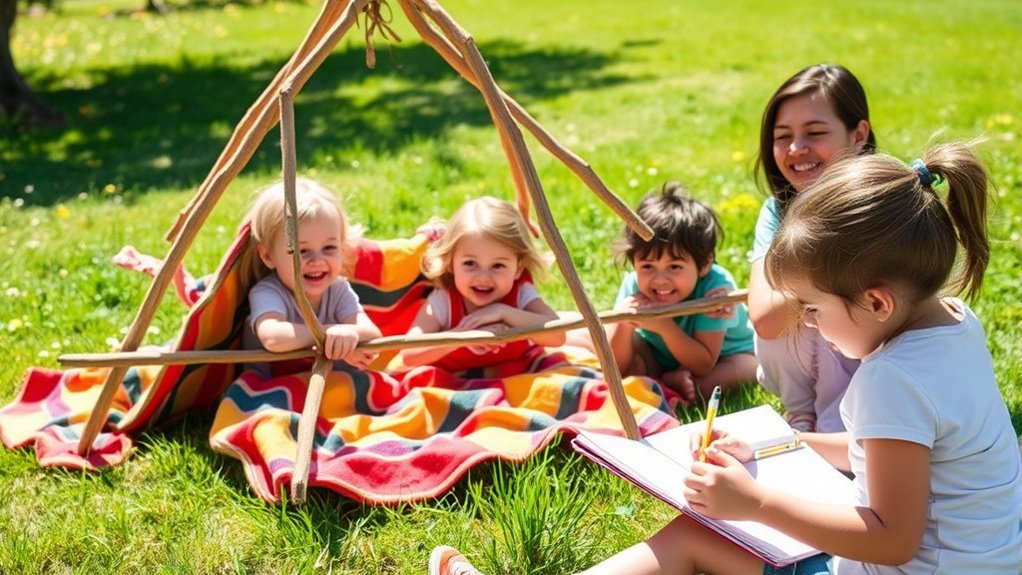

To document learning from play without worksheets, observe children during their natural activities and note their interactions, problem-solving moments, and social behaviors. Use checklists or guiding questions beforehand to focus on key skills like language, motor development, and creativity. Record specific behaviors or responses through notes or videos, capturing how children think and engage. This approach reveals genuine insights into their development, and if you keep exploring, you’ll discover even more effective ways to understand their growth.
Key Takeaways
- Use detailed notes or videos to record children’s behaviors, interactions, and problem-solving during play sessions.
- Prepare checklists of targeted skills (language, motor, social) to guide observations and capture relevant evidence.
- Observe and document spontaneous behaviors, such as sharing, negotiating, and creative problem-solving, to assess development.
- Engage children with open-ended questions after play to gain insights into their interests, understanding, and reflections.
- Interpret behaviors as indicators of cognitive, social, and emotional growth, using natural play as authentic evidence of learning.
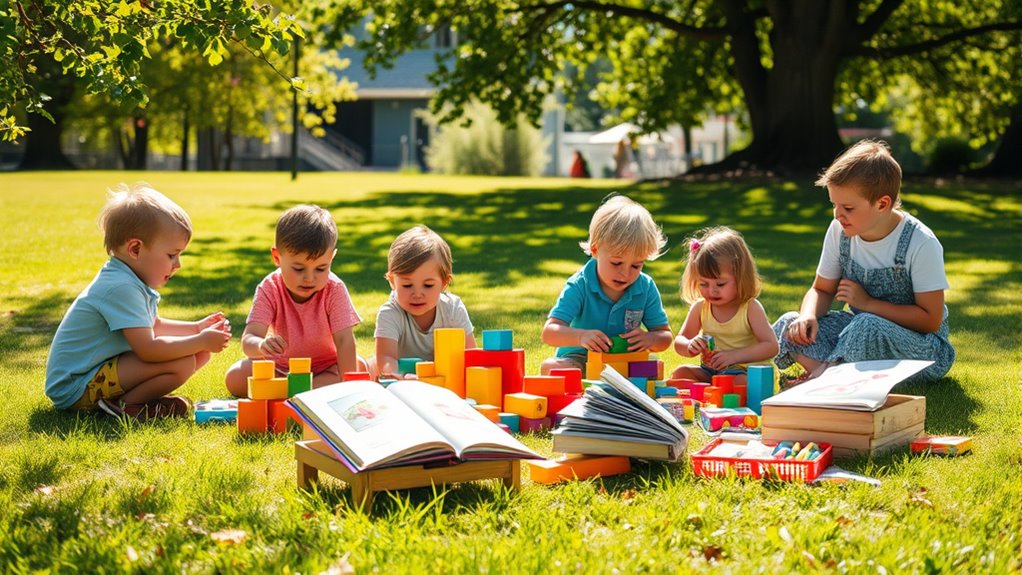
Have you ever wondered how to effectively capture the learning that happens during play? It’s a common question among educators and caregivers who want to see the growth and development children demonstrate through their natural activities. Instead of relying on worksheets or formal tests, you can use play-based assessment techniques that provide a true picture of a child’s skills and understanding. Play-based assessment centers on observing children as they engage in their usual play routines, giving you rich insights into their cognitive, social, emotional, and physical development. These assessments don’t require any special tools—just your keen eye and a strategic approach to observing.
Observational strategies are key to documenting what children learn during play. As you watch, focus on specific behaviors, interactions, and problem-solving moments that reveal their developmental levels. For instance, notice how they negotiate rules, share materials, or solve puzzles. These behaviors offer concrete evidence of their thinking abilities and social skills. Keep in mind that your role isn’t to direct play but to observe quietly, jotting down notes or recording videos when appropriate. This approach allows children to explore freely while you gather meaningful data on their progress.
To make the most of observational strategies, create a checklist or a set of guiding questions beforehand. Identify what skills you’re looking for—language use, fine motor skills, creativity, or collaboration, for example. During play, note specific instances that demonstrate these skills. Record detailed observations, including what the child said or did, how they interacted with peers or materials, and their emotional responses. These notes serve as evidence for your assessments and can help you identify areas where children excel or need additional support. Additionally, understanding that play is a form of learning helps you interpret behaviors more effectively and appreciate the depth of development occurring during these activities.
Another tip is to observe children across different play contexts—free play, guided activities, and peer interactions. This broader view offers a holistic picture of their development. Additionally, involve the children by asking open-ended questions after play, like “What did you enjoy most?” or “Tell me about what you were doing.” Their responses can shed light on their understanding and interests, enriching your observational data.
Frequently Asked Questions
How Can I Share Play-Based Learning With Parents Effectively?
You can share play-based learning with parents effectively by involving them in the process through regular updates and parent collaboration. Use storytelling techniques to vividly describe their child’s experiences and growth during play. Share photos, videos, or anecdotes that highlight their child’s skills and discoveries. Encourage parents to ask questions and share their observations too, fostering a strong partnership that celebrates and supports the child’s learning journey.
What Are Creative Ways to Document Unstructured Play?
You can creatively document unstructured play through visual journaling and photo documentation. Use a visual journal to sketch or collage moments, capturing emotions and actions. Take photos during play sessions, then compile them into a digital or physical album. These methods allow you to reflect on children’s learning, share progress with parents, and highlight their creativity without relying on worksheets, making the documentation process more engaging and authentic.
How Do I Assess Learning Outcomes From Spontaneous Play?
You can assess learning outcomes from spontaneous play through play observation, noting how children solve problems, communicate, and explore. Keep learning portfolios to document these insights over time, capturing photos, children’s reflections, or examples of their work. Regularly reviewing these portfolios helps you identify growth patterns, understand individual interests, and gauge developmental progress without relying on formal tests or worksheets.
What Tools Are Best for Tracking Informal Play Activities?
Think of tracking informal play as capturing a fleeting butterfly—you need the right tools. Play journaling allows you to jot down observations and reflections on play activities, while digital portfolios serve as vibrant collections of a child’s spontaneous moments. Both tools are flexible, engaging, and easy to update, helping you document learning outcomes without formal tests. Use these tools consistently to build a rich picture of each child’s growth through play.
How Can I Encourage Children to Reflect on Their Play Experiences?
You can encourage children to reflect on their play experiences through play journaling, which makes reflection fun and meaningful. Use simple reflection prompts like “What was your favorite part?” or “What did you learn today?” to guide their thinking. Encourage them to draw or write about their play, helping them process their feelings and ideas. This approach fosters self-awareness and deepens their understanding of their own learning.
Conclusion
By observing and documenting children’s play, you discover a world of hidden learning and creativity. You see their ideas unfold, their problem-solving skills grow, and their confidence blossom—all without a single worksheet. Isn’t it amazing how much can be learned through simply watching and recording? When you embrace this approach, you turn everyday moments into powerful insights, showing that learning is everywhere—if you’re willing to look closely enough. Are you ready to start capturing those precious play moments?