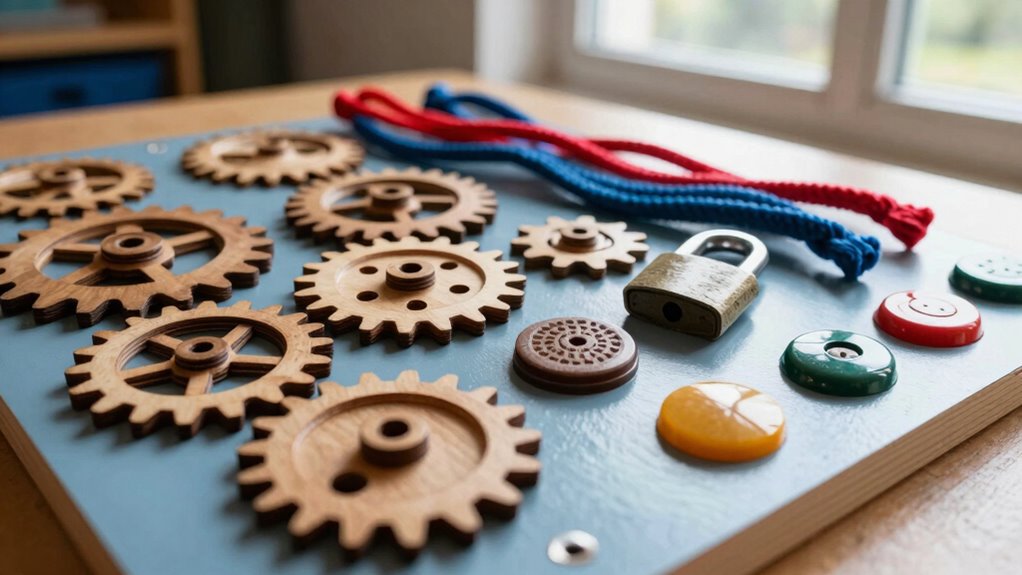
Busy boards support your child’s independent exploration by creating a safe, engaging space where they can freely experiment and solve problems. They encourage testing limits, making decisions, and discovering how things work at their own pace. This boosts confidence while fostering critical thinking and motor skills. By offering diverse textures and activities, busy boards inspire curiosity and self-directed learning. Keep exploring to see how these tools can help your child grow even more confident and capable.

Turn the school run and nap time into listening time
- Thousands of audiobooks, podcasts and originals
- Listen on your phone, tablet or Echo — also offline
- Cancel anytime
Key Takeaways
- Busy boards allow children to explore at their own pace, fostering self-directed discovery and decision-making.
- They provide a safe, contained environment for testing limits and understanding how different components work.
- Interactive features encourage problem-solving and critical thinking, promoting independent learning.
- They reinforce confidence through successful task completion and mastery of new skills.
- Busy boards support sensory exploration, helping children learn about textures, shapes, and cause-and-effect independently.
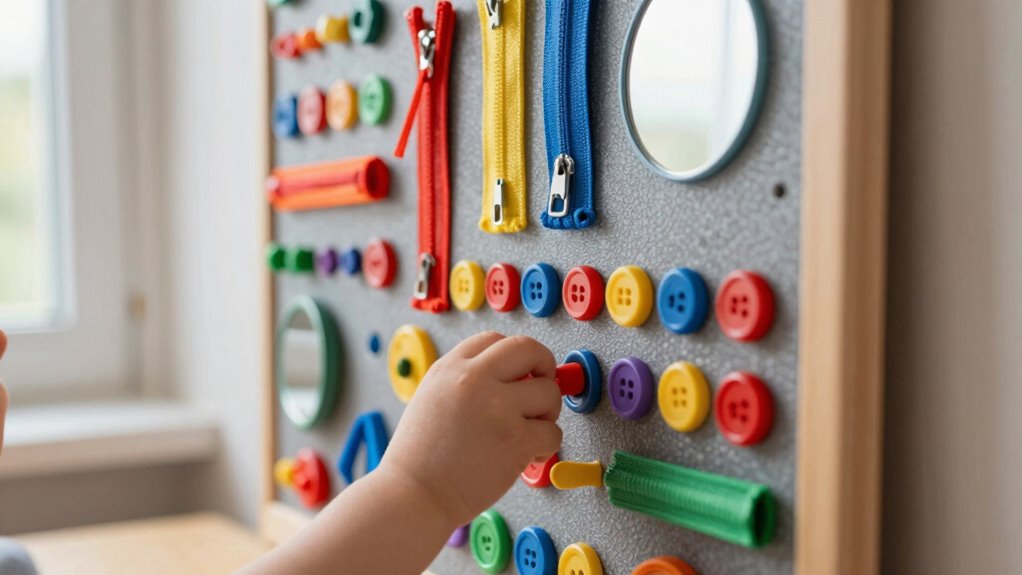
Have you ever wondered how to effectively foster independent exploration? One way to do this is by introducing a busy board into your child’s environment. These interactive tools are designed to encourage children to explore their surroundings safely and confidently. As your child manipulates various objects on the board, they engage in sensor development—learning through touch, sight, and sound. This hands-on experience helps sharpen their senses and boosts their ability to process different stimuli, laying a solid foundation for future learning. Through these activities, children also make noticeable progress toward their developmental milestones, such as fine motor skills, hand-eye coordination, and problem-solving abilities.
When your child interacts with a busy board, they’re actively testing their limits and discovering how things work. This kind of exploration promotes independence because your little one learns to rely on their senses to navigate new challenges. As they grasp, push, turn, or slide different components, they develop fine motor control, which is essential for tasks like writing and buttoning their clothes. These activities also support cognitive growth as your child figures out how various parts connect and operate, fostering early critical thinking skills. As they master each task, they gain confidence, reinforcing their motivation to explore even more on their own. Incorporating sensory-rich components can enhance their engagement and learning even further.
Supporting sensor development through busy boards helps your child recognize different textures, shapes, and sounds. This sensory input is crucial during early childhood because it enables your child to understand their environment more fully. For example, feeling a textured surface or hearing a click when a button is pressed helps them associate actions with outcomes, an important step in their cognitive development. These interactions also aid in achieving developmental milestones related to spatial awareness and cause-and-effect understanding. The more your child manipulates and experiments, the more their brain wires connections that underpin future skills like reading, writing, and logical reasoning. Additionally, incorporating elements inspired by biodiversity can introduce natural textures and shapes, enriching their sensory experiences. Engaging with diverse natural materials can also foster an early appreciation for the environment and its variety. This exposure to different textures and shapes can also promote sensory integration, helping your child better process and respond to sensory information.
Supporting sensor development with busy boards helps children recognize textures, shapes, and sounds, fostering cognitive growth and early milestone achievement.
Furthermore, busy boards serve as a safe space for independent exploration. They allow your child to practice decision-making and problem-solving at their own pace. Watching them figure out how to open a latch or turn a wheel can be incredibly rewarding, affirming their growing independence. Including a variety of sensory-rich components can further enhance their engagement and learning. By providing a variety of engaging, age-appropriate activities, you support their natural curiosity while helping them reach key developmental milestones. Ultimately, busy boards are more than just toys—they’re powerful tools that facilitate sensor development and foster a child’s confidence in their abilities to explore the world around them.
As an affiliate, we earn on qualifying purchases.
Frequently Asked Questions
How Do Busy Boards Aid in Developing Fine Motor Skills?
Busy boards help you develop fine motor skills by encouraging sensory engagement and hand-eye coordination. When you manipulate buttons, zippers, and switches, you refine your finger movements and improve control. These activities stimulate your senses, making exploration engaging and educational. As you practice these skills, your precision and dexterity grow, laying a strong foundation for everyday tasks like dressing and writing.
Are Busy Boards Suitable for All Age Groups?
Yes, busy boards are suitable for all age groups because of their age adaptability and material variety. For young children, they promote sensory exploration and fine motor skills, while older kids and adults can enjoy more complex challenges. The diverse materials keep everyone engaged, and you can customize the board’s complexity to match different developmental stages. This versatility makes busy boards a fun, educational tool for all ages.
How Can Parents Customize a Busy Board for Their Child?
You can easily customize a busy board for your child through DIY customization, adding sensory features like textured fabrics, bells, or mirrors to engage their senses. Consider their interests and developmental stage, then incorporate elements like colorful buttons, Velcro, or different materials. Personal touches make the board more inviting and fun, encouraging exploration. Adjust the complexity over time to keep your child challenged and excited to discover new textures and activities.
What Safety Considerations Should Be Taken With Busy Boards?
Think of your busy board as your child’s own mini medieval castle—safety hazards and material safety are essential. You should guarantee all parts are securely attached, with no sharp edges or small pieces that can be swallowed. Use non-toxic, child-safe materials, and regularly check for wear and tear. By prioritizing these safety considerations, you create a secure environment that encourages independent exploration without unnecessary risks.
How Do Busy Boards Promote Problem-Solving Abilities?
You’ll see that busy boards promote problem-solving abilities by engaging your child’s cognitive development and encouraging creativity enhancement. As they manipulate different objects and puzzles, they learn to think critically, experiment, and find solutions. This hands-on approach stimulates their brain, helping them develop essential skills like reasoning and concentration. By offering diverse challenges, busy boards foster a love for learning and boost their confidence in tackling new problems.
Conclusion
By engaging with busy boards, you encourage curiosity, foster independence, and build confidence. You allow children to explore freely, to learn through play, and to develop their skills at their own pace. You empower their sense of discovery, nurture their creativity, and strengthen their problem-solving abilities. In supporting independent exploration, you help children become confident, capable, and curious learners—ready to face new challenges, enthusiastic to explore, and excited to grow.
Fall Picks
fall essentials
As an affiliate, we earn on qualifying purchases.