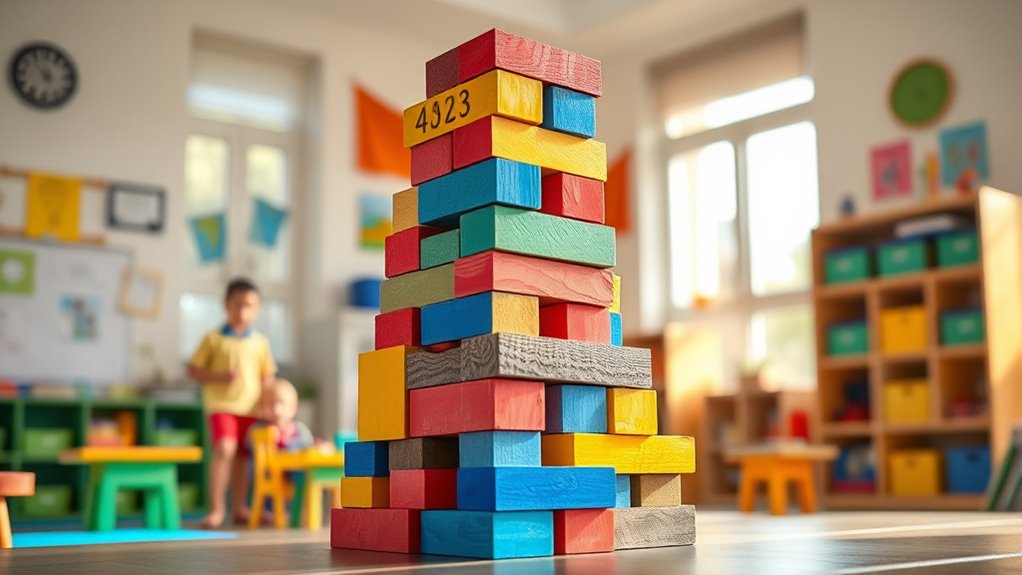

Building with blocks helps you develop your child’s spatial awareness by encouraging them to judge distances, plan structures, and understand how objects relate in space. It sparks their creativity and problem-solving skills as they experiment with shapes and stability. This open-ended play also teaches about balance and design, promoting confidence and resilience through trial and error. If you want to discover more ways this activity supports your child’s growth, keep exploring.
Key Takeaways
- Building with blocks develops understanding of spatial relationships and object positioning in a three-dimensional space.
- It enhances spatial reasoning by requiring children to judge distances and alignments accurately.
- Constructing complex structures encourages visualization of how parts fit together within a larger design.
- Engaging in open-ended building activities boosts awareness of spatial dimensions and proportions.
- Repeated experimentation with block arrangements improves overall spatial awareness and cognitive development.
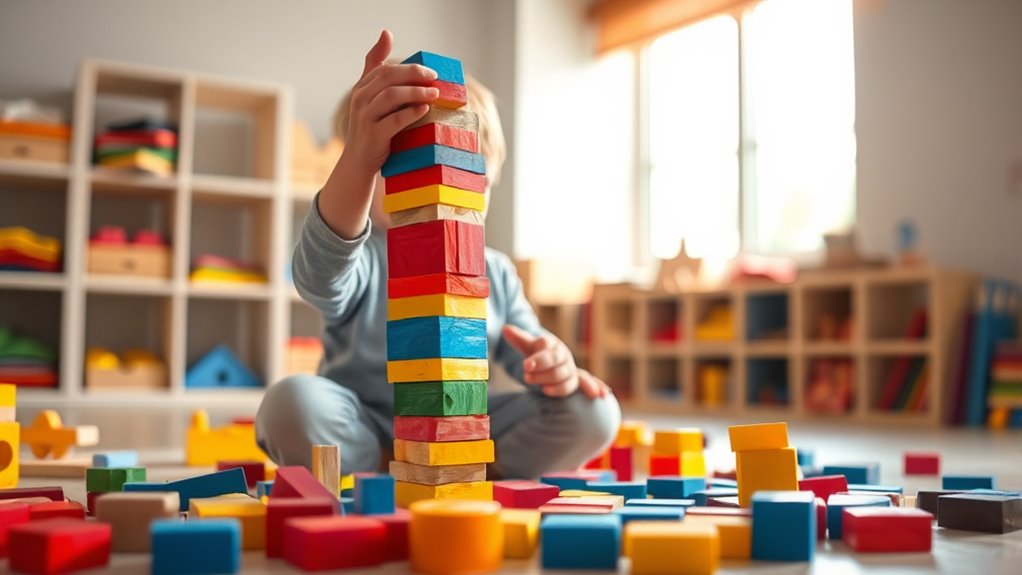
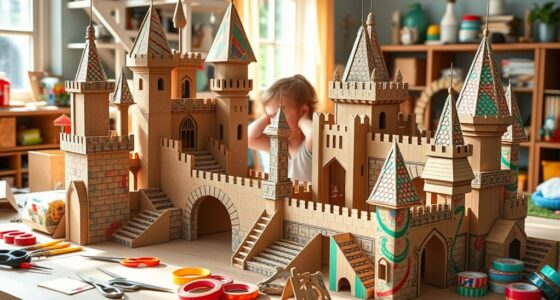
Building with blocks isn’t just about physical coordination; it’s also a powerful way to foster creativity. With endless possibilities, your child can design towers, bridges, castles, or abstract sculptures, encouraging imaginative thinking. When they decide what to build next, they’re exploring their ideas, experimenting with different shapes and arrangements, and thinking outside the box. This creative process promotes flexible thinking and helps them develop their own unique approaches to solving problems. As they experiment with different configurations, they learn about balance, symmetry, and structural integrity, which deepens their understanding of how objects relate to each other in space. Additionally, engaging in building activities can introduce children to fundamental concepts of spatial awareness, helping them better judge distances and understand spatial relationships in both play and real-world scenarios. Moreover, building with blocks offers a safe environment for your child to take risks and learn from mistakes. If a tower collapses, they analyze what went wrong and try again, strengthening their resilience and critical thinking. This iterative process enhances their problem-solving abilities and encourages persistence. As they gain confidence, they may begin to plan more complex structures, considering stability and design, which further stimulates their cognitive development.
Frequently Asked Questions
What Are the Best Types of Blocks for Different Age Groups?
When choosing the best block types for different age groups, you should consider age-appropriate blocks that match their developmental stage. For toddlers, soft or large plastic blocks are ideal for safe, simple stacking. Preschoolers benefit from wooden or foam blocks that challenge their creativity. Older children enjoy more complex block types like interlocking or magnetic blocks. Always select age-appropriate blocks to support learning and guarantee safe, enjoyable play.
How Can Building With Blocks Improve Problem-Solving Skills?
Building with blocks can substantially boost your problem-solving skills by improving spatial reasoning and supporting cognitive development. When you manipulate and assemble blocks, you challenge yourself to think critically about balance, structure, and design. This hands-on activity encourages you to explore different solutions, adapt your strategies, and learn from mistakes. As a result, your ability to analyze problems and develop creative solutions strengthens, benefiting your overall cognitive growth.
Are There Specific Strategies to Encourage Creativity With Blocks?
You might think there’s a strict formula for sparking creativity with blocks, but ironically, the best approach is just to let go. Encourage creative experimentation by providing open-ended activities that challenge you to build freely without rules. Set no limits, offer diverse shapes, and watch your imagination soar. The key is to embrace messiness and surprises, turning simple blocks into endless possibilities, where every creation sparks new ideas.
How Does Block Building Support Developmental Milestones?
When you encourage block building, you’re supporting your child’s sensorimotor development and motor coordination. As they manipulate blocks, they refine their fine and gross motor skills, while also developing spatial awareness. This activity helps them understand relationships between objects and improves problem-solving abilities. Building with blocks also fosters their creativity and cognitive growth, making it a essential part of reaching developmental milestones through hands-on, engaging play.
Can Building With Blocks Help Children With Learning Disabilities?
Imagine unfastening a treasure chest of potential—you can help children with learning disabilities thrive. Building with blocks boosts sensory integration and fine motor skills, giving kids a hands-on way to improve coordination and focus. It creates a fun, engaging environment where they develop confidence and problem-solving abilities. By supporting their unique needs, you empower them to overcome challenges and discover their strengths through active, playful learning.
Conclusion
Building with blocks isn’t just about stacking; it’s about sharpening your spatial awareness and *discovering* your creativity. As you experiment and design, you’ll find that your understanding of shapes and space deepens—it’s a skill that grows with you. Remember, practice makes perfect, and every block you place helps you see the bigger picture. So keep at it, and soon you’ll be able to turn even the wildest ideas into reality with ease.