
TL;DR
Building your own AI workstation used to be cheaper, but recent market shifts now make prebuilt systems competitive or even cheaper. The decision depends on workload, support needs, and how much control you want over thermal management and upgrades.
Choosing between building or buying your AI workstation isn’t just a question of assembling parts or clicking ‘order.’ It’s about what truly matters: speed, support, cost, and control. The AI boom has reshuffled the deck, making the once-clear advantage of DIY less obvious.
Today, the decision is a balancing act. Do you want a machine you can customize down to the last detail, or do you prefer a plug-and-play system with tested thermals and support? This guide clears the fog—helping you decide based on your workload, budget, and patience.
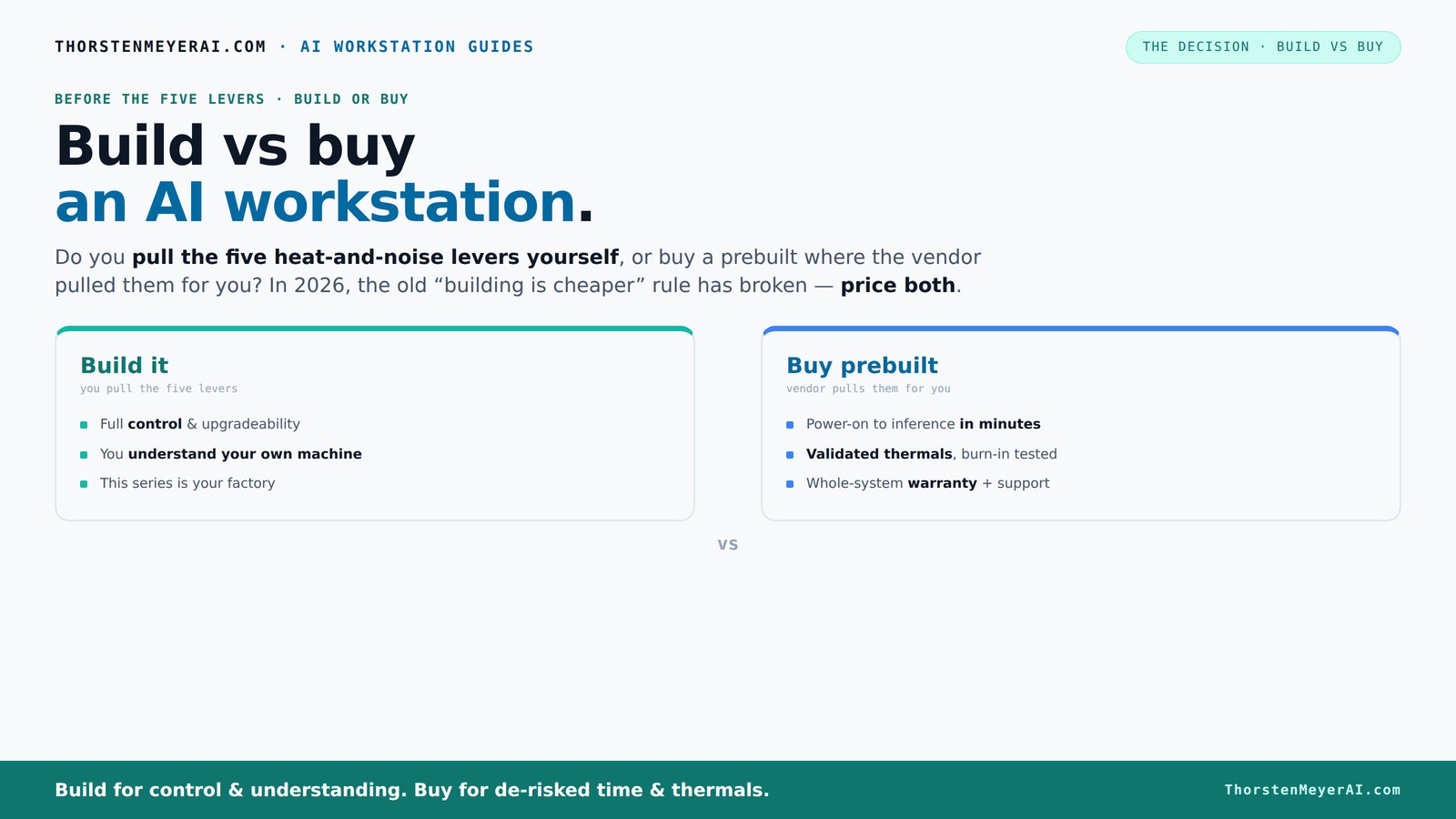
Build vs buy
an AI workstation.
The real question behind this whole series: do you pull the five heat-and-noise levers yourself, or buy a prebuilt where the vendor pulled them for you? And in 2026, the old “building is cheaper” rule has broken. Match your situation in Part 3.
Key Takeaways
- Market shortages in 2026 make prebuilt AI workstations often as affordable or cheaper than DIY builds, especially for high-end configs.
- Prebuilt systems save time, come with validated thermals, and include support/warranty, reducing risk for production workloads.
- Building your own machine offers maximum control over components and cooling but demands time, expertise, and ongoing tuning.
- The decision now hinges more on workload, support needs, and how much control you want, rather than just cost.
- Always price out both options today—market conditions change fast, and the best choice depends on your specific use case.

Dell ECT1250 Tower Desktop Computer - Intel Core Ultra 5 225 Processor, 16GB DDR5 RAM, 512GB NVMe SSD, Intel UHD Graphics, Wi-Fi 6 & Bluetooth 5.4, Keyboard & Mouse, AI Copilot, Windows 11 Pro
- Processor: Intel Core Ultra 5-225 10-Core
- Memory: 16GB DDR5 RAM
- Storage: 512GB NVMe SSD
As an affiliate, we earn on qualifying purchases.
As an affiliate, we earn on qualifying purchases.
Why 2026 Changes the Cost Game: Building Isn’t Always Cheaper
The old rule was simple: build your own for less. That’s no longer true. Market shortages and bulk buying have driven up component prices, making DIY builds more expensive than ever.
For example, a high-end GPU like the RTX 4090 used to cost around $1,200 in 2024, but now it’s often above $1,400 due to demand and supply chain issues. Meanwhile, prebuilt systems from vendors like Lambda or BIZON can include these GPUs at a similar or even lower price, thanks to buying power.
This shift means your choice isn’t just about parts — it’s about total cost, including shipping, assembly, and support. Running the numbers today often favors prebuilt options, especially for complex multi-GPU setups.
Beyond raw costs, this market shift impacts your strategic decision. If you’re a hobbyist or researcher, the increased expense might push you toward prebuilt options to avoid the time-consuming process of sourcing and troubleshooting parts. Conversely, if you value customization and learning, the higher costs might be acceptable for the control it provides, but it’s crucial to weigh the time investment against potential savings.
The Five Levers of a High-Power AI Workstation — Who Pulls Them?
Imagine a furnace: your AI workstation. Keeping it cool and quiet requires five key levers: undervolting the GPU, matching the cooling system, optimizing airflow, tuning fans, and strategic placement.
If you buy prebuilt, the vendor pulls these levers—testing, tuning, validating thermal performance, and often including water-cooling for quieter operation. You pay for that peace of mind, which translates into reduced risk of overheating, throttling, or hardware failure during critical workloads. This validation process is essential because thermal issues can significantly degrade performance or shorten component lifespan, especially in high-load AI tasks.
Build it yourself? You become the thermal engineer. You choose each component—quiet GPU, custom cooler, case with good airflow—and tune everything. While this offers maximum control, it also involves tradeoffs: extensive time investment, potential trial-and-error, and the risk of thermal inefficiency if not properly managed. The implications are clear: the more control you want, the more you need to understand thermal dynamics and invest in proper testing. Skipping this can lead to overheating, noise issues, or reduced component longevity, which might negate any cost savings or customization benefits.
Prebuilt AI Workstations: Why They Might Save You Time and Hassle
Prebuilt systems are designed for immediate deployment. They arrive with the OS, drivers, and AI software stacks pre-installed—ready to run inference or training in minutes. For busy professionals, that’s a huge advantage because it minimizes downtime and accelerates project timelines. This ready-to-go setup reduces the risk of configuration errors that can be costly in AI workflows, where every minute counts.
Plus, they come with validation tests—24 to 48 hours of burn-in—ensuring the system won’t throttle under load. This process detects potential thermal or power issues before the system reaches your hands, providing peace of mind and stability during intensive tasks. Support and warranty are baked in—if something goes wrong, you call one number, and it gets fixed. This reduces the need for in-depth troubleshooting skills, which can be a significant barrier for teams lacking dedicated hardware experts. Learn more about building vs buying in the context of AI workstations.
Take Lambda’s systems, which are engineered for multi-GPU setups with robust cooling and power delivery. They are optimized for stability and reliability, especially under continuous high loads typical of AI training. For organizations or individuals who prioritize uptime and predictable performance, these prebuilt solutions often outweigh the benefits of DIY customization, especially when time and support are critical factors.
Building Your Own AI Workstation: When It’s Still Worth It
If you’re someone who enjoys the process or needs a custom setup, building your own can still make sense. You get complete control over every component, from the quiet GPU to the cooling system, which allows you to tailor the system precisely to your workload and environment. This control can lead to better thermal performance, quieter operation, and the ability to upgrade specific parts over time.
It’s ideal if you want specific hardware, like ECC RAM for error correction—crucial for research or mission-critical applications—or a custom water-cooling loop for ultra-quiet operation, which can significantly reduce noise levels during intensive workloads. Plus, it can be cheaper if you’re willing to put the time into sourcing parts, tuning, and troubleshooting, especially if you already have some technical experience. The tradeoff is that this approach demands patience, technical skill, and ongoing maintenance, but it offers the highest level of customization and learning potential.
For example, a hobbyist who loves tuning their system might spend a weekend assembling a machine with a high-quality quiet cooler, undervolted GPU, and optimized airflow—plus learn a ton along the way. If you’re interested in the process, check out this guide on building your own AI workstation. This process not only results in a tailored machine but also deepens your understanding of hardware and thermal dynamics, which can be invaluable for future upgrades or troubleshooting.
Frequently Asked Questions
Is it cheaper to build or buy a prebuilt AI workstation?
It used to be that building was always cheaper, but in 2026, market shortages and bulk buying have often made prebuilt systems equally or more affordable. Always compare prices for your specific configuration today to be sure.
Which option is better for training large models versus inference?
For large training jobs, support, thermal validation, and stability matter most—so prebuilt systems from vendors like Lambda are often better. For inference or hobbyist projects, building your own can be more cost-effective and customizable.
How much GPU memory do I need for AI workloads?
It depends on your workload. For training large models, 24-48GB of GPU RAM is typical. For inference, 8-16GB might suffice. Always match your GPU choice to your specific needs—more memory generally equals more flexibility.
Is ECC RAM necessary for AI workstations?
ECC RAM reduces errors in critical calculations, but it’s usually reserved for research, enterprise, or very sensitive tasks. Most hobbyists and small teams get by with standard RAM, but if stability matters, consider ECC.
How do I choose between 1 GPU and multiple GPUs?
If your workload involves training very large models or running multiple inference tasks simultaneously, multiple GPUs make sense. For lighter or infrequent tasks, a single high-end GPU might be enough.
Conclusion
In 2026, the old rule of 'build cheaper, buy faster' no longer always applies. The smarter move depends on your workload, skills, and how quickly you need to deploy.
Whether you choose the thrill of DIY or the peace of a prebuilt, remember: it’s about what works for you now, not what did in the past. Your perfect AI workstation is out there—just make sure it’s the right fit for today’s market chaos.