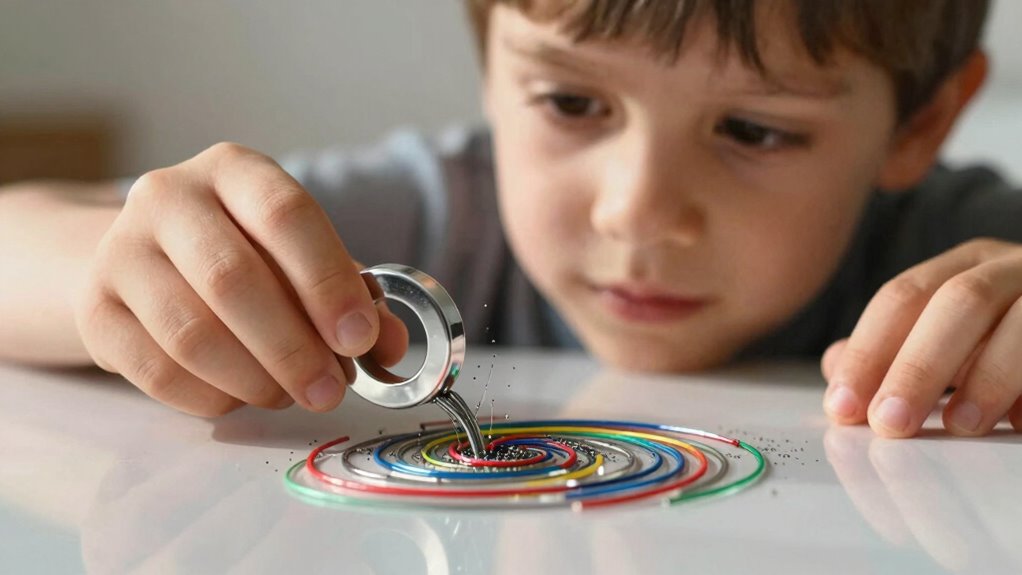

Magnets spark your child’s curiosity by inviting questions about how and why forces work. As they explore magnetic attraction and repulsion, they start thinking critically about the invisible forces around them. Hands-on experiments help turn abstract ideas into tangible discoveries, encouraging them to ask more detailed questions about real-world applications like MRI machines or navigation. If you keep exploring, you’ll see how these moments nurture their love for science and discovery.
Play games included with Prime
Start a Prime free trial and play with Amazon Luna on your devices.
As an affiliate, we earn on qualifying purchases.
Key Takeaways
- Magnets stimulate curiosity about unseen forces, prompting kids to ask how and why they attract or repel objects.
- Hands-on magnet experiments encourage children to explore and question magnetic properties and behaviors.
- Connecting magnetism to real-world applications sparks questions about technology and natural phenomena.
- The wonder of magnetic interactions inspires kids to inquire about related scientific concepts like electricity and fields.
- Engaging with magnets fosters a mindset of inquiry, encouraging kids to develop their own questions and seek answers.

Have you ever noticed how a simple magnet can spark a flood of questions from kids? It’s almost like magic, isn’t it? Kids are naturally curious, and when they see a magnet attracting or repelling metal objects, their minds start racing with questions. This magnetic attraction isn’t just about pulling paper clips or fridge magnets; it’s a gateway to understanding fundamental science concepts. When you show children how magnets stick to the fridge, they begin to wonder why that happens and how. This curiosity opens the door to exploring the idea of magnetic fields and forces, encouraging them to ask more questions about how things work.
Magnets ignite kids’ curiosity, sparking questions about science and how the world around them works.
One way to nurture this curiosity is through polarity experiments. These simple activities help kids visually grasp the concept that magnets have poles—north and south—that either attract or repel each other. As they experiment with different magnets, they quickly learn that opposite poles attract, while like poles push away. This hands-on approach turns abstract ideas into tangible experiences, making the science much more engaging. Kids start to ask why certain objects are attracted or repelled, sparking their interest in the invisible forces at play. They may even wonder if other objects or materials have similar properties, which leads to deeper exploration and critical thinking. Conducting these polarity experiments not only helps children understand magnetism but also encourages them to formulate hypotheses and test their ideas, nurturing their problem-solving skills. Additionally, understanding magnetic fields is closely related to biodiversity and technology, showing how science concepts connect to real-world applications. Recognizing that magnetic principles are used in marine navigation can further inspire their curiosity about how science influences our environment and technology. Exploring the magnetic field itself, which extends invisibly around the magnet, can deepen their understanding of how forces operate at a distance. A further connection can be made to electromagnetism, which explains how magnetic fields and electric currents are interconnected.
As they experiment, children often start asking questions that go beyond magnetism itself. They wonder about the real-world applications, like how compasses work or how magnetic fields are used in technology. Their questions might include: “Can magnets make electricity?” or “How do MRI machines use magnets?” These inquiries show that their natural curiosity extends beyond what they see and touch, prompting you to introduce more complex scientific ideas in a way that’s accessible. When you answer these questions, you’re guiding their learning process and helping them develop critical thinking skills. You’re also reinforcing the idea that science is about discovery—that asking questions and testing ideas is how we learn more about the world.
Magnets, with their magnetic attraction and polarity, serve as powerful tools to spark children’s curiosity. They turn everyday objects into science experiments and open up a world of questions that lead to deeper understanding. The more you encourage their questions and explorations, the more their natural inquisitiveness grows. This isn’t just about learning about magnets; it’s about cultivating a mindset that values curiosity, experimentation, and discovery. So next time you see a kid fascinated by a magnet, remember that you’re witnessing the start of their scientific journey—one question at a time.
kids magnetic science experiment kit
As an affiliate, we earn on qualifying purchases.
As an affiliate, we earn on qualifying purchases.
Frequently Asked Questions
How Do Magnets Work at a Molecular Level?
Magnets work at a molecular level through magnetic domains—groups of atoms with aligned electron spins. When these domains align in the same direction, they create a magnetic field. Electron spins are tiny magnetic moments that contribute to this alignment. In a magnet, many domains line up, producing a magnetic force. When you bring two magnets close, their fields interact, causing attraction or repulsion based on the alignment of their electron spins and domains.
Can Magnets Affect Electronic Devices Nearby?
Magnets can affect electronic devices nearby, especially if they’re strong. About 70% of electronic malfunctions are due to magnetic interference. You might notice magnetic shielding inside devices, designed to protect circuits from magnetic fields, or magnet corrosion, which can weaken magnets over time. Keep your devices away from powerful magnets to prevent disruptions, and remember that weaker magnets generally won’t cause issues with electronics.
Are There Different Types of Magnets?
Yes, there are different types of magnets, mainly based on their shapes and magnetic poles. You’ll find bar magnets, horseshoe magnets, and disk magnets, each with unique shapes that serve different purposes. All magnets have two magnetic poles, North and South, which attract or repel other magnets. Understanding these differences helps you explore how magnets work and how their shapes and poles influence their magnetic forces.
How Strong Can Magnets Get Naturally?
Magnets can be insanely strong, almost like a force of nature itself! Naturally, Earth’s magnetic field is the strongest example, reaching about 25 to 65 microteslas at the surface. While natural magnetic fields are powerful on a planetary scale, individual magnets’ strength varies widely. Some rare minerals, like lodestone, have natural magnetic properties, but their strength isn’t nearly as intense as man-made magnets.
What Are Some Common Everyday Uses of Magnets?
You use magnets every day in many ways. For instance, they hold notes on your fridge with magnetic strips or magnets, and magnetic toys help kids develop fine motor skills while having fun. Magnet art allows you to create colorful displays on metal surfaces. You also find magnets in your headphones, computer components, and even in some door catches. These common uses show how magnets make daily life more convenient and engaging.
Conclusion
So, next time your child is curious about magnets, remember that curiosity is the spark that lights the fire of learning. By encouraging their questions and exploring together, you’re helping them develop critical thinking and a love for discovery. As the old adage goes, “You can’t teach an old dog new tricks,” but kids are always enthusiastic to learn new ones. Embrace their wonder — it’s the first step toward a lifetime of curiosity.
NFL season / tailgating Picks
team gear
As an affiliate, we earn on qualifying purchases.