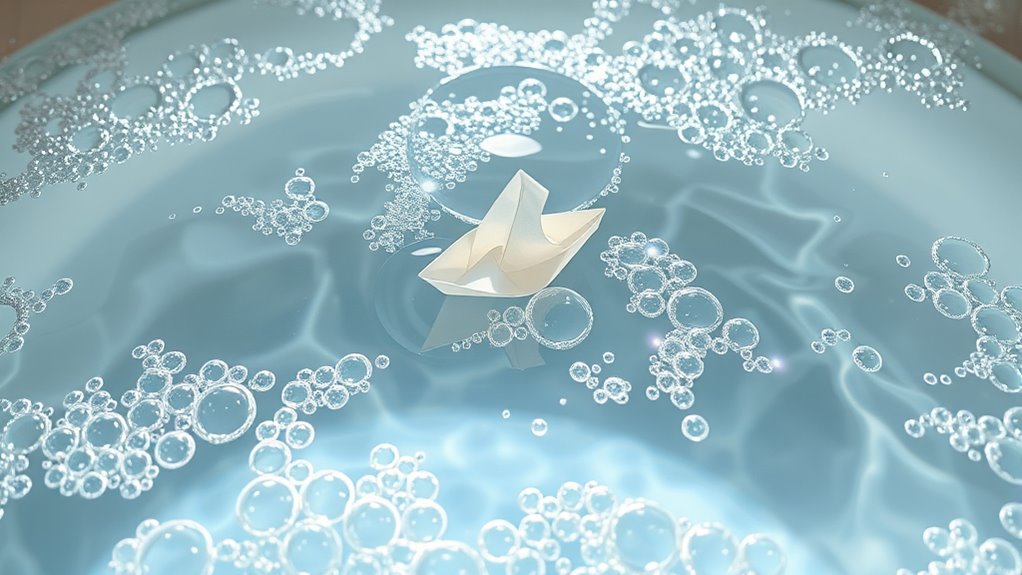

Soap-powered boats work by creating surface tension differences on water. When soap is added, it disrupts hydrogen bonds, lowering surface tension and causing uneven tension areas. These gradients generate tiny forces that propel the boat forward, making it glide smoothly. This phenomenon highlights how molecular interactions influence motion on a visible scale. If you want to discover how adjusting soap concentration can optimize boat speed, keep exploring this fascinating surface tension science.
Key Takeaways
- Soap-powered boats demonstrate how surface tension gradients create propulsion on water surfaces.
- Adding soap reduces surface tension, allowing small objects to float and move more freely.
- Variations in soap concentration generate surface tension differences that push boats forward.
- The setup illustrates the link between molecular interactions and macroscopic motion.
- Understanding surface tension effects aids in designing small-scale watercraft and surface chemistry applications.

Imagine propelling a boat across the water using nothing but soap. It might sound like a trick, but it’s rooted in the fascinating science of molecular interactions and surface tension effects. When you add a small amount of soap to water, you’re changing how the water molecules interact at the surface. Normally, water molecules cling tightly to each other because of hydrogen bonds, creating a strong surface tension that acts like a stretched elastic sheet. This surface tension allows small objects, like a boat made from lightweight materials, to stay afloat even if they’re denser than water.
Adding soap to water reduces surface tension, allowing small objects like boats to stay afloat and move more easily.
But when soap enters the picture, it disrupts these molecular interactions. Soap molecules are amphiphilic—they have a hydrophilic (water-loving) head and a hydrophobic (water-hating) tail. When soap mixes into water, these molecules embed themselves at the surface, breaking the hydrogen bonds between water molecules. This reduces the surface tension, making the water’s surface less “elastic” and more prone to movement. As a result, the water’s ability to support small objects diminishes, and the boat’s motion is affected.
Now, here’s where the propulsion comes in. If you place a tiny soap boat—a small, lightweight craft—on the water’s surface, adding a bit of soap can create surface tension gradients. When soap molecules spread unevenly or are concentrated in certain areas, they cause local variations in surface tension. These differences generate tiny forces that push the boat forward. Think of it like a miniature tug-of-war at the water’s surface, where the soap’s molecular interactions and surface tension effects work together to produce movement. As soap molecules continue to spread, they alter the surface tension dynamically, creating a kind of “push” that propels your soap boat across the water.
This phenomenon isn’t just a cool trick; it’s a demonstration of how molecular interactions influence macroscopic behavior. The delicate balance of surface tension effects determines whether your boat glides smoothly or stalls. By understanding how soap affects these surface tension effects, you can experiment with different soap types or concentrations to optimize the boat’s speed. It’s a simple yet powerful way to visualize complex scientific concepts right in your bathtub. So, next time you watch a soap-powered boat race across the water, remember, it’s all about those tiny molecules, their interactions, and how they manipulate surface tension to make your miniature vessel move.
Frequently Asked Questions
How Does Surface Tension Differ From Other Forces in Water?
Surface tension differs from other water forces because it results from molecular cohesion, where water molecules stick together at the surface. Unlike gravity or pressure, surface tension creates a thin, elastic film that resists external forces. This force differentiation makes water behave uniquely at its surface, allowing small objects to stay afloat and insects to walk on water, even though gravity pulls downward on the entire body of water.
Can Soap-Powered Boats Be Used for Scientific Experiments?
You can definitely use soap-powered boats for scientific experiments. They’re great for exploring experimental designs, especially when studying surface tension and fluid dynamics. Historically, such boats have been used in classrooms to demonstrate principles of physics and chemistry, making concepts more tangible. By tweaking variables like soap type or boat shape, you can observe different effects, helping you understand the science behind surface tension in a fun, hands-on way.
What Materials Are Best for Building Soap-Powered Boats?
When building soap-powered boats, you should focus on materials that work well with manufacturing techniques like cutting, gluing, and shaping. Lightweight materials such as foam, plastic, or balsa wood are ideal because they float easily. Also, consider the soap formulation; a simple dish soap with good surface tension helps propel your boat. These choices guarantee your boat moves smoothly and efficiently across the water.
How Does Soap Concentration Affect Boat Movement?
You’ll notice that as soap concentration increases, boat speed initially improves because the soap reduces surface tension more effectively, creating a stronger propulsive force. However, if the soap concentration gets too high, it can weaken the surface tension too much, slowing the boat down or causing it to stop. So, balancing soap concentration is key to maximizing boat speed and maintaining smooth movement across the water.
Are There Safety Concerns When Handling Soap and Water?
Think of handling soap and water like walking a tightrope—you need balance for safety. When you mix soap, you should consider chemical safety because some ingredients can be irritating or harmful. Also, be mindful of environmental impact, especially if soap enters waterways. Always follow label instructions, wear gloves if needed, and store soap properly. Staying cautious guarantees you avoid accidents and protect the environment while enjoying your soap-powered boat experiments.
Conclusion
As you gently set your soap-powered boat afloat, you realize that beneath its simple surface lies a delicate dance of forces, whispering secrets about nature’s quiet elegance. Though it may seem just a playful experiment, it hints at the intricate balance that sustains countless unseen wonders around you. Sometimes, it’s in these small, gentle moments that you find a subtle reminder: even the simplest things carry a touch of profound mystery, waiting to be explored.