
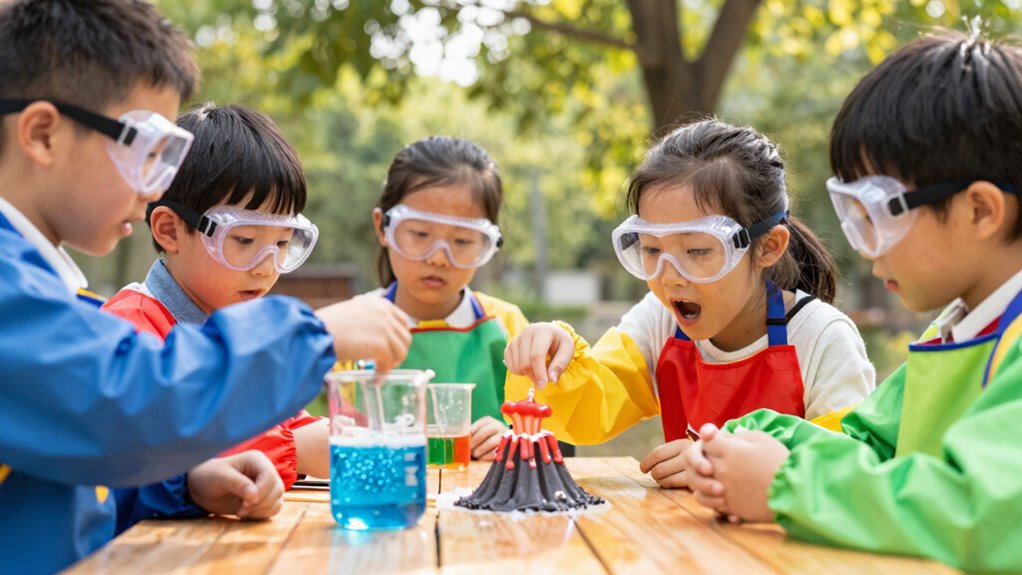

You can add more science talk to everyday play by turning simple activities into learning moments. Encourage curiosity by asking questions about plants, weather, and natural changes as children explore outdoors or during routine tasks. Describe what’s happening in natural terms, like sunlight helping plants grow or wind moving clouds. Use everyday moments to explain scientific ideas in a friendly way. Keep conversations engaging and fun—if you keep exploring, you’ll discover even more ways to make science a natural part of play.

Turn the school run and nap time into listening time
- Thousands of audiobooks, podcasts and originals
- Listen on your phone, tablet or Echo — also offline
- Cancel anytime
Key Takeaways
- Incorporate questions about nature, weather, and plants during outdoor activities to spark curiosity and discussion.
- Use everyday routines, like watering plants or observing the sky, to explain scientific concepts naturally.
- Encourage children to make predictions and observe changes in weather or plant growth over time.
- Relate daily experiences to basic science ideas, such as photosynthesis or the water cycle.
- Make learning fun by exploring science topics during walks, gardening, or rainy day play.
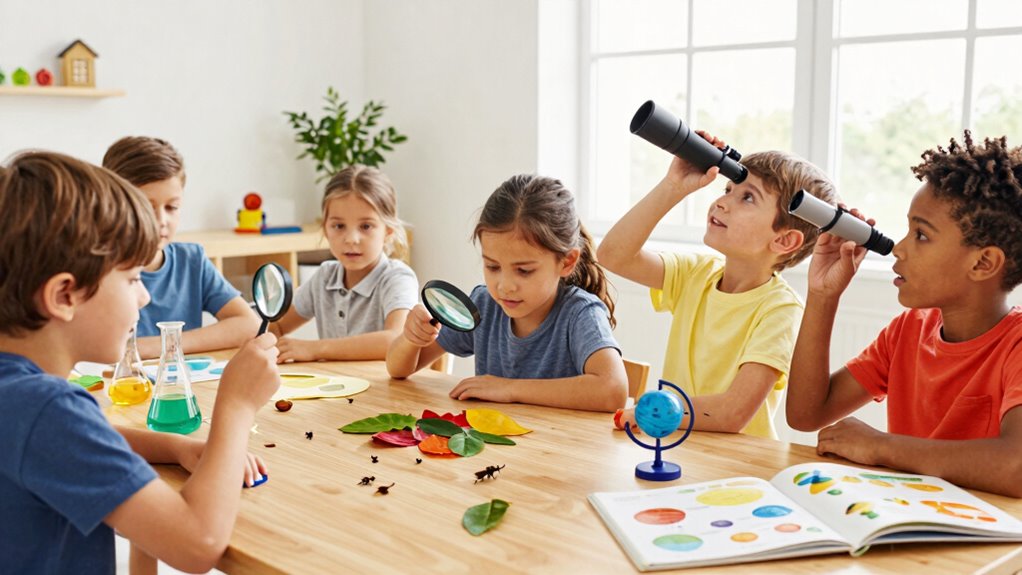
Incorporating science talk into everyday play can make learning both fun and natural for your child. When you’re outside, take a moment to observe the world around you and encourage your child to do the same. Talk about how plants grow by sunlight, water, and soil. You might say, “Look at that tiny seed we planted last week. Do you see how it’s starting to sprout? That’s because it’s getting enough sunlight and water.” This simple observation introduces your child to the basic concepts of plant growth and shows how nature works in real life. As you tend to your garden or even a few potted plants, ask questions like, “What do you think plants need to grow?” or “Why do you think some plants grow faster than others?” These questions stimulate curiosity and reinforce understanding.
While exploring outdoors, you can also introduce weather patterns. On a breezy day, talk about how the wind moves clouds and carries weather from one place to another. Explain, “The wind is a weather pattern that helps move air around. When the wind blows strongly, it can bring a cold front or a warm front. Do you feel the wind right now? What do you think it’s telling us about the weather today?” If it’s raining, use the opportunity to discuss how rain forms and why it’s essential for plants and animals. You could say, “Rain is part of the water cycle. It helps keep the earth moist so plants can grow and fills up streams and rivers.” Recognizing the water cycle can help your child grasp how weather and climate are interconnected. Understanding weather patterns in daily life can also help your child develop an awareness of how climate influences our environment.
During walks or outdoor play, encourage your child to notice changes in weather or plant life. Ask questions like, “Why do you think the leaves change color in the fall?” or “What happens to the snow when it melts?” These conversations help your child connect everyday observations to larger scientific concepts. When you add simple explanations or predictions, you’re nurturing their ability to think critically about how the world works. Incorporating scientific concepts into routine activities creates opportunities for natural learning and curiosity. For example, pointing out how photosynthesis helps plants produce oxygen can deepen their understanding of plant biology. Recognizing how plants absorb sunlight is another key idea that can be explained simply during outdoor activities. The key is to keep the conversation light, engaging, and rooted in their natural curiosity. By weaving science talk into routine activities, you’re not only making learning interesting but also helping your child develop a lifelong love of discovery. Every walk, garden session, or rainy day becomes a chance to explore science in a way that feels effortless and enjoyable for both of you.
children's outdoor science experiment kit
As an affiliate, we earn on qualifying purchases.
As an affiliate, we earn on qualifying purchases.
Frequently Asked Questions
How Can I Introduce Science Concepts to Very Young Children During Play?
You can introduce science concepts during play by using simple science vocabulary like “mix,” “observe,” or “float” to explain what’s happening. Ask open-ended questions to nurture curiosity, such as “What do you think will happen if we add more water?” and encourage them to explore and experiment. This approach makes science fun and accessible, helping young children develop a love for discovery and understanding the world around them.
What Are Simple Science Experiments I Can Do at Home With Kids?
You can try simple science experiments like observing plant growth during nature exploration or recording findings in a science journaling activity. For example, plant sunflower seeds and track their progress, or collect leaves and discuss their shapes and colors. These activities turn play into learning, encouraging curiosity and observation. Plus, journaling helps kids document their discoveries, making science an exciting part of everyday life.
How Do I Encourage Children to Ask Their Own Science Questions?
Curiosity sparks when you ask kids exciting question prompts that turn everyday moments into science adventures. Encourage them to ask their own science questions by celebrating their curiosity with enthusiastic reactions and providing answers that inspire more wonder. Use open-ended prompts like “What do you think will happen if…?” and listen attentively. When children see their questions valued, they’ll eagerly ask more, transforming every playtime into a thrilling scientific exploration.
What Materials Are Best for Science-Related Play Activities?
You should choose versatile materials like magnifying glasses, simple microscopes, and transparent containers for science-related play. Material suggestions include items such as baking soda, vinegar, and food coloring for experiments. Science toy ideas like beginner microscopes or grow-your-own crystal kits also spark curiosity. These materials encourage exploration, observation, and experimentation, making science engaging and accessible for children during everyday activities.
How Can I Make Science Talk Fun and Engaging for Kids?
Imagine igniting a spark that sets their curiosity ablaze—making science talk fun and engaging is just like that. You can do this by using simple science vocabulary in lively conversations, asking playful questions, and encouraging kids to explore their world. Share fascinating facts, act out experiments with excitement, and relate science to everyday life. These strategies turn learning into an adventure, transforming ordinary moments into exciting opportunities for discovery.
Conclusion
By blending playful prompts with probing questions, you’ll foster curiosity and cultivate a love for learning. Don’t shy away from steamy science surprises or silly science stories that spark spontaneous discussions. Keep the conversations lively, lively, and full of wonder, and watch your child’s world grow wider with each discovery. Remember, simple science sessions turn everyday moments into marvelous, memorable milestones. So, seize the science, spark the spirit, and make every playtime a playful foray into the fascinating world of science!
Fall Picks
fall essentials
As an affiliate, we earn on qualifying purchases.