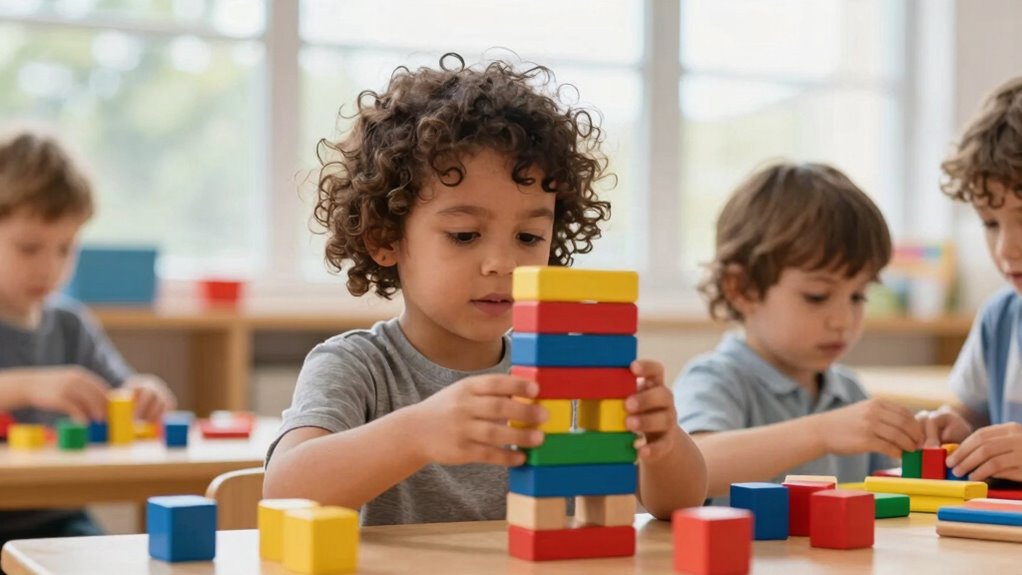

Repetition in preschool toy play helps you support your child’s development by building motor skills, social understanding, and confidence. When they repeatedly manipulate toys, they refine their hand-eye coordination and problem-solving abilities. It also encourages social interactions like sharing and turn-taking, creating a sense of security. As they master familiar activities, they gain motivation to explore new challenges. Keep exploring how this simple process greatly benefits their growth and learning journey.

Turn the school run and nap time into listening time
- Thousands of audiobooks, podcasts and originals
- Listen on your phone, tablet or Echo — also offline
- Cancel anytime
Key Takeaways
- Repetition strengthens fine motor skills and hand-eye coordination through repeated manipulation of toys.
- It enhances social skills like sharing, turn-taking, and understanding social cues during interactive play.
- Repetitive play helps children recognize patterns, develop problem-solving abilities, and grasp new concepts.
- Consistent routines build confidence, reduce anxiety, and foster a sense of mastery and emotional security.
- Caregivers’ encouragement of repetition supports overall cognitive, motor, and social development.
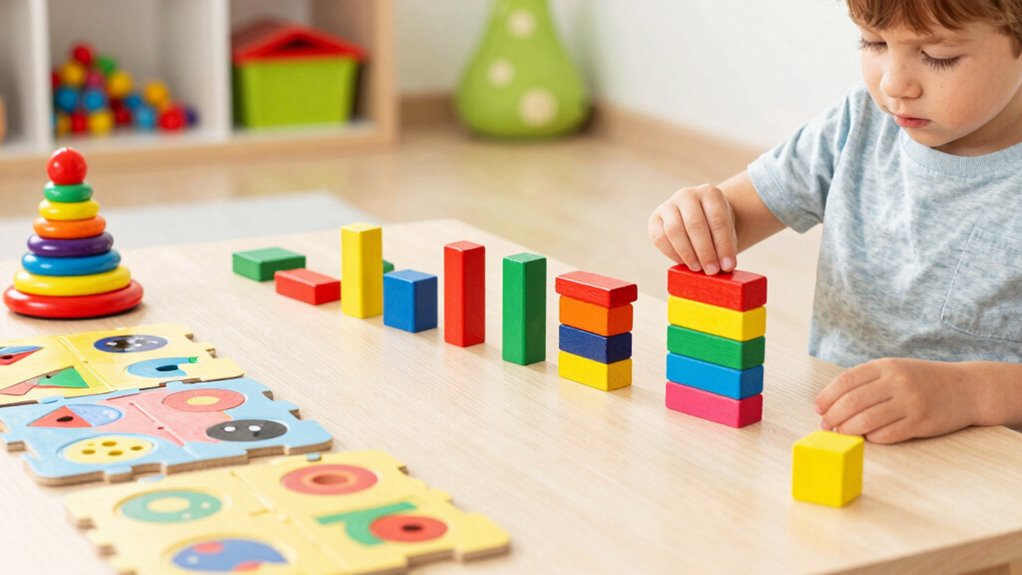
Repetition in preschool toy play is a common and essential part of early childhood development. When you watch a child repeatedly stacking blocks or lining up toy cars, you’re witnessing a critical process that helps build foundational skills. Repetition isn’t just about doing the same thing over and over; it’s a powerful tool that promotes motor skill development. As children grasp, release, and manipulate toys repeatedly, they strengthen their hand-eye coordination and fine motor skills. These repeated actions help refine their ability to control small muscles, which later translates into tasks like writing, drawing, and tying shoelaces. The more they practice, the more confident they become in their physical abilities, setting a strong groundwork for future learning.
Repetition builds motor skills, confidence, and a strong foundation for future learning through playful practice.
Beyond motor skills, repetition also plays an essential role in fostering social interaction. When children engage in play that involves repeating activities, they often do so alongside peers or caregivers, creating opportunities for communication and cooperation. For example, playing a game of pretend store where children take turns “selling” and “buying” items encourages them to share, wait, and respond to each other’s cues. This repetitive nature helps children understand social rules and develop empathy because they learn to anticipate others’ actions and reactions through repeated exchanges. Repetition also enhances a child’s understanding of learning processes, helping them grasp new concepts more effectively through consistent practice. Additionally, repeated play routines can help children develop problem-solving skills as they figure out how to navigate familiar challenges. Repetition in play routines also contributes to developing cognitive skills, as children recognize patterns and anticipate outcomes during familiar activities. As they repeat familiar play routines, they become more comfortable and confident in social settings, which supports their overall social-emotional growth. Incorporating repetitive play into daily routines can also create a sense of security for children, making them more open to exploring new activities.
Repetition also provides children with a sense of mastery and predictability, which is essential for building confidence. When a child repeatedly plays with a particular toy or engages in the same activity, they gain a clearer understanding of what to expect, reducing anxiety and encouraging exploration. This sense of mastery motivates them to try new variations or more complex versions of familiar activities, further expanding their skills. Additionally, when children see their progress through repetition, they develop perseverance and patience, important traits for all areas of learning.
In your role as a caregiver or educator, encouraging repetitive play can be incredibly beneficial. Offer toys that promote active manipulation and social interaction, and give children ample time to explore familiar routines. Recognize that repetition isn’t boredom; it’s a natural pathway for children to develop motor skills, social understanding, and confidence. When children repeat activities, they’re not just playing—they’re laying the groundwork for a lifetime of learning, growth, and connection.
As an affiliate, we earn on qualifying purchases.
Frequently Asked Questions
How Does Repetition Support Language Development in Preschoolers?
Repetition supports language development by reinforcing vocabulary and sentence structures, making language acquisition easier for preschoolers. When you encourage kids to repeat words and phrases, they internalize meaning and gain confidence to use new language skills. This process also promotes cognitive growth, as children connect words with objects and actions. By providing repeated opportunities, you help preschoolers develop strong communication skills essential for social interaction and future learning.
Are There Any Downsides to Excessive Repetition in Play?
Excessive repetition in play can lead to overstimulation concerns, making your preschooler anxious or bored. It may also create habit formation risks, where they become overly fixated on specific toys or activities, limiting exploration. To balance this, introduce variety and new experiences, encouraging your child to develop adaptability and curiosity. Moderating repetition helps guarantee play remains engaging, healthy, and developmentally beneficial without overwhelming or restricting them.
How Can Parents Encourage Healthy Repetition During Play?
You can encourage healthy repetition by setting up play scenarios that foster creative exploration and emotional resilience. Offer your child familiar toys and introduce slight variations to keep their interest alive. Praise their efforts and resilience during play, which boosts confidence. Allow time for repetitive play, as it helps your child master skills and develop emotional resilience. Balance structured play with free exploration to nurture their creativity and emotional growth.
What Types of Toys Promote Beneficial Repetitive Play?
You should choose toys that promote beneficial repetitive play, like building blocks, puzzles, and pretend play sets. Toy variety encourages your child to explore different activities, while repetitive routines help develop skills and confidence. These toys allow your child to engage in familiar actions, strengthening their understanding and mastery. By providing a mix of toys that support repetitive routines, you help foster focus, patience, and cognitive growth during playtime.
How Does Repetition Influence Preschoolers’ Problem-Solving Skills?
Think of repetition as planting seeds in a garden; each turn helps your preschooler’s problem-solving skills bloom. Repeating activities strengthen motor skills and encourage cognitive growth, like a loop that refines their understanding. As they revisit the same toy or task, they learn to adapt, strategize, and develop resilience. This ongoing process builds a sturdy foundation for tackling more complex challenges, empowering their confidence and critical thinking.
Conclusion
Repetition in preschool toy play isn’t just about fun; it’s an essential part of learning. By engaging repeatedly with the same toys, you help children develop skills, confidence, and understanding. Isn’t it remarkable how these simple cycles foster growth? Embracing repetition allows your child to master new concepts and find joy in their discoveries. So next time they play the same game, remember—you’re nurturing their development in a powerful, lasting way.
Halloween Picks
halloween
As an affiliate, we earn on qualifying purchases.