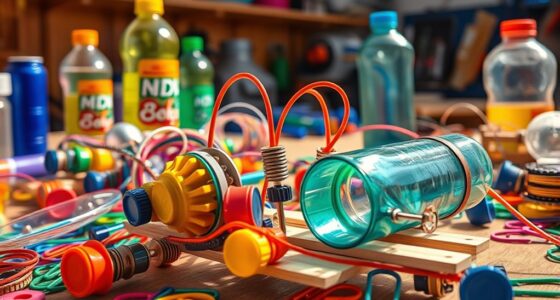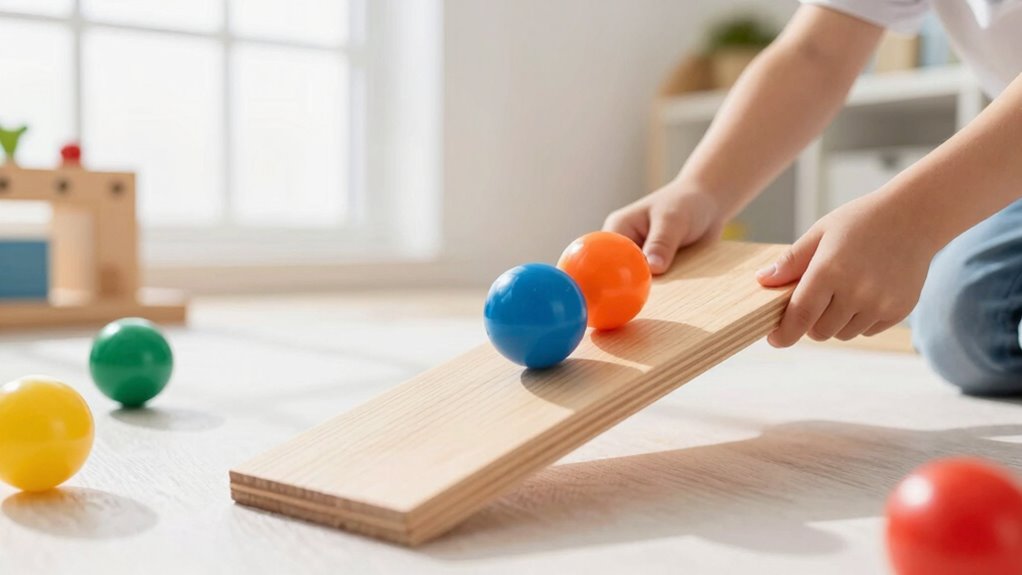

To use ramps and balls for easy science play, set up stable, adjustable ramps using common materials like cardboard or wood. Experiment by changing the ramp angle and observing how it affects the ball’s speed and motion. Add obstacles or rough patches to explore friction. Roll different balls to see how mass and surface impact movement. Modify your setup to see new effects—and if you keep experimenting, you’ll discover even more about how forces and motion work.

Get baby and family essentials delivered free — and shop member deals
- Fast, free delivery on millions of items
- Access to Prime Big Deal Days deals on October 6–7
- Prime Video, Amazon Music and more included
Key Takeaways
- Use everyday materials like cardboard or plastic to build stable, adjustable ramps for safe play.
- Experiment with different ramp angles and obstacles to observe effects on ball speed and motion.
- Test various balls of different sizes and weights to understand how mass influences movement.
- Record and compare results to learn about energy, friction, and acceleration principles.
- Incorporate creative features like loops or bumps to make experiments engaging and deepen understanding.
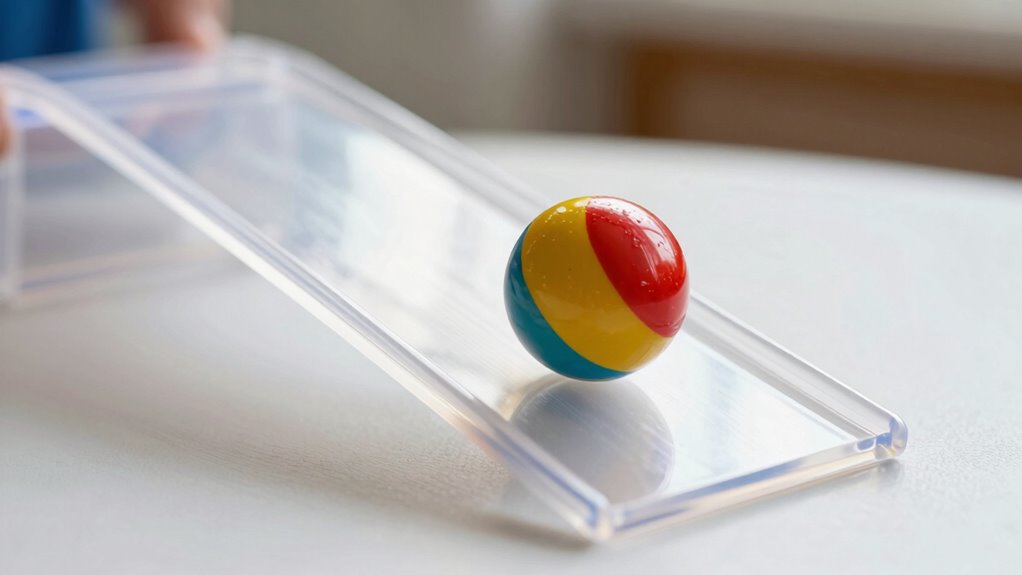
If you’re looking for a fun and simple way to explore science concepts, using ramps and balls is a great choice. This hands-on approach lets you dive into physics principles in an engaging way. By setting up different ramps and rolling balls of various sizes and weights, you can create creative experiments that reveal how objects move and interact. It’s a perfect method to demonstrate concepts like gravity, acceleration, friction, and energy transfer in a tangible, visual manner.
Start by constructing ramps from everyday materials like cardboard, wood, or even plastic sheets. Make sure they are stable and can be adjusted to different angles. As you roll balls down these ramps, observe how the steepness affects the speed of the balls. The physics principles at play, such as potential energy converting into kinetic energy, become clear as you watch faster speeds on steeper inclines. You can also experiment with different types of balls—rubber, plastic, metal—to see how mass and material influence motion. These creative experiments allow you to compare how different variables affect the outcome.
Build stable, adjustable ramps from everyday materials to explore how incline affects speed and motion.
You can also introduce obstacles or rough patches on the ramp to explore friction’s role in slowing down or diverting the balls. This adds complexity and helps you better understand how surfaces impact motion. For example, a rougher surface increases friction, reducing the ball’s speed, while a smoother surface allows for a more effortless glide. Adjusting the angle of the ramp and noting the changes in speed or distance traveled can help you grasp the relationship between force, mass, and acceleration, providing a practical application of Newton’s laws. Additionally, understanding physics principles can enhance your ability to predict and control motion in various real-world situations. Incorporating scientific methods such as systematic testing and observation can further deepen your understanding and improve your experimental results. Engaging in these experiments can also boost your skills in problem-solving and critical thinking, which are valuable in many areas of science and everyday life.
Encourage experimentation by changing one variable at a time—like ramp angle or ball type—and recording your results. This systematic approach fosters a deeper understanding of physics principles and encourages creative thinking. As you explore, you might try building longer or more intricate ramps, adding loops or bumps, to see how the balls respond. Exploring experimental design can help you optimize your experiments and uncover new insights. These creative experiments not only make learning fun but also reinforce fundamental scientific concepts through observation and deduction.
As an affiliate, we earn on qualifying purchases.
Frequently Asked Questions
Can Ramps and Balls Be Used for Indoor Science Experiments?
Yes, you can definitely use ramps and balls for indoor science experiments. They’re perfect for gravity experiments, showing how objects accelerate downhill, and friction analysis, helping you see how different surfaces affect motion. Set up ramps indoors, change angles or materials, and observe how the balls roll differently. These hands-on tools make learning physics fun and tangible, giving you clear insights into fundamental science concepts right at home.
What Materials Are Safest for Making Ramps at Home?
Imagine a smooth, sturdy surface guiding your ball effortlessly down. For safe, durable ramps at home, use materials like thick cardboard, plywood, or plastic. These options are non-toxic and withstand repeated use, ensuring safety considerations are met. Avoid sharp edges and fragile materials that can splinter or break easily. Prioritize stability and smoothness to keep your science play safe, fun, and engaging for everyone involved.
How Do Different Ball Sizes Affect Speed and Motion?
Different ball sizes affect speed and motion because gravity effects each ball differently; larger balls often roll faster due to increased mass, but smaller balls can accelerate more quickly on ramps. Friction influence also varies, with smaller balls experiencing more friction relative to their size, slowing them down. You’ll notice that bigger balls tend to maintain momentum longer, while smaller ones respond more to surface textures, impacting how they move on the ramp.
Are There Age-Appropriate Ramps for Young Children?
Yes, there are age-appropriate ramps designed specifically for young children. When choosing one, look for toddler safety features like smooth edges, non-slip surfaces, and sturdy construction. Opt for colorful designs that capture your child’s attention and encourage exploration. These ramps help develop motor skills and understanding of cause-and-effect in a safe, engaging way, making science play both fun and educational for your little one.
How Can I Measure Energy Transfer With Ramps and Balls?
Think of your experiment as a story of energy transfer. To measure it, observe how potential energy at the top of the ramp transforms into kinetic energy as the ball rolls down. Use a stopwatch to time the ball’s speed and a ruler to measure distance. By comparing the ball’s height and speed, you can calculate energy transfer, seeing how potential energy converts into kinetic energy along the way.
Conclusion
Now that you know how to set up ramps and balls for science play, you’re all set to jump into fun experiments. Remember, the key is to keep it simple and let curiosity lead the way. Don’t be afraid to try different angles or materials—sometimes, the simplest ideas create the biggest surprises. With a little creativity, you’ll find that learning becomes a walk in the park. So go ahead, make science fun and watch the magic happen!
Fall Picks
fall essentials
As an affiliate, we earn on qualifying purchases.