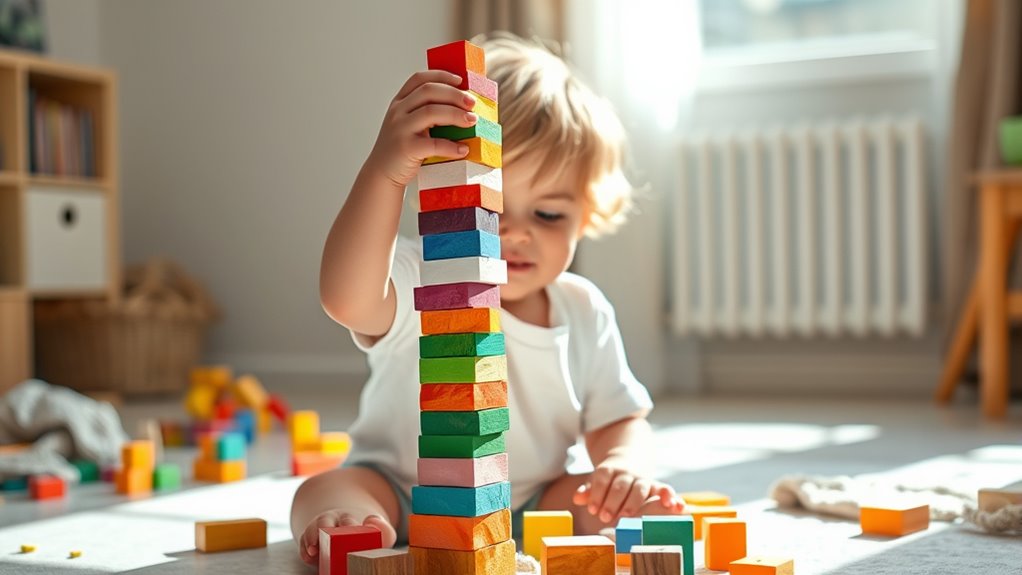
You might notice your child repeating actions during play because it helps them understand their world and develop essential skills. Repetition allows kids to practice social roles, build confidence, and explore different perspectives safely. These behaviors reinforce learning, enhance their emotional understanding, and improve social interactions. Repeating actions is a natural part of mastering new concepts and skills. If you keep observing, you’ll discover even more about how play supports their growth and development.
Key Takeaways
- Kids repeat actions in play schemas to explore roles, understand social norms, and gain mastery over social interactions.
- Repetition helps children process emotions, practice scenarios, and develop empathy through imaginative role-playing.
- Engaging repeatedly in schemas reinforces learning, builds confidence, and enhances problem-solving skills.
- Play schemas serve as patterns for children to make sense of their environment and experiment with different perspectives.
- Organizing play environments encourages repeated behaviors, supporting ongoing social, emotional, and cognitive development.

Have you ever wondered why children are naturally drawn to certain types of play? It’s often because they’re engaging in play schemas—patterns of behavior that help them make sense of their world. One common schema involves imaginative play, where kids create stories, pretend to be different characters, or explore new scenarios. This type of play allows children to experiment with roles and ideas, helping them develop creativity and problem-solving skills. When children act out scenarios, they’re not just having fun; they’re practicing social interaction, learning how to communicate, negotiate, and cooperate with others. You might notice that a child who repeatedly plays “house” or “doctor” is using these schemas to better understand relationships and social cues.
Children use imaginative play to develop social skills, creativity, and understanding of relationships and social cues.
Imaginative play is especially important because it provides a safe space for children to explore different perspectives and emotions. By pretending to be someone else, they process their own feelings and learn empathy. Repeating these actions isn’t just about entertainment; it’s a crucial part of their cognitive and emotional development. When kids revisit certain play patterns, they’re reinforcing their understanding of social roles and expectations, which helps them navigate real-world interactions more effectively. For example, if a child frequently pretends to be a teacher, they’re not only practicing authority and communication but also learning patience and leadership skills.
Social interaction plays a significant role in these schemas because it offers a real-world context for children to practice their social skills. During play, they learn to share, take turns, and resolve conflicts—all essential for healthy relationships. Repeating actions like passing toys, initiating play scenarios, or using specific phrases helps children feel more confident and competent in social situations. They’re fundamentally rehearsing the social scripts that will serve them in everyday life. When children engage in these schemas with peers or adults, they’re also building social bonds and understanding social norms. This repeated behavior isn’t accidental; it’s driven by their desire to master social interaction and to feel a sense of control and competence within their social environment.
Inherently, these repeated actions are a natural part of how children learn and grow. They use imaginative play and social schemas as tools to understand the world and their place in it. Additionally, engaging in interior design elements such as creating organized play areas can support their development by providing accessible spaces for schema exploration. When you observe a child repeatedly engaging in certain play behaviors, remember that they’re not just being playful—they’re actively developing essential skills that will support their social and emotional well-being for years to come.
Frequently Asked Questions
How Do Play Schemas Evolve as Children Grow Older?
As children grow older, their play schemas undergo schema progression, reflecting age-related changes. You’ll notice that repetitive actions become more complex and imaginative, integrating new ideas and skills. Around ages 3 to 5, kids start combining schemas, like pretending to cook while stacking blocks. This evolution supports cognitive development, creativity, and problem-solving, showing how play adapts to their expanding abilities and understanding of the world.
Can Understanding Play Schemas Improve Parenting Strategies?
Yes, understanding play schemas can considerably improve your parenting techniques. By recognizing schemas, you can better interpret your child’s actions and needs, fostering more effective communication. This awareness helps you create activities tailored to their developmental stage, encouraging exploration and learning. When you observe schema patterns, you can support your child’s growth more intentionally, making playtime both fun and educational. Ultimately, schema recognition deepens your connection and promotes positive developmental outcomes.
Are Some Play Schemas More Common Than Others?
Some schemas are indeed more common than others, with certain schemas like pushing, pulling, and transporting frequently seen in children’s play. You’ll notice these patterns often because of schema prevalence, which varies across cultures. Cultural impacts influence which schemas children explore most, shaping their play experiences. Recognizing these common schemas helps you understand your child’s interests and supports their development through targeted play activities.
How Do Cultural Differences Influence Play Schemas?
Cultural differences considerably influence play schemas, shaping how children engage in play. In some cultures, children participate in cultural play activities that emphasize community and tradition, leading to schema variations. You’ll notice that certain schemas, like role-playing or object exploration, may be more prominent based on cultural norms. These variations help children develop social skills and cultural understanding, highlighting how cultural play enriches their overall development and shapes their play behaviors.
What Activities Best Support Development of Specific Schemas?
Imagine combining sensory play with fine motor activities to boost your child’s development. Activities like finger painting, stringing beads, or sand scooping help strengthen fine motor skills while engaging their senses. These hands-on tasks encourage repetition, which reinforces schemas, and make learning fun. By integrating sensory play with fine motor tasks, you support their growth, coordination, and curiosity—key ingredients for healthy, active development.
Conclusion
Understanding play schemas is like unfastening a child’s secret language, revealing why they repeat actions. These patterns aren’t just random; they’re building blocks of learning, helping kids make sense of the world. When you see your child engaged in the same activity, remember they’re crafting their own blueprint, layer by layer. Embrace these moments—they’re like tiny footsteps guiding them on their journey of discovery and growth.