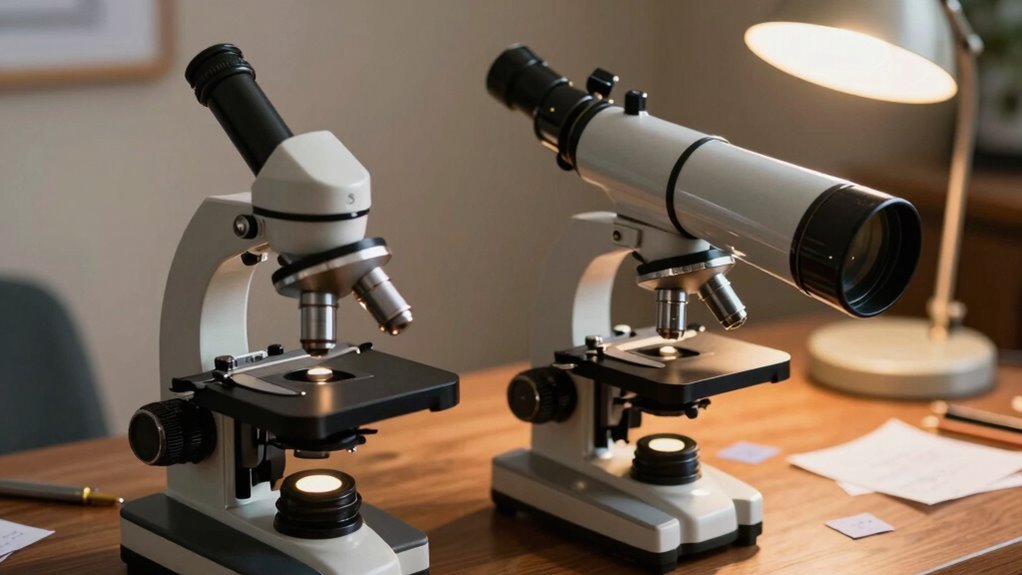

Microscopes and telescopes spark your long-term curiosity by revealing hidden worlds and distant domains you can’t see with the naked eye. They expand your understanding of the universe at every scale, from microscopic structures to far-off celestial objects. As technology advances, you gain new ways to explore and uncover mysteries, fueling your desire to explore further. If you keep exploring, you’ll discover even more about the endless possibilities these tools open.

Turn the school run and nap time into listening time
- Thousands of audiobooks, podcasts and originals
- Listen on your phone, tablet or Echo — also offline
- Cancel anytime
Key Takeaways
- They reveal unseen worlds, fueling curiosity about the microscopic and cosmic realms.
- Technological advancements continually improve observation, inspiring ongoing exploration and discovery.
- They enable detailed analysis, prompting questions about the nature and origin of observed objects.
- Their ability to uncover new phenomena keeps long-term interest and scientific inquiry alive.
- Instruments serve as gateways to exploration, sparking wonder and motivating continuous learning.
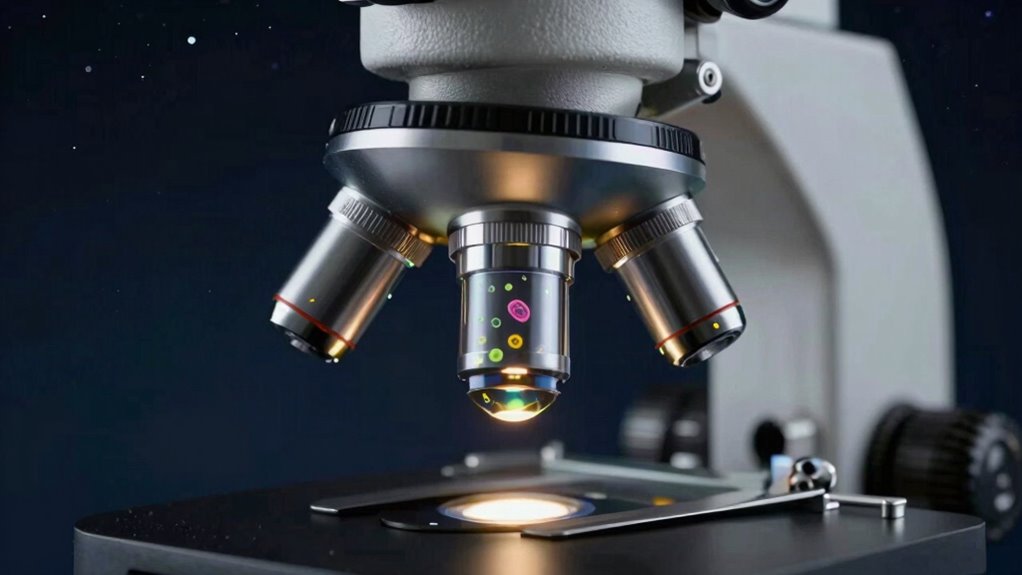
Microscopes and telescopes have fascinated humans for centuries because they open windows to worlds beyond our natural senses. These tools ignite curiosity by revealing hidden dimensions of life and the universe, fueling a desire to understand what lies beyond our immediate perception. As technology progresses, optical advancements have played a vital role in enhancing the capabilities of both microscopes and telescopes. For instance, improvements in lens quality, image resolution, and light sensitivity allow you to observe finer details, whether it’s a distant galaxy or microscopic organisms. These advancements continually push the boundaries of what you can see, encouraging you to explore further. Each new breakthrough in optics invites questions, challenges assumptions, and leads to new discoveries, reinforcing the long-term allure of these instruments. Additionally, the development of sophisticated imaging techniques has expanded our ability to analyze and interpret the intricate details captured through these tools. The exploration techniques employed with microscopes and telescopes are equally intriguing. With telescopes, you learn to navigate celestial objects—stars, planets, nebulae—using methods like long-exposure imaging and computerized tracking. These techniques enable you to capture images of distant worlds and analyze their composition, atmospheres, and movements. Similarly, microscopy introduces you to a domain of cellular structures and microorganisms, often requiring precise sample preparation and staining methods to enhance visibility. Both fields demand a combination of skill and curiosity, pushing you to refine your techniques in order to see more clearly and understand better. As you master these exploration methods, you become more confident in your ability to uncover the unknown, fueling a cycle of continuous learning and discovery. What keeps your curiosity alive is the sense of endless possibilities. Every new observation, whether it’s identifying a new star or a previously unseen microorganism, sparks a sense of wonder. The ongoing evolution of optical technologies ensures that there’s always something new to learn or see. You’re motivated by the prospect of mapping uncharted territories—whether in the vast expanse of space or the microscopic world. These tools serve as gateways to discovery, inspiring generations to ask questions and seek answers. The combination of cutting-edge optical advancements and innovative exploration techniques sustains long-term curiosity because they remind you that the universe, in all its scales, remains full of mysteries waiting to be unraveled. Moreover, ongoing research in optical technology continues to drive innovations that expand our observational capabilities.
high magnification microscope for beginners
As an affiliate, we earn on qualifying purchases.
As an affiliate, we earn on qualifying purchases.
Frequently Asked Questions
How Do Microscopes and Telescopes Differ in Design?
You’ll notice microscopes and telescopes differ mainly in design through their magnification mechanisms and optical configurations. Microscopes use multiple lenses close together to enlarge tiny objects, focusing on high magnification at close range. Telescopes, however, employ large primary lenses or mirrors to capture distant light, offering a wide field of view. Their optical setups are tailored to either very small or very distant objects, shaping how you observe the universe or microorganisms.
What Are the Latest Technological Advancements in These Tools?
A picture is worth a thousand words, and recent advancements prove it. You now benefit from quantum imaging, which allows microscopes and telescopes to see even the tiniest details with incredible precision. AI enhancements further optimize image processing, making discoveries faster and more accurate. These innovations push the boundaries of what you can observe, opening new frontiers in science and exploration by making previously impossible views a reality.
How Do They Influence Scientific Research Today?
You see, microscopes and telescopes profoundly influence scientific research today by enabling discoveries across vast scales. Their historical significance lies in revealing unseen worlds, shaping our understanding of biology and astronomy. Their educational impact is equally essential, inspiring curiosity and teaching critical thinking. By pushing technological boundaries, these tools continue to open new knowledge, fostering long-term scientific progress and fueling future innovations.
Are There Any Health Risks Associated With Their Use?
Sure, gazing into microscopes or telescopes might turn you into a space or germ fanatic, but beware of eye strain and radiation exposure! Spending hours peering through lenses can cause tired eyes, headaches, or even long-term vision issues. And, if you’re using older equipment, you might be exposed to harmful radiation. So, take breaks, use proper eye protection, and don’t forget to keep your curiosity in check with safety!
How Accessible Are These Devices for Amateur Enthusiasts?
You’ll find that microscopes and telescopes are increasingly accessible for amateur enthusiasts, especially with affordable options on the market. Many beginner guides and resources help you learn how to use them effectively, making it easier to start exploring the tiny world or distant stars. Whether you’re on a budget or just starting out, you can enjoy these devices without breaking the bank, fostering your curiosity and discovery.
Conclusion
As you explore microscopes and telescopes, you’ll find they ignite your curiosity and expand your understanding of the universe. Did you know that the Hubble Space Telescope has captured images of over 1.5 million celestial objects? This incredible number shows just how much there is to discover beyond what meets the eye. Keep questioning, keep exploring, and let these tools fuel your long-term desire to learn more about the world and cosmos around you.
Fall Picks
fall essentials
As an affiliate, we earn on qualifying purchases.