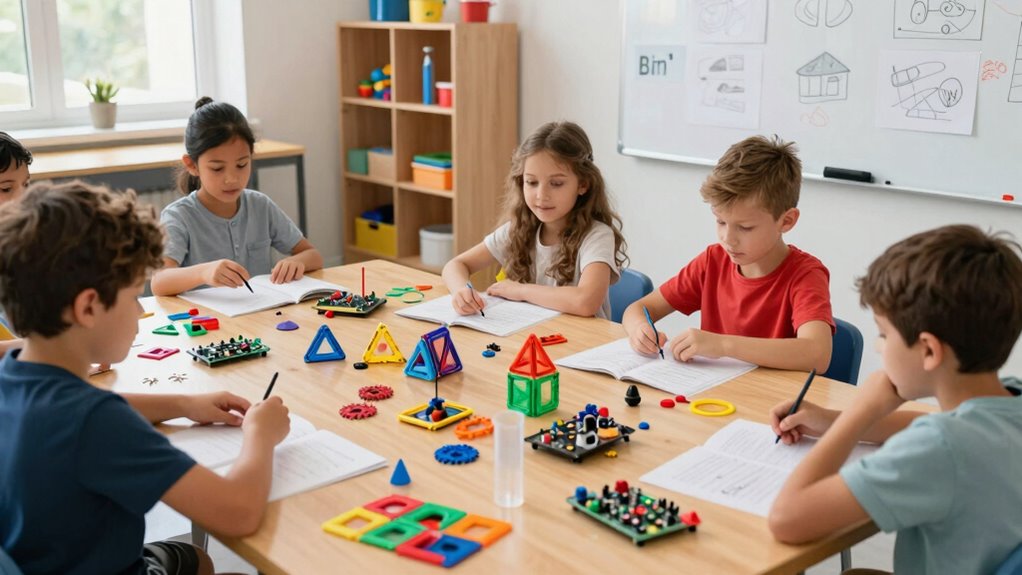

To keep STEM play open-ended, provide a variety of materials like motors, sensors, and craft supplies, and focus on broad goals rather than specific instructions. Ask open-ended questions to encourage exploration, and celebrate different approaches and ideas. Create a safe space where mistakes are part of learning, and support children’s resilience by prompting reflection and problem-solving. If you want to discover more ways to foster curiosity and creativity, keep exploring these strategies.
Key Takeaways
- Provide diverse materials and broad goals to encourage exploration and multiple approaches rather than fixed outcomes.
- Pose open-ended questions that stimulate curiosity and experimentation, avoiding step-by-step instructions.
- Create a safe environment that celebrates effort, resilience, and unique solutions over correctness or perfection.
- Emphasize iterative testing, reflection, and problem-solving as core parts of the learning process.
- Facilitate activities by guiding, not directing, and prompting critical thinking through thoughtful questions.

Keeping STEM play open-ended encourages creativity and critical thinking, but it can be challenging to prevent activities from becoming too structured or outcome-focused. When kids are engaged in robotics challenges, it’s tempting to guide them toward specific solutions or set strict rules, but doing so can limit their opportunity for creative experimentation. To keep play truly open-ended, you need to step back and let curiosity lead the way. Instead of providing detailed instructions, offer basic materials and a broad goal, like building a robot that can navigate a maze or perform a simple task. This way, children are free to explore different approaches, test ideas, and learn from their mistakes.
Encourage open-ended STEM play by providing materials and broad goals, fostering creativity, exploration, and learning from mistakes.
Encouraging creative experimentation is key to maintaining open-ended STEM activities. When kids are allowed to try out their own ideas without the fear of failure, they develop resilience and a genuine interest in problem-solving. You can facilitate this by posing open-ended questions: “How might you improve your robot’s movement?” or “What other ways could this design work?” These prompts invite children to think outside the box and see setbacks as opportunities for innovation. Remember, the focus should be on the process of discovery, not just the end product. Celebrate their efforts and unique solutions, even if they don’t work perfectly the first time.
It’s also important to create a flexible environment where experimentation is safe and supported. Avoid overly prescriptive activities that specify every detail or outcome. Instead, provide a range of materials—such as motors, sensors, cardboard, and craft supplies—and let children decide how to use them. When children have control over their projects, they’re more likely to engage deeply and pursue multiple ideas. You can also introduce mini-challenges that emphasize exploration rather than perfection, like designing a robot that can carry objects or navigate uneven terrain. These challenges should be framed as opportunities to test different strategies, not as tests they must pass. Creating a supportive environment promotes confidence and encourages risk-taking, which are essential for open-ended exploration. Incorporating creative problem-solving techniques can also inspire children to see obstacles as opportunities rather than setbacks. Additionally, providing opportunities for reflection helps children understand their learning process and enhances their ability to adapt and improve. Recognizing the value of iterative testing reinforces the importance of continuous improvement in the learning journey.
Finally, your role is to facilitate rather than direct. Offer guidance when needed, but resist the urge to solve every problem for them. Ask questions that prompt reflection and encourage them to think critically about what works and what doesn’t. By doing so, you foster a mindset of continual learning and creative experimentation. Providing a safe environment for trial and error is essential for fostering innovative thinking and resilience. The goal isn’t to produce a perfect robot but to nurture their curiosity and problem-solving skills. When you maintain this approach, STEM play remains engaging, dynamic, and truly open-ended—just like real-world exploration and innovation.
open-ended STEM activity kits for kids
As an affiliate, we earn on qualifying purchases.
As an affiliate, we earn on qualifying purchases.
Frequently Asked Questions
How Can Parents Encourage Open-Ended STEM Play at Home?
You can encourage open-ended STEM play at home by providing diverse materials and letting your child lead exploration. Ask open-ended questions that promote creative problem solving, like “What happens if you try this?” or “Can you find a different way?” Avoid guiding their every step, and instead, support their curiosity. This approach fosters child-led exploration, allowing them to experiment freely and develop critical thinking skills naturally through play.
What Are Common Challenges in Maintaining Open-Ended STEM Activities?
You might face challenges like lack of teacher training and rigid curriculum development, which can limit open-ended STEM activities. To overcome this, advocate for ongoing teacher training that emphasizes creativity and exploration. Support curriculum development that prioritizes flexibility, allowing kids to experiment freely. By addressing these areas, you help create an environment where open-ended STEM play flourishes, fostering curiosity and problem-solving skills without the constraints of traditional, school-like settings.
How Does Open-Ended STEM Play Support Creativity?
Open-ended STEM play boosts your creativity by encouraging you to explore multiple solutions and think outside the box. It fosters creativity enhancement as you experiment freely, uncovering new ideas and approaches. This type of play also supports innovation development because you’re constantly challenging yourself to develop unique solutions. By engaging in open-ended activities, you cultivate a mindset that values curiosity, adaptability, and inventive problem-solving, all essential for creative growth and innovative thinking.
Are There Age-Appropriate Open-Ended STEM Toys?
You bet there are age-appropriate open-ended STEM toys that hit the mark! Their toy versatility allows kids to explore creatively, while age suitability guarantees safe, engaging fun. These toys grow with your child’s skills, keeping their curiosity alive. Think of them as a jack-of-all-trades—adaptable and perfect for sparking wonder. So, pick toys that challenge and delight, fostering innovation at every stage of development.
How Can Educators Assess Open-Ended STEM Exploration?
You can assess open-ended STEM exploration through observation techniques, noting how children experiment, problem-solve, and collaborate. Use assessment strategies like checklists or learning journals to document their process and growth. Focus on their curiosity, creativity, and perseverance rather than just the final product. Regularly reflecting on these observations helps you understand each child’s developmental progress and supports providing tailored, engaging STEM experiences that foster open-ended exploration.
Conclusion
By nurturing curiosity and resisting the urge to steer every project toward a “correct” answer, you keep STEM play a wild garden of discovery. Imagine it as a bubbling brook, meandering freely, inviting endless exploration. When you let go of rigid expectations, you create a space where imagination blooms like wildflowers, unconfined and vibrant. So, embrace the chaos and watch curiosity blossom into a lifelong love of learning—where the journey, not the destination, truly matters.