You can turn everyday household items into fun math manipulatives to make learning engaging and memorable. Use objects like paper plates, sliced fruits, or buttons to explore fractions, shapes, and spatial concepts. For example, divide a chocolate bar into sections to learn fractions or use shapes to create patterns. Moving and arranging these items helps you understand ideas better and makes math feel less intimidating. Keep exploring to discover more creative ways to teach and learn math skills.

Turn the school run and nap time into listening time
- Thousands of audiobooks, podcasts and originals
- Listen on your phone, tablet or Echo — also offline
- Cancel anytime
Key Takeaways
- Use household items like paper plates or fruits to create fraction models, illustrating parts of a whole visually.
- Incorporate everyday objects such as buttons or lids to explore geometric shapes and their properties.
- Cut shapes from paper or cardboard to demonstrate how fractions combine to form complex figures.
- Arrange common household items to develop spatial reasoning and pattern recognition skills.
- Enhance understanding with visual aids and physical manipulation of familiar items for engaging math activities.
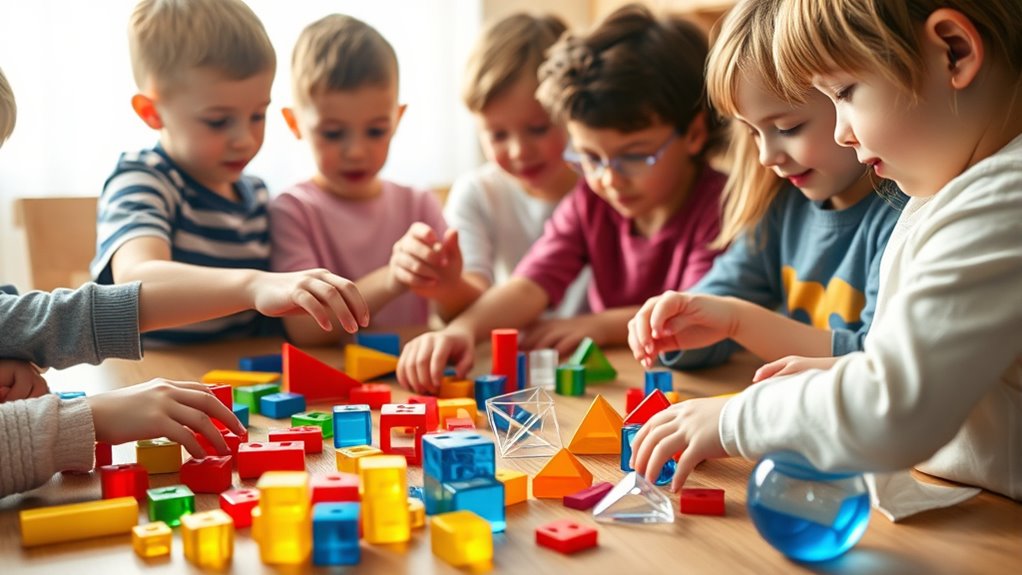
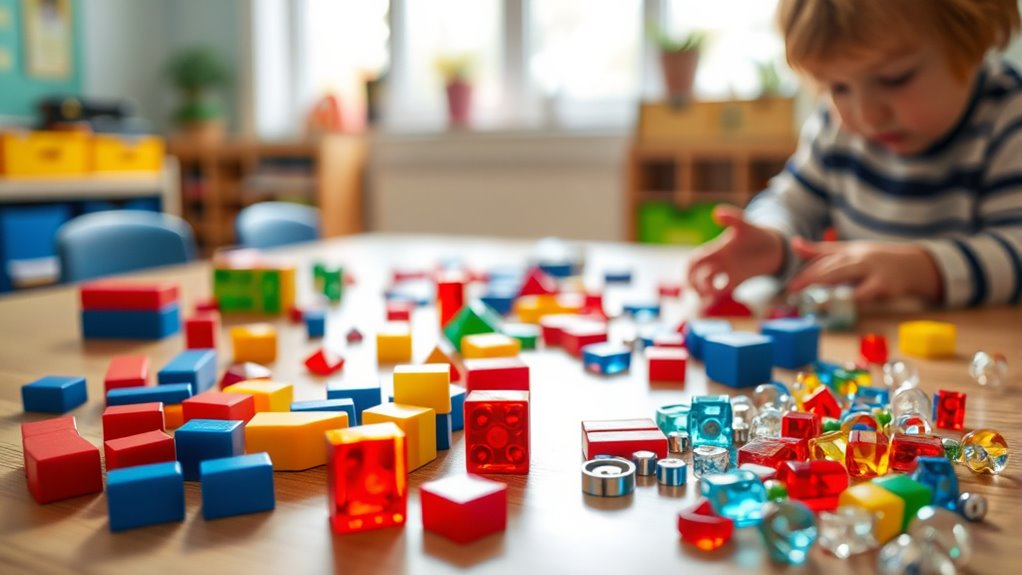
Math play with manipulatives is a hands-on approach that makes learning math concepts engaging and easier to understand. When you use everyday items to teach, you turn abstract ideas into tangible experiences. For example, you can easily create fraction models with household objects like paper circles, chocolate bars, or even sliced fruits. These models help you visualize parts of a whole, making it simpler to grasp fractions’ meaning. By dividing a circle into equal parts and shading some sections, you demonstrate how fractions represent portions of a whole. This visual approach allows you to see the relationship between numerators and denominators clearly, reinforcing your understanding of fractions in a practical way.
In addition to fraction models, geometric shapes are fantastic manipulatives you might already have around the house. Using items like cardboard cutouts, plastic lids, or even shaped pasta, you can explore various geometric shapes such as triangles, squares, rectangles, and circles. Playing with these shapes helps you recognize their properties—such as sides, angles, and symmetry—and understand how they relate to each other. For instance, you can compare the sides of a square and a rectangle or discuss how triangles can be equilateral or right-angled. Creating patterns or tessellations with these shapes not only enhances your understanding of geometry but also encourages creativity and spatial reasoning.
You can also combine geometric shapes and fraction models in your play. For example, cut a paper square into smaller shapes to explore how different fractions make up a whole or assemble various shapes to create complex figures. Manipulating these shapes allows you to experiment with concepts like area, perimeter, and congruence in a fun, accessible way. This hands-on exploration helps solidify your understanding because you’re actively engaging with the materials rather than passively receiving information.
Engaging with projector technology or visual aids can further enhance your understanding of these concepts by providing clear, visual representations that support your manipulative activities. Using household items as manipulatives also makes math more relatable and less intimidating. When you physically move and arrange objects, you connect concepts to real-world experiences. This approach promotes problem-solving skills and encourages you to think critically about how different shapes and fractions work together. Whether you’re slicing a sandwich into equal parts or arranging buttons into patterns, these everyday activities translate into meaningful mathematical understanding. The key is to see math not as a set of abstract rules but as a practical, visual process that you can explore with objects already in your home. This way, learning becomes more natural, enjoyable, and memorable.
Frequently Asked Questions
How Can I Adapt Manipulatives for Different Age Groups?
You can adapt manipulatives for different age groups by tailoring activities to be age appropriate, ensuring they’re engaging and suitable for developmental levels. Use simple, tangible items for younger children to build foundational skills, and incorporate more complex, challenging tasks for older kids. These adaptive learning tools help maintain interest and promote learning. Adjust the complexity and instructions to match each age group, making math fun and accessible for everyone.
What Are Creative Ways to Incorporate Everyday Items Into Math Activities?
You can get creative by turning household items into DIY math tools and household number games. Use buttons or coins for counting and sorting, or repurpose paper clips for addition and subtraction activities. Incorporate everyday objects like fruit or utensils into matching or pattern games. These simple, fun ideas make math engaging, allowing you to seamlessly integrate learning into daily routines and spark curiosity in learners of all ages.
How Can I Assess a Child’s Understanding Through Manipulative Play?
Imagine your child’s understanding as a treasure chest, waiting to be opened. You assess their grasp of number recognition and problem-solving skills by observing how they manipulate objects like coins or blocks, explaining their reasoning, and solving puzzles independently. Ask open-ended questions and watch for their ability to apply concepts. Their choices, explanations, and strategies reveal their depth of understanding, guiding your next steps in supporting their learning journey.
Are There Specific Strategies to Encourage Critical Thinking During Play?
To encourage critical thinking during play, ask open-ended question prompts that challenge children to explain their reasoning. Use problem-solving strategies like breaking down problems or exploring multiple solutions, and prompt children to compare options. Encourage them to justify their choices, fostering deeper understanding. By actively engaging them with thoughtful questions and strategies, you help develop their analytical skills and inspire independent thinking during manipulative play.
How Often Should Children Engage in Manipulative-Based Math Activities?
You should aim for children to engage with manipulative-based math activities at least 3-4 times a week, as this frequency fosters ideal engagement and solidifies understanding. Think of it as fueling a supercharged brain—more consistent play leads to stronger skills and deeper critical thinking. Keep sessions fun and brief, around 15-20 minutes, so kids stay excited and enthusiastic to explore math through hands-on activities.
Conclusion
You’ll find that using everyday objects as manipulatives makes math engaging and accessible. Did you know that students who use hands-on tools improve their understanding by up to 75%? By incorporating items you already have at home, you turn ordinary moments into powerful learning experiences. So go ahead, explore, experiment, and watch your math confidence grow—it’s fun, simple, and effective! Embrace these creative approaches and see how easily math becomes part of your everyday play.
Fall Picks
fall essentials
As an affiliate, we earn on qualifying purchases.