

To foster a growth mindset in young children through play, encourage activities that challenge them and support persistence, like puzzles or building projects. Praise their effort and strategies, not just outcomes, to boost confidence and resilience. Create a stimulating environment with engaging materials and positive language that celebrates perseverance. Emphasize that mistakes are part of learning and that trying again leads to success. Keep exploring how these strategies can help your child’s love for discovery grow.
Key Takeaways
- Incorporate challenge-based activities like puzzles and building projects to promote resilience and a love for discovery.
- Use positive reinforcement that emphasizes effort and strategies instead of just outcomes to build confidence.
- Create a stimulating environment with organized spaces and engaging decor to support focus and motivation.
- Encourage children to view mistakes as learning opportunities, fostering curiosity and intrinsic motivation.
- Support perseverance during setbacks with encouraging language to help children embrace challenges and develop a growth mindset.
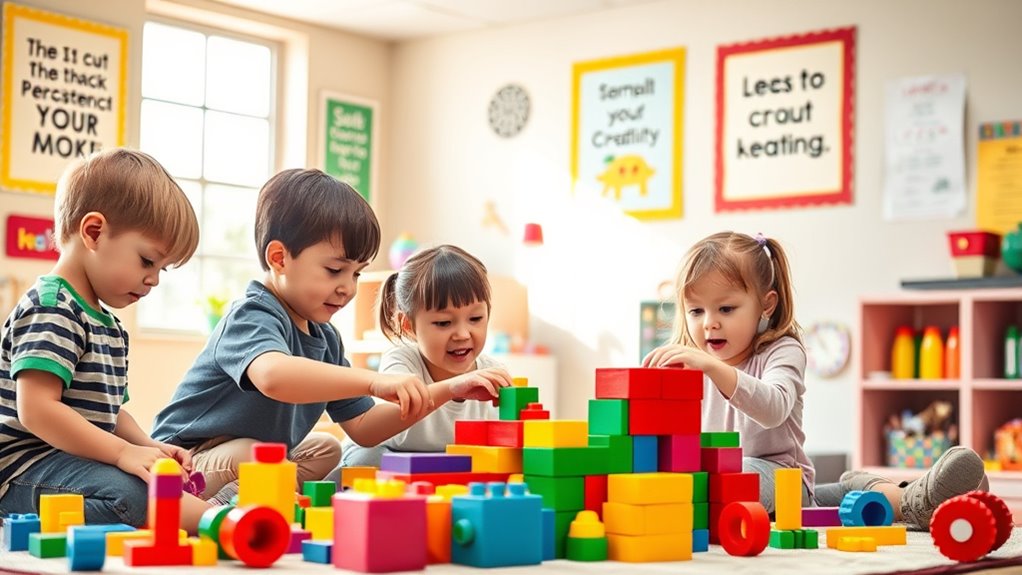
Fostering a growth mindset in young children is essential for their development, and one of the most effective ways to do this is through play. When you encourage children to view challenges as opportunities to learn, you help them develop resilience and a love for discovery. One powerful method is using challenge-based activities that push their boundaries just enough to promote effort without causing frustration. These activities could include puzzles, building projects, or problem-solving games that require persistence and creativity. When children encounter difficulty, your role is to guide them with positive reinforcement, emphasizing their effort and strategies rather than just the outcome. For example, praising a child’s determination after they finish a difficult task reinforces the idea that effort leads to success, which is at the core of a growth mindset.
By integrating challenge-based activities into play, you create an environment where children are motivated to try new things and persist through setbacks. Instead of avoiding tough tasks, they learn to embrace them as opportunities to grow. When a child struggles with a puzzle, you might say, “I see you’re really working hard on this. Keep trying—you’re getting closer!” This kind of positive reinforcement encourages them to see effort as valuable and attainable. It’s important to celebrate their perseverance, not just their achievements, because this shifts their focus from innate ability to the power of effort. Over time, these experiences build confidence and resilience, making children more willing to tackle complex tasks in the future.
Additionally, challenge-based activities foster a sense of curiosity and intrinsic motivation. When children understand that mistakes are part of learning, they’re more likely to take risks without fear of failure. Your supportive approach helps them see setbacks as temporary and manageable, reinforcing the growth mindset philosophy. Through play, you can introduce activities that require trial and error, like science experiments or creative art projects, where the process matters more than the perfect result. When children succeed or struggle, your positive feedback shapes their mindset, helping them view effort and persistence as pathways to mastery. Incorporating wall organization and other home decor elements that create a stimulating environment can further support their engagement and focus during these activities. This foundation supports their overall development, enabling them to approach learning with confidence and enthusiasm.
Frequently Asked Questions
How Early Can Children Start Developing a Growth Mindset?
You can start helping children develop a growth mindset in early childhood, even as young as toddlers. During this stage, they reach key developmental milestones that support learning resilience and effort. By encouraging curiosity, praising persistence, and modeling positive attitudes toward challenges, you foster a growth mindset early on. The sooner you introduce these concepts, the more natural they become as children grow and face new obstacles.
What Are Some Common Play Activities That Promote Growth Mindset?
You can promote a growth mindset through resilient play and challenge acceptance. Encourage activities like puzzle-solving, building blocks, or obstacle courses where children face challenges, persevere, and learn from mistakes. Support their efforts and praise persistence, helping them understand that setbacks are opportunities to grow. These play activities foster resilience and a positive attitude toward challenges, laying the foundation for a growth mindset in young children.
How Can Parents Effectively Model a Growth Mindset During Play?
You can effectively model a growth mindset during play by demonstrating positive reinforcement and role modeling. When your child faces a challenge, praise their effort rather than just the outcome, showing that persistence matters. Let them see you embrace mistakes as learning opportunities. By staying positive and demonstrating resilience yourself, you encourage your child to adopt a growth mindset, understanding that effort and perseverance lead to growth.
Are There Age-Specific Strategies for Teaching Growth Mindset Through Play?
Think of teaching growth mindset through play as planting seeds in different gardens. For toddlers, use age-appropriate activities like simple puzzles to encourage persistence. As children reach developmental milestones, introduce challenges that foster problem-solving and resilience, like building blocks or role-playing. Tailor activities to their age, ensuring they feel supported yet challenged. This approach helps nurture a growth mindset that blooms naturally as they grow.
How Do Cultural Differences Influence Growth Mindset Development in Children?
Cultural perceptions and parenting styles shape how you influence a child’s growth mindset. In some cultures, emphasis on effort and perseverance fosters resilience, while others focus on innate talent. Your approach may need to adapt by respecting cultural values, encouraging children to view challenges as opportunities, and reinforcing positive beliefs about learning. Understanding these differences helps you create supportive environments that nurture a growth mindset across diverse backgrounds.
Conclusion
Think of your child’s mind as a garden, where each play session is like planting a new seed. With your guidance and encouragement, they nurture resilience and curiosity, watering these seeds so they grow into strong, vibrant plants. Just as a gardener tends to each sprout, you help your child develop a growth mindset through playful exploration. Over time, this garden blossoms with confidence, teaching them that effort and persistence can turn any challenge into a beautiful bloom.