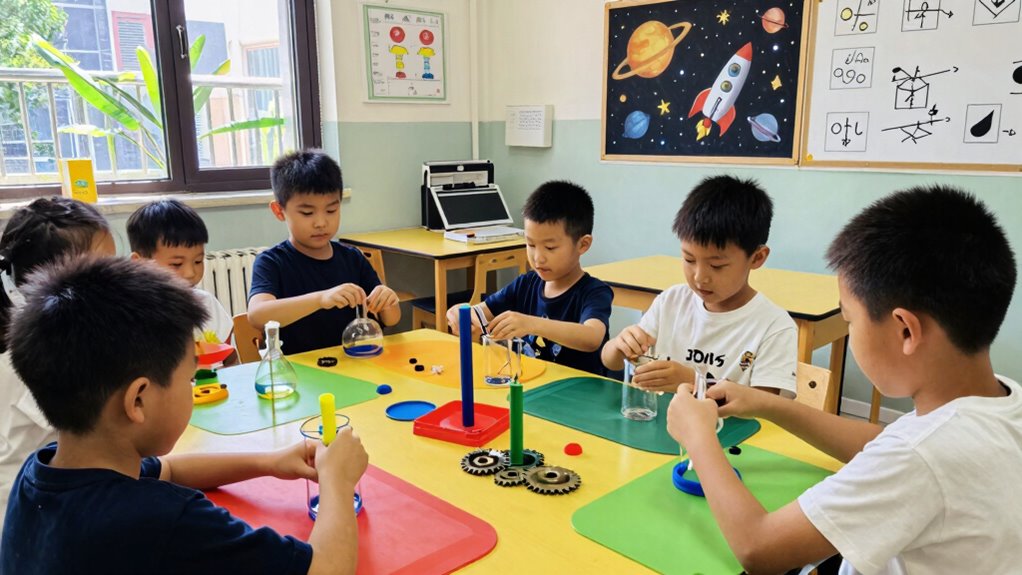

A good STEM invitation for young children sparks their natural curiosity through engaging, open-ended activities that invite exploration and experimentation. Use sensory materials like water, sand, or textured objects to deepen understanding and cater to different learning styles. Provide adaptable resources that allow children to create their own solutions and ask questions. Clear guidance helps keep safety in mind without limiting creativity. Keep exploring to discover how these strategies can foster confident, enthusiastic young learners.

Turn the school run and nap time into listening time
- Thousands of audiobooks, podcasts and originals
- Listen on your phone, tablet or Echo — also offline
- Cancel anytime
Key Takeaways
- Engage curiosity through open-ended questions and exploration opportunities.
- Incorporate sensory-rich, tactile materials to foster hands-on learning.
- Use adaptable, open-ended resources that allow multiple outcomes and creativity.
- Provide simple guidance that encourages independent thinking and reflection.
- Link activities to broader ecological or scientific concepts to deepen understanding.

Introducing STEM invitations to young children can spark their curiosity and lay a strong foundation for future learning. When designing these invitations, it’s vital to focus on engaging their natural desire to explore and discover. Play-based exploration is at the heart of effective STEM activities because it transforms learning into an exciting adventure rather than a chore. Children learn best when they can manipulate objects, experiment, and make connections in a hands-on way. By creating opportunities for open-ended play, you encourage them to ask questions, test ideas, and develop critical thinking skills without feeling pressured to reach a specific outcome.
Sensory activities are also a key component of a good STEM invitation. These activities invite children to use their senses—touch, sight, smell, and even sound—to explore materials and concepts. Sensory-rich experiences captivate children’s attention and deepen their understanding of scientific principles. For example, providing different textured materials like sand, water, or textured fabrics allows children to observe how they feel and interact with each element. This tactile engagement helps solidify their understanding and makes learning memorable. Incorporating sensory activities into STEM invitations makes the experience more immersive and accessible for young learners, especially those who thrive with hands-on experiences.
To make your STEM invitations truly effective, guarantee they are open-ended and adaptable. This means presenting materials and prompts that can lead to multiple outcomes, encouraging children to explore in their own unique ways. For instance, offering building blocks or simple machines invites experimentation and problem-solving without a fixed answer. The goal is to foster a sense of curiosity and independence, so children feel empowered to lead their own exploration. Additionally, keep the environment inviting and safe, so children are comfortable to take risks and try new ideas without fear of failure. Recognizing the importance of safety in the learning environment also helps children feel secure as they try new challenges. Incorporating child-led activities can further enhance their confidence and motivation to explore STEM concepts. When children are allowed to direct their own learning, they naturally develop problem-solving skills and resilience.
Finally, clear and simple instructions or questions can guide children without limiting their creativity. Instead of telling them exactly what to do, pose questions like “What do you notice?” or “What happens if…?” These prompts stimulate thinking and reflection, which are vital for STEM learning. Understanding the importance of biodiversity and its role in a healthy environment can also enrich their perspective, fostering a sense of responsibility toward conservation. Furthermore, emphasizing the interconnectedness of living things can help children appreciate the broader impact of their actions and curiosity. Combining play-based exploration with sensory activities, open-ended materials, and thoughtful guidance helps create an engaging STEM invitation that nurtures young children’s natural curiosity and supports their development as enthusiastic learners.
As an affiliate, we earn on qualifying purchases.
Frequently Asked Questions
How Can Parents Support STEM Invitations at Home?
You can support STEM invitations at home by actively engaging in your child’s curiosity and projects. Encourage family involvement by exploring science and technology together, asking questions, and sharing ideas. Use creative encouragement to make learning fun, like building simple experiments or puzzles. Show genuine enthusiasm for their discoveries, and provide accessible materials. Your support boosts confidence, fosters a love for learning, and helps your child see STEM as exciting and achievable.
What Safety Precautions Should Be Taken During STEM Activities?
You should always wear safety gear, like goggles and gloves, to protect against potential hazards during STEM activities. Supervision protocols are essential; you must closely watch your child to prevent accidents and guide proper use of materials. Keep a first aid kit nearby, and make sure the workspace is clear of unnecessary objects. By prioritizing safety gear and supervision, you create a secure environment where curiosity can flourish without risks.
How Do STEM Invitations Cater to Different Learning Styles?
You cater to different learning styles by designing STEM invitations that incorporate activity adaptability, allowing children to explore concepts through hands-on experiments, visual aids, or storytelling. By offering choices and diverse approaches, you respect individual learning preferences, making activities engaging for everyone. This flexibility encourages active participation, helps children grasp complex ideas, and fosters a love for STEM by meeting each child’s unique way of understanding and exploring the world around them.
What Are Affordable Materials for STEM Invitations?
Did you know that 85% of parents want affordable ways to introduce STEM? You can create engaging DIY experiments using budget supplies like plastic bottles, rubber bands, and paper clips. These materials are inexpensive and readily available, making it easy to design hands-on activities that spark curiosity. With a little creativity, you can turn everyday items into exciting STEM invitations that inspire young children to explore and learn without breaking the bank.
How to Encourage Sustained Interest in STEM Activities?
To encourage sustained interest in STEM activities, you should regularly offer hands-on experiments that challenge children and spark curiosity. Encourage creative problem solving by presenting open-ended tasks where they can explore different solutions. Celebrate their discoveries and efforts, fostering confidence and enthusiasm. Keep activities engaging, varied, and developmentally appropriate, ensuring children see the fun and relevance of STEM, which motivates ongoing exploration and learning.
Conclusion
A well-crafted STEM invitation is like a spark that ignites young minds, illuminating curiosity and wonder. By offering engaging, open-ended activities, you create a playground for exploration where children can build, experiment, and ask questions. When your invitation is inviting and accessible, it’s like opening a door to a world of endless possibilities. With each invitation, you plant seeds of discovery that can grow into a lifelong love of learning.
Cold & flu season Picks
humidifiers
As an affiliate, we earn on qualifying purchases.