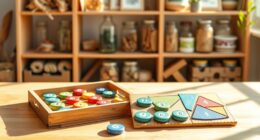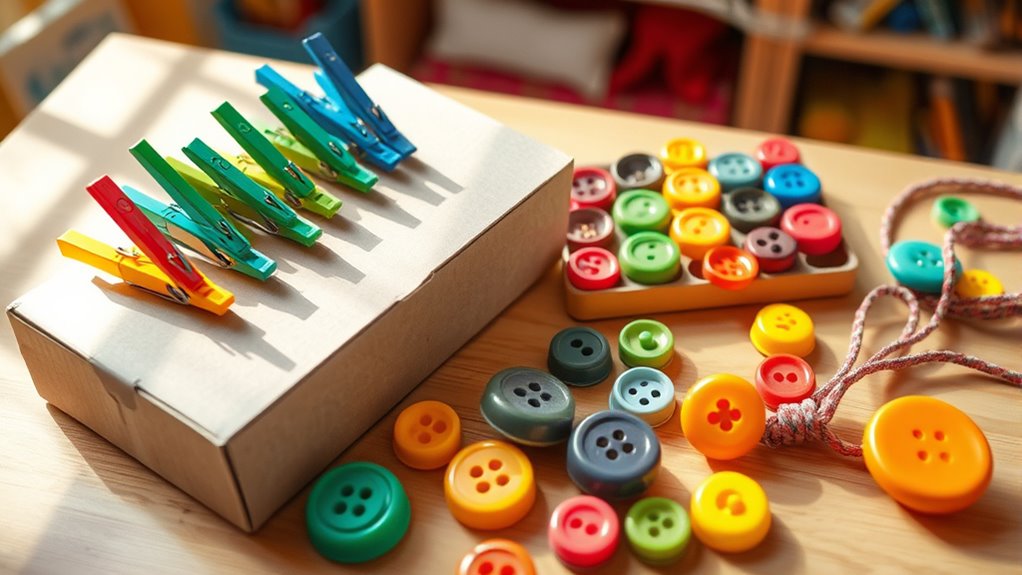

You can create fun fine motor activities at home using everyday household items. Try making sensory bins with dry pasta, rice, or beans, adding small toys or tools for grasping and pouring. Craft puzzles by cutting shapes from cardboard or using household objects like lids as pieces. Incorporate threading with shoelaces and beads, or practice daily routines by using utensils. Exploring these simple ideas will help you find creative ways to develop your child’s small muscle skills and coordination.
Key Takeaways
- Create sensory bins with household items like rice, pasta, or beans, adding small toys for grasping and pouring activities.
- Use household objects such as lids, containers, and paper shapes as puzzles to develop spatial awareness and pinching skills.
- Incorporate threading activities with shoelaces and cardboard cutouts to enhance finger dexterity and hand-eye coordination.
- Practice fine motor skills during daily routines, like using utensils or opening containers, to promote functional hand use.
- Customize activities using household items based on interests, combining sensory, movement, and problem-solving for engaging skill development.

Developing fine motor skills is essential for young children, and choosing the right toys can make this process engaging and fun. You don’t need expensive equipment to help your little one improve their hand-eye coordination and dexterity. Household items can be transformed into stimulating toys that encourage movement and problem-solving. For example, DIY sensory bins are an excellent way to engage your child’s senses while strengthening their small muscles. Fill a shallow container with items like dry pasta, rice, or beans, and add small toys or scoops. Your child can practice grasping, pouring, and sorting, all of which develop their fine motor skills. Plus, you can customize the sensory bin based on your child’s interests, whether they love animals, colors, or textures. The act of scooping and pouring sharpens their hand control and coordination, making the activity both fun and educational.
Another fantastic idea is to incorporate toddler puzzle games into your routine. You don’t need fancy puzzle sets—simple household items can suffice. For example, you can cut out shapes from cardboard or paper and have your toddler match them to corresponding outlines on a tray or mat. This activity encourages pinching and grasping, which are vital for developing fine motor control. As your child manipulates the pieces, they refine their pincer grip and spatial awareness. You can also turn everyday objects into puzzle pieces—like fitting different-sized lids into containers or matching socks by size and color. These activities promote problem-solving skills while honing fine motor movements.
In addition to sensory bins and puzzles, you can create threading activities using household items. For instance, thread shoelaces through a cardboard cutout or string beads onto a shoelace. These activities require precise finger movements and help build strength and coordination. Similarly, practicing with utensils during snack time—using a fork or spoon—can also improve fine motor skills in a natural, everyday setting.
Frequently Asked Questions
What Safety Precautions Should I Take With Household Items?
You should always check for household hazards before turning items into toys. Guarantee small parts are kept away from young children to prevent choking, and avoid sharp or breakable objects. Supervise toy play closely to prevent accidents, especially with items that could pose a risk. Regularly inspect homemade toys for damage or loose parts, and teach children safe play habits. These precautions help make household items safe and fun for kids.
Are These Toy Ideas Suitable for All Age Groups?
You might find that these household toy ideas can be suitable across different age groups, but it’s essential to tailor them to each child’s developmental considerations. For younger children, focus on age-appropriate activities that enhance fine motor skills safely. As kids grow, adapt the activities to challenge their coordination and dexterity. Always supervise and modify based on individual abilities, ensuring safety and engagement for every age level.
How Can I Modify Ideas for Children With Special Needs?
To modify ideas for children with special needs, focus on sensory integration and adaptive modifications. You can add textured materials, like fabric or sandpaper, to enhance sensory input. Use larger, easier-to-grasp objects for better grip or include visual cues for guidance. Adjust the activity’s complexity to suit their abilities, ensuring they stay engaged without frustration. These tweaks create a more inclusive, supportive experience that promotes fine motor development.
What Materials Are Safest for Young Children?
You should always choose non toxic materials and age appropriate items for young children. Look for toys made from BPA-free plastics, natural woods, and food-grade silicone. Avoid small parts that could be a choking hazard, and steer clear of sharp edges or toxic paints. Always check labels for safety certifications, and supervise playtime to ensure your child interacts safely with their toys. This way, you safeguard their health while encouraging development.
How Do I Encourage Independent Play With These Toys?
Did you know that children who engage in independent exploration develop stronger problem-solving skills? To encourage this, set up simple, inviting self-directed activities with household items, like sorting or stacking. Offer guidance initially, then step back, allowing your child to explore at their own pace. Praise their efforts to boost confidence, and rotate toys regularly to keep their interest high, fostering independence and creativity in play.
Conclusion
By transforming everyday household items into engaging toys, you not only fuel your child’s creativity but also strengthen their fine motor skills. Remember, these simple yet clever ideas prove that learning and play are often just a household away. Don’t underestimate the power of imagination—after all, the tiniest object can become the key to limitless growth. So, get creative and watch your child’s skills flourish, because sometimes, the simplest tools hold the greatest potential.