
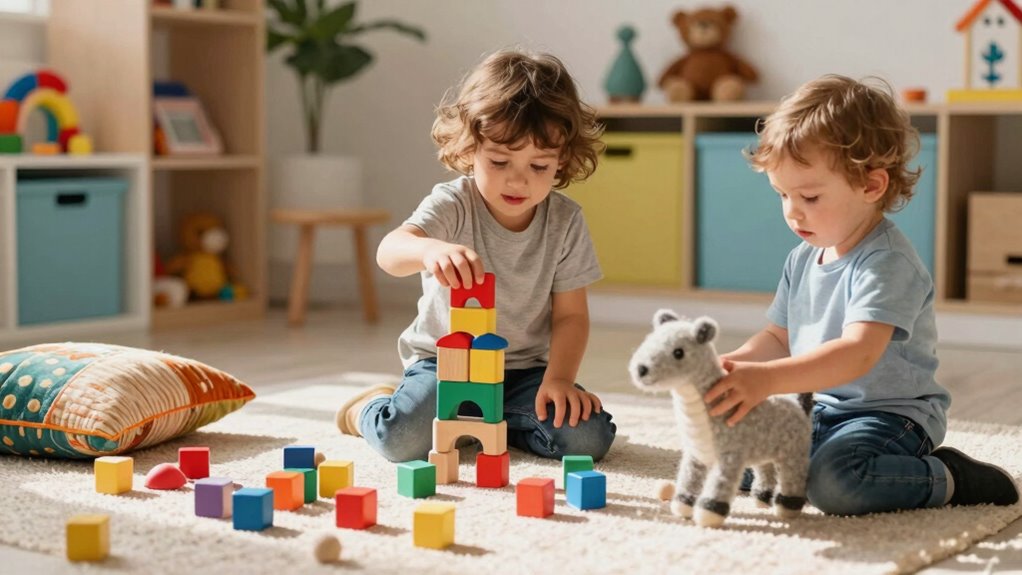

Child development experts value open-ended play because it helps you support your child’s emotional intelligence, social skills, and creativity. It encourages them to recognize and manage feelings, share resources, and solve problems through exploration. Open-ended play also fosters a love for nature, boosts confidence, and builds resilience by allowing children to experiment, learn from mistakes, and develop independence. Keep exploring how this type of play can nurture their growth and prepare them for life’s challenges.

Turn the school run and nap time into listening time
- Thousands of audiobooks, podcasts and originals
- Listen on your phone, tablet or Echo — also offline
- Cancel anytime
Key Takeaways
- Open-ended play fosters creativity and independence by encouraging children to explore and experiment freely.
- It enhances emotional intelligence through self-expression and understanding diverse perspectives.
- Open-ended activities promote social skills like collaboration, negotiation, and conflict resolution.
- Play in natural environments deepens ecological awareness and nurtures environmental responsibility.
- It builds resilience and a growth mindset by allowing children to learn from mistakes and persist through challenges.

Have you ever wondered how play influences a child’s growth? Open-ended play, in particular, plays a crucial role in nurturing essential skills that shape a child’s development. When children engage in activities without strict rules or specific outcomes, they’re encouraged to explore, invent, and problem-solve. This kind of play fosters emotional intelligence because it allows kids to recognize and manage their feelings while understanding those of others. As they navigate these open-ended scenarios, they learn patience, empathy, and resilience, which are fundamental components of emotional maturity.
Open-ended play nurtures emotional intelligence, patience, empathy, and resilience in children.
In addition, open-ended play helps children develop strong social skills. When kids participate in unstructured activities, they often interact more freely with peers, negotiating roles, sharing resources, and resolving conflicts. These interactions teach them how to communicate effectively, listen actively, and collaborate. Unlike structured play, where rules are predetermined, open-ended play requires children to come up with their own rules and adapt as situations unfold. This process enhances their ability to think flexibly and consider different perspectives, important traits for social competence. Moreover, engaging in natural environments during open-ended play can deepen their understanding of the world around them and foster a sense of environmental responsibility. Additionally, outdoor and unstructured environments promote biodiversity awareness, helping children appreciate the variety of life forms and ecosystems. Recognizing these connections can inspire a lifelong appreciation for ecosystem health and sustainability.
Furthermore, because open-ended play doesn’t have a fixed endpoint, children learn to enjoy the process rather than just focusing on a specific goal or product. This fosters creativity and independence, as they realize their ideas can lead to meaningful outcomes. Such experiences build confidence and a sense of agency, which are foundational for healthy emotional development. When children feel empowered to create and explore without constant adult direction, they gain a better understanding of their strengths and interests.
Child development experts emphasize that open-ended play also encourages intrinsic motivation. Kids become driven by their curiosity and desire to learn, rather than external rewards or praise. This internal motivation boosts their engagement and persistence, helping them develop a growth mindset that will serve them well throughout life. It also provides a safe space for children to express their individuality, experiment with new ideas, and learn from mistakes.
In essence, open-ended play is a fundamental tool for fostering emotional intelligence and social skills because it offers a rich environment for children to practice real-life skills in a natural, meaningful way. It nurtures their ability to understand themselves and others, promotes cooperation, and inspires creativity. Child development experts recognize that these qualities form the foundation of well-rounded, confident individuals who are prepared to navigate the complexities of life with resilience and empathy. Additionally, engaging in open-ended play can contribute to children’s understanding of biodiversity, as it encourages them to appreciate natural environments and the interconnectedness of living things.
open-ended educational toys for children
As an affiliate, we earn on qualifying purchases.
As an affiliate, we earn on qualifying purchases.
Frequently Asked Questions
How Does Open-Ended Play Differ From Structured Activities?
Open-ended play differs from structured activities because it encourages creative exploration and lets you follow your child’s lead. You provide open materials, and your child uses their imagination to create and explore. This type of play promotes cognitive flexibility, allowing children to adapt, problem-solve, and think creatively without strict rules. Unlike structured activities, open-ended play fosters independence, curiosity, and a love for learning through self-directed discovery.
Can Open-Ended Play Be Integrated Into Daily Routines Easily?
Yes, you can effortlessly weave open-ended play into daily routines like threads in a tapestry. It sparks inclusive learning and fuels creative exploration, transforming mundane moments into magical adventures. During snack time or bath time, introduce versatile objects or prompts that invite your child to imagine and create. With a little flexibility, open-ended play becomes a natural part of your day, nurturing their growth while making everyday activities exciting and meaningful.
What Materials Are Best for Encouraging Open-Ended Play?
You should choose innovative toys and creative materials that inspire imagination and flexibility. Items like building blocks, art supplies, dress-up clothes, and natural objects like stones or shells are excellent. These materials encourage your child to explore, invent, and problem-solve on their own. Keep a variety of open-ended options accessible, so your child’s curiosity is constantly sparked, fostering their development through engaging, versatile play.
How Does Open-Ended Play Support Emotional Development?
Open-ended play helps you build your child’s emotional resilience and social confidence by encouraging them to explore feelings and solve problems independently. As they navigate open-ended activities, they learn to cope with setbacks and express emotions healthily. This kind of play fosters self-awareness and empathy, empowering your child to handle social interactions confidently and develop a strong emotional foundation essential for their overall growth.
Are There Age-Specific Benefits of Open-Ended Play?
You’ll find that open-ended play acts like a key to a child’s evolving world, revealing age-specific benefits at every stage. For toddlers, it sparks creative exploration and supports early developmental milestones, like fine motor skills. As children grow, it encourages problem-solving and social skills, helping them navigate more complex ideas. Each age uncovers new layers of growth, making open-ended play a essential tool for nurturing your child’s unique developmental journey.
Conclusion
While structured activities can teach specific skills, open-ended play unleashes a child’s limitless imagination and resilience. Unlike rigid tasks, it encourages exploration and problem-solving, shaping confident, adaptable individuals. In a world that often values precision and correctness, embracing open-ended play invites creativity and joy. By fostering this freedom, you nurture a child’s inner strength and curiosity—reminding us that sometimes, the greatest growth happens when we simply let go and play.
Columbus Day / Indigenous Peoples' Day Picks
long weekend sales
As an affiliate, we earn on qualifying purchases.