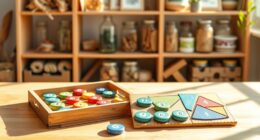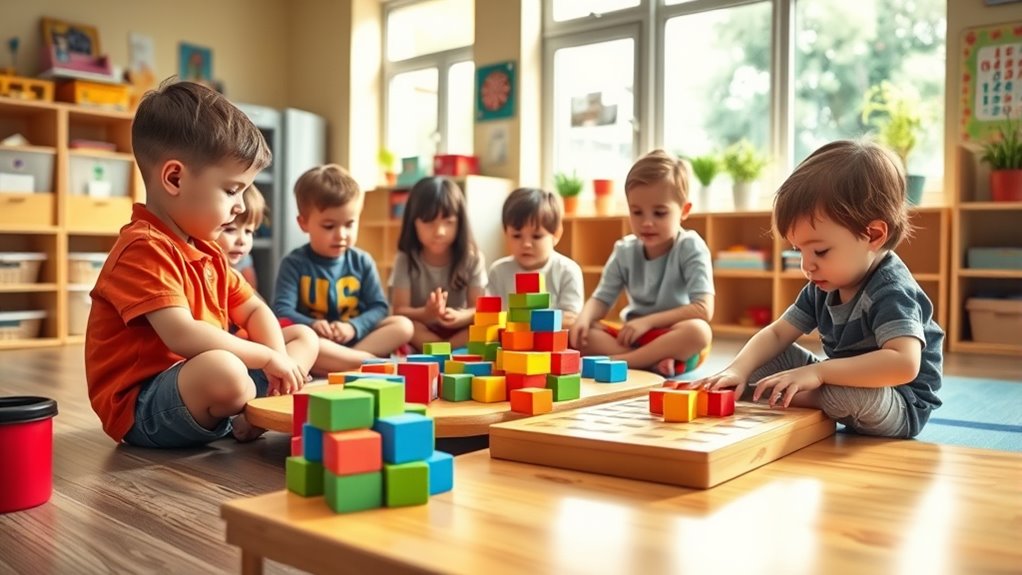
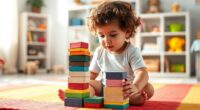
Using blocks and board games is a great way to build your child’s early math skills. These tools help kids recognize numbers, identify patterns, and understand sequences through hands-on activities. Playing with blocks reinforces number recognition and pattern grouping, while board games challenge children to count, compare, and arrange numbers practically. Incorporating durable, interactive tools guarantees ongoing engagement. Keep exploring how these simple activities can set a strong math foundation for your child’s future learning success.
Key Takeaways
- Using blocks and board games reinforces number recognition and sequencing through hands-on, engaging activities.
- Pattern identification with blocks promotes understanding of relationships, sequences, and problem-solving skills.
- Board games involving counting and resource management enhance practical math application and reinforce foundational skills.
- Tactile and durable tools like waterproofed blocks support sustained, interactive learning experiences.
- Combining these tools builds confidence and fluency in early math concepts essential for future success.

Have you ever wondered why some children excel in math from an early age? It often comes down to the way they engage with foundational skills like number recognition and pattern identification. These skills are vital because they serve as building blocks for more complex mathematical concepts. When children learn to recognize numbers quickly, they develop confidence and fluency that help them solve problems faster. Pattern identification, on the other hand, sharpens their ability to see relationships and sequences, setting the stage for understanding functions, algebra, and even geometry later on. Incorporating waterproofing treatments into their learning tools, such as laminated or durable blocks, can help maintain their quality for longer-term use. Using blocks and board games is an effective way to nurture these skills in a fun and interactive manner. When you introduce children to blocks, you’re giving them a tactile experience that reinforces number recognition. For example, counting blocks as they stack or line them up helps children internalize the sequence of numbers. They begin to associate specific quantities with their written symbols, strengthening their ability to recognize numbers instantly. This process builds a mental connection between the numeral and its value, making math less abstract and more concrete. Pattern identification comes into play naturally during block play. When children group blocks by color, size, or shape, they’re actively observing patterns. You can encourage them to create repeating sequences or alternate colors, which enhances their pattern recognition skills. As they experiment with these patterns, they start to see the underlying structures that govern many mathematical concepts. This skill not only supports their understanding of patterns but also improves their problem-solving and logical thinking. Board games are another powerful tool for early math readiness. Games like matching or sequencing puzzles challenge children to recognize patterns and numbers in different contexts. For instance, they might need to match numbers to corresponding objects or arrange cards in numerical order. These activities require children to identify numerical relationships quickly, fostering fluency that’s essential for more advanced math. Furthermore, many board games involve counting spaces, managing resources, or calculating scores, which reinforces number recognition through repetition and practical application.
Frequently Asked Questions
How Early Can Children Start Learning Math Through Blocks and Games?
You can start helping children learn math through blocks and games as early as age two. At this stage, they begin developing number recognition and spatial awareness. By guiding them to count blocks, match shapes, and build structures, you encourage their understanding of basic math concepts. These activities make learning fun and engaging, laying a strong foundation for future math skills while nurturing their curiosity and problem-solving abilities.
Are There Specific Brands or Types of Blocks Recommended for Math Skills?
Think of building block brands as your child’s adventure toolkit—brands like Lego, Mega Bloks, and Melissa & Doug excel at sparking curiosity. These brands offer versatile, colorful options that make learning math feel like play. Pair them with educational game options that challenge shapes and patterns. Together, they create a foundation where math becomes a fun, engaging puzzle, setting your child on a path to brighter problem-solving skills.
How Can Parents Incorporate Board Games Into Daily Math Practice?
You can incorporate board games into daily math practice by choosing games that involve counting, patterns, or simple addition and subtraction. Play interactively by storytelling around the game, making it engaging and fun. This not only reinforces math skills but also promotes parent-child bonding. Encourage your child to explain their moves and strategies, turning game time into a valuable learning experience that strengthens both their math understanding and your connection.
What Are Signs of Math Readiness in Preschoolers?
Imagine your preschooler enthusiastically pointing at numbers on a clock or counting blocks. You’ll notice signs of math readiness when they recognize numbers, like knowing 3 comes after 2, and show pattern awareness, such as lining up toys by size or color. These moments reveal their growing understanding of numbers and sequences, signaling they’re ready to explore more complex math concepts. Your encouragement turns everyday play into a powerful learning adventure.
Can These Activities Support Children With Learning Differences?
Yes, these activities can support children with learning differences. You should incorporate inclusive strategies and adaptive tools, like tactile blocks or visual aids, to help every child engage and succeed. By tailoring the activities to individual needs, you create an accessible environment that fosters confidence and learning. This approach encourages participation, builds foundational math skills, and promotes a positive attitude toward learning for all children.
Conclusion
As you watch children build towers with blocks or navigate board games, you see their confidence grow like a seedling reaching toward the sun. Just as each block stacks to create something stronger, these activities lay a foundation for math skills that will support their future learning. Remember, every game played and block stacked is a step forward—like planting tiny seeds today that will blossom into confident, capable mathematicians tomorrow.