
To introduce gravity to toddlers in your business, use simple, hands-on experiments like dropping different objects to show how gravity pulls everything downward. Engage children with activities that involve balancing toys or standing on one foot to feel how gravity affects movement. Ask questions to spark curiosity and promote exploration. These playful activities make abstract ideas tangible and help young children develop a basic understanding of gravity, setting the stage for more fun discoveries ahead.
Key Takeaways
- Use simple dropping activities to demonstrate how gravity pulls objects downward consistently.
- Incorporate balance and stability exercises, like balancing toys or standing on one foot, to feel gravity’s effects.
- Encourage toddlers to predict and observe which objects land first to foster curiosity and critical thinking.
- Connect everyday experiences, such as dropping toys, to scientific concepts of gravity for better understanding.
- Utilize hands-on, safe experiments that make abstract gravity ideas tangible and engaging for young children.

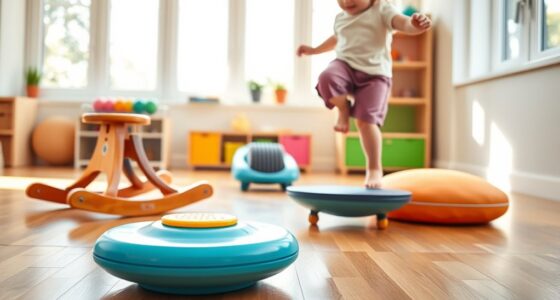
Have you ever wondered how complex scientific ideas are built from simple, fundamental units? When teaching toddlers about gravity, you can start by engaging them in force experiments that demonstrate how objects fall and why some things drop faster than others. These activities don’t need to be complicated; even a basic experiment like dropping different objects from a low height helps children observe that gravity pulls everything downward. As they watch, encourage them to make predictions about which item will land first. This sparks curiosity and introduces the idea of forces acting on objects. By involving your little ones in force experiments, you help them grasp that gravity is a fundamental force shaping their everyday experiences. Practicing safe bicycle safety during play can also help reinforce awareness of natural forces. Balance activities are another excellent way to introduce the concept of gravity to toddlers. Simple activities such as balancing a toy on a spoon or trying to stand on one foot help children feel how their bodies respond to gravitational pull. When they attempt to keep objects steady or stand still, they become aware of the force of gravity as they work against it to maintain balance. These activities aren’t just fun—they serve as practical demonstrations of how gravity constantly influences movement and stability. You can make it more engaging by asking questions like, “What happens when you try to walk without falling?” or “Can you keep your toy from falling off your hand?” This encourages them to think about how gravity affects their actions and surroundings. Introducing gravity through force experiments and balance activities encourages hands-on learning that’s both accessible and engaging for toddlers. These simple activities build a bridge from everyday experiences to more complex scientific concepts, making abstract ideas tangible. When you set up a force experiment, such as dropping different objects, you’re providing a direct way for your child to observe how gravity works. Similarly, balance activities help them develop an intuitive understanding of how gravity influences stability and movement. As they practice, they learn that gravity is a consistent force acting on everything around them, shaping their environment and everyday actions.

Stroller Organizer with Cup Holder, Non-Slip Stroller Caddy Baby Essentials
- Large Capacity Storage: Holds bottles, diapers, toys, snacks
- Ideal Baby Shower Gift: Perfect for new moms and dads
- Universal Compatibility: Fits Uppababy, Baby Jogger, Nuna, and more
As an affiliate, we earn on qualifying purchases.
Frequently Asked Questions
What Safety Precautions Should Parents Take During Experiments?
When conducting experiments, you should prioritize safety by using appropriate safety gear like goggles and gloves to protect your child. Always supervise your toddler closely, following supervision tips such as staying within arm’s reach and explaining safety rules beforehand. Keep the workspace tidy and free of hazards, and make certain all materials are child-safe. This way, your little one can explore gravity safely while you enjoy the learning experience together.
How Can I Adapt Experiments for Different Age Groups?
You can adapt experiments for different age groups by incorporating sensory activities that match their developmental levels. For toddlers, focus on simple, hands-on tasks that enhance fine motor skills, like stacking or pouring. For older children, introduce more complex challenges that encourage problem-solving and exploration. Adjust the materials and complexity to guarantee safety, engagement, and appropriate learning, making sure each activity is both fun and educational for their age.
Are There Recommended Materials for Young Toddlers?
Think of your young toddler’s curiosity as a gentle breeze guiding your choices. For age-appropriate materials, select safe household items like soft balls, plastic cups, and lightweight blocks. These tools act as tiny explorers, revealing gravity’s secrets safely. Always prioritize non-toxic, durable items, and supervise closely. By choosing simple, safe household items, you create a playful, secure environment where your little one can discover the wonders of science.
How Do I Explain Gravity Concepts Simply to Toddlers?
To explain gravity basics to toddlers, keep it simple and engaging. Use everyday examples like dropping toys or watching leaves fall. Show them how objects fall when released and encourage hands-on experiments. Use bright visuals and lively language to capture their attention. By making it fun and relatable, you help toddlers understand gravity concepts while boosting their engagement and curiosity about how things work around them.
What Are the Best Ways to Encourage Curiosity in Children?
Did you know that children are naturally curious, with studies showing they ask around 100 questions a day? To encourage this, embrace playful learning and hands-on exploration. Create engaging activities that spark their imagination, like experiments or pretend play. Offer open-ended questions and praise their ideas. When you foster curiosity, you help children develop critical thinking and a love for discovery that lasts a lifetime.
Conclusion
By introducing toddlers to gravity through simple experiments, you’re laying a foundation for future science curiosity. Did you know that early science play can boost a child’s problem-solving skills by 25%? So, keep exploring together—building blocks of understanding today lead to tomorrow’s innovators. Your efforts make learning fun and impactful, turning everyday objects into exciting science tools. Keep experimenting and watch your little one develop a lifelong love of discovery!