


Choosing a ride-on sand dune buggy for kids means separating vehicles built for uneven outdoor ground from larger UTVs that are better suited to firm, level areas. My strongest terrain-focused picks are the Razor Ground Force Dune Runner, with pneumatic tires and rear suspension, and the Razor Dune Buggy, which offers similar outdoor-oriented features in a slightly slower package. For siblings, the First Ride On 36V Black Camo UTV provides two seats, a gradual-start throttle, and a stated runtime of 40–60 minutes.

Turn the school run and nap time into listening time
- Thousands of audiobooks, podcasts and originals
- Listen on your phone, tablet or Echo — also offline
- Cancel anytime
The tradeoff is clear: the Razor models are single-seat buggies with pneumatic tires and hand-operated disc brakes, while the UTVs prioritize passenger space and family-friendly controls. But sand itself is demanding terrain. None of the supplied descriptions confirms that these vehicles are designed for loose, deep dunes, so I would treat “sand dune” as an outdoor buggy style—not a promise of reliable beach or dune performance. My ranking favors evidence of suitable tires, suspension, rider control, and useful safety features, while calling out where the product information leaves uncertainty.
Complete the kit


Key Takeaways
- The Razor Ground Force Dune Runner is my leading pick for a child who wants a single-seat, outdoor-style buggy, thanks to its 350-watt motor, pneumatic tires, rear suspension, and hand-operated disc brake.
- The Razor Dune Buggy offers a comparable knobby-tire setup and side cage, but its 250-watt motor and 9 mph stated maximum speed place it below the Dune Runner for performance.
- The First Ride On Black Camo UTV is the more practical family choice for two riders and lists a 40–60 minute runtime, but it has no parental remote and uses EVA tires rather than pneumatic ones.
- The pink First Ride On UTV shares the Black Camo model’s two-seat layout and 36V platform, but its listed runtime is shorter at approximately 25–45 minutes.
- The Nitoess UTV includes a parental remote and two seats, yet its description recommends hard, even surfaces, its charging time is 8–12 hours, and its motor specifications conflict.
| Razor Ground Force Dune Runner Electric Go-Kart for Kids |  | Best Overall for Outdoor Buggy-Style Riding | Recommended age: 8–12 years | Motor: 350 watts, chain drive | Maximum speed: Up to 10 mph | VIEW ON AMAZON | See Our Full Breakdown |
| Razor Dune Buggy Electric Ride-On for Kids, Blue |  | Best Classic Buggy Design | Recommended age: 8 years and up | Motor: 250-watt, chain-driven | Maximum speed: Up to 9 mph | VIEW ON AMAZON | See Our Full Breakdown |
| First Ride On 36V Two-Seater Kids Electric UTV, Black Camo |  | Best Two-Seater for Longer Listed Runtime | Battery and motors: 36V 9Ah; dual 200W motors | Maximum speed: 5–8 mph | Runtime: 40–60 minutes per charge, depending on terrain | VIEW ON AMAZON | See Our Full Breakdown |
| First Ride On 36V Two-Seater Kids Electric UTV, Pink |  | Best Colorful Two-Seater for Shared Rides | Recommended age: 6 years and up | Battery and motors: 36V 9Ah; dual 200W motors | Maximum speed: 5–8 mph | VIEW ON AMAZON | See Our Full Breakdown |
| Nitoess 24V 2-Seater 4WD Kids Ride-On UTV |  | Best for Remote Parental Control | Battery: 24V 7Ah | Motor details: Conflicting listing: 54W motors in description; 4×150W in item highlight | Speed: 3.73–5.6 mph | VIEW ON AMAZON | See Our Full Breakdown |
| ride on sand dune buggy for kid | Recommended age | Maximum speed | Tires and suspension |
|---|---|---|---|
| Razor Ground Force Dune Runner | 8–12 years | Up to 10 mph | 8-inch pneumatic tires; rear suspension |
| Razor Dune Buggy Electric Ride | 8 years and up | Up to 9 mph | 8-inch knobby pneumatic tires; active rear suspension |
| First Ride On 36V Two-Seater K | 6–10 years | 5–8 mph | 14-inch EVA tires; rear metal spring suspension |
| First Ride On 36V Two-Seater K | 6 years and up | 5–8 mph | 14-inch EVA tires; rear metal spring suspension |
| Nitoess 24V 2-Seater 4WD Kids | — | — | — |
More Details on Our Top Picks
Razor Ground Force Dune Runner Electric Go-Kart for Kids
The Ground Force Dune Runner ranks first because it combines the most persuasive outdoor-oriented package in this lineup: 8-inch pneumatic tires, rear suspension, and a hand-operated rear disc brake. Those features matter more to a buyer considering grass, dirt, or uneven pavement than music systems or extra seating. Its stated 350-watt motor and maximum speed of 10 mph also give it a performance advantage over the other Razor buggy here, which is listed at 250 watts and 9 mph.
This remains a single-seat go-kart, not a two-child UTV, and its recommended age is 8–12. The padded bucket seat and lap belt give the child a defined sitting position, while the hand brake calls for a rider who can understand and operate it. Battery life is listed as up to 40 minutes, so extended outings need a charging plan. I would not read pneumatic tires as proof of deep-sand capability: the stated surfaces are lawns, dirt, and uneven pavement, not loose dunes.
Compared with the Razor Dune Buggy, this model has the stronger stated motor and slightly higher maximum speed; compared with the First Ride On UTVs, it trades passenger capacity and gradual-start controls for a more conventional buggy setup and disc brake. It is my strongest match for a child seeking outdoor buggy-style riding on suitable firm ground, but families wanting a parent remote or two seats should choose a different design.
Pros:- Pneumatic tires and rear suspension suit varied ground better than the listed EVA-tire UTVs.
- 350-watt motor and stated 10 mph maximum speed lead the lineup’s single-seat buggies.
- Hand-operated rear disc brake gives the rider a dedicated braking control.
- Padded bucket seat and lap belt provide a defined seating position.
Cons:- Single-seat layout cannot carry a sibling.
- Battery life is listed as up to 40 minutes.
- Recommended age is limited to 8–12 years, and deep-sand use is not confirmed.
Best for: Children ages 8–12 who want a single-seat buggy for lawns, dirt, or uneven pavement and can use a hand-operated brake.
Not ideal for: Families seeking a two-seat vehicle, remote parental control, long outings between charges, or a model explicitly confirmed for loose, deep sand.
- Recommended age:8–12 years
- Motor:350 watts, chain drive
- Maximum speed:Up to 10 mph
- Battery life:Up to 40 minutes
- Tires and suspension:8-inch pneumatic tires; rear suspension
- Brakes:Hand-operated rear disc brake
- Seat:Foam-padded bucket seat with lap belt
- Vehicle weight:66.8 pounds
Our verdict“I would choose the Dune Runner for an older child who wants the strongest listed single-seat buggy setup for suitable outdoor ground.”
Razor Dune Buggy Electric Ride-On for Kids, Blue
The Razor Dune Buggy is the more straightforward choice for a child who wants an open, low-slung buggy rather than a cabin-style UTV. Its knobby pneumatic tires, active rear suspension, tubular steel frame, and side cage give it a distinct outdoor focus among the five options. A lap belt and hand-operated rear disc brake add practical controls without the extra passenger seating and entertainment features found on the First Ride On models.
Against the Ground Force Dune Runner, this Razor is the less powerful option: its motor is listed at 250 watts and its maximum speed at 9 mph, compared with 350 watts and 10 mph for the Dune Runner. That makes the Dune Buggy a reasonable alternative when the older child does not need the higher stated performance, but it does not lead the lineup on those figures. Both offer pneumatic tires, rear suspension, a disc brake, and a battery life of up to 40 minutes.
The stated recommended age is 8 and up, with a 120-pound maximum rider weight. That may make it more flexible by age than the Dune Runner’s stated 8–12 range, but fit and manufacturer guidance still decide whether a particular child is a suitable rider. The product details mention dirt, grass, and gravel; they do not confirm deep-sand use. I would skip it for buyers who need parental remote control or a passenger seat, and choose an appropriate firm surface rather than assuming a knobby tire can handle soft dunes.
Pros:- Knobby pneumatic tires and active rear suspension are aimed at varied outdoor terrain.
- Side cage and lap belt distinguish it from the UTV options.
- Hand throttle and rear disc brake give the rider direct controls.
- Can be stored vertically, according to the product details.
Cons:- 250-watt motor and 9 mph stated maximum speed are below the Dune Runner’s listed figures.
- Battery life is up to 40 minutes per charge.
- The 120-pound rider limit and single seat restrict who can ride.
Best for: A child age 8 or older who prefers an open, classic buggy design for dirt, grass, or gravel and fits within the stated rider limit.
Not ideal for: Buyers who want the highest listed motor output, a two-seat layout, remote supervision, or confirmed deep-sand capability.
- Recommended age:8 years and up
- Motor:250-watt, chain-driven
- Maximum speed:Up to 9 mph
- Battery:24-volt sealed lead-acid; two 12-volt batteries
- Battery life:Up to 40 minutes
- Tires and suspension:8-inch knobby pneumatic tires; active rear suspension
- Rider limit:120 pounds maximum
- Brakes:Hand-operated rear disc brake
Our verdict“I would pick this Razor over the UTVs for a child who values an open buggy form and pneumatic tires more than passenger space or remote control.”
First Ride On 36V Two-Seater Kids Electric UTV, Black Camo
The Black Camo First Ride On UTV makes more sense for family rides than either Razor buggy. It has two seats, 3-point seat belts, and a 132-pound maximum load, so it can carry two appropriately sized children within the stated limit. A variable pedal throttle, gradual start, forward and reverse, and electronic brake provide an approachable control set for a child learning to steer a powered ride-on. Its listed 40–60-minute runtime is longer than the pink version’s approximate 25–45 minutes, though the black model’s figure is said to vary by terrain.
For a buyer focused on buggy-style terrain performance, the compromise is its 14-inch EVA tires. The product description says it can be used on grass, dirt, and gravel, and rear metal spring suspension is included, but these are not pneumatic tires like the Razor models. I would not rank it above the Razors for a child seeking a traditional dune buggy, particularly where loose sand is the goal. No parental remote is listed, so adults do not get the remote-driving option offered by the Nitoess.
Compared with the pink First Ride On, the Black Camo version shares the 36V 9Ah battery, dual 200W motors, two-seat layout, and controls, while its listed runtime is more generous. Compared with the Nitoess, it has a clearer motor specification and a higher stated top speed, but lacks a remote. The extra storage box, lights, Bluetooth audio, and FM radio are useful add-ons; they do not replace surface guidance or adult supervision.
Pros:- Two seats and 3-point belts support carrying a passenger within the load limit.
- Listed runtime of 40–60 minutes is longer than the pink version’s stated range.
- Gradual start, variable pedal throttle, forward and reverse, and electronic brake support hands-on driving.
- Rear spring suspension, storage box, lights, and audio features suit family-style outings.
Cons:- No parental remote is listed.
- EVA tires are different from the pneumatic tires on both Razor buggies.
- Runtime varies with terrain, and deep-sand suitability is not confirmed.
Best for: Families with two children who want a UTV-style ride-on, gradual-start controls, and the longer runtime stated among the two First Ride On versions.
Not ideal for: A buyer seeking pneumatic tires, a rider-operated disc brake, remote parental driving, or confirmed use on deep sand.
- Battery and motors:36V 9Ah; dual 200W motors
- Maximum speed:5–8 mph
- Runtime:40–60 minutes per charge, depending on terrain
- Seating and belts:Two seats; 3-point seat belts
- Maximum load:132 pounds
- Tires and suspension:14-inch EVA tires; rear metal spring suspension
- Recommended age:6–10 years
- Controls:Variable pedal throttle, forward and reverse, gradual start, electronic brake
Our verdict“I would choose the Black Camo UTV when two seats and its longer stated runtime matter more than pneumatic tires or remote control.”
First Ride On 36V Two-Seater Kids Electric UTV, Pink
The pink First Ride On 36V UTV earns its place as a shared-ride option for children who want a passenger seat, not as a direct substitute for a pneumatic-tire dune buggy. Like its Black Camo counterpart, it pairs a 36V battery and dual 200W motors with a variable pedal throttle, gradual start, reverse, and electronic brake. Its 3-point safety belts and 20.5-inch seat width are concrete reasons to look at this model when a child wants company on a ride.
The key comparison is runtime. This version lists approximately 25–45 minutes per charge, while the Black Camo model lists 40–60 minutes depending on terrain. The pink model also uses 14-inch EVA tires and rear metal spring suspension, rather than the Razor buggies’ smaller pneumatic tires and rider-operated disc brakes. That gives it a different role: passenger capacity and family-friendly driving controls take priority over the more classic buggy equipment.
Its listed speed is 5–8 mph, below both Razor models’ stated maximum speeds. That may suit families who prefer a slower UTV-style ride, but it also means this is not the pick for a child seeking the quicker, open-go-kart experience. The product description does not list a parental remote, and nothing here confirms operation in loose sand. I would compare its age guidance of 6 and up and its 132-pound capacity with the actual riders and follow the manufacturer’s surface and safety instructions.
Pros:- Two seats and 3-point belts support shared rides within the stated capacity.
- Variable throttle, gradual start, reverse, and electronic brake offer a broad control set.
- Rear spring suspension and 14-inch EVA tires are included for outdoor use.
- Bluetooth, FM radio, LED lights, and a rear storage box add family-use features.
Cons:- Listed runtime is shorter than the Black Camo First Ride On version.
- No parental remote is listed.
- EVA tires and stated 5–8 mph speed make it less like the Razor dune buggies.
Best for: Families wanting a pink two-seat electric UTV with gradual-start controls for children age 6 and up.
Not ideal for: Buyers who prioritize longer stated runtime, remote parental control, pneumatic tires, or a single-seat buggy with a hand brake.
- Recommended age:6 years and up
- Battery and motors:36V 9Ah; dual 200W motors
- Maximum speed:5–8 mph
- Runtime:Approximately 25–45 minutes per charge
- Seating:Two seats; 20.5-inch seat width
- Maximum capacity:132 pounds
- Tires and suspension:14-inch EVA tires; rear metal spring suspension
- Features:Gradual start, forward and reverse, electronic brake, Bluetooth, FM radio, LED lights, storage box
Our verdict“I would select the pink UTV for a shared, slower-paced ride where two seats matter more than longer runtime or classic buggy hardware.”
Nitoess 24V 2-Seater 4WD Kids Ride-On UTV
The Nitoess 24V UTV is the only option in this group with a listed 2.4GHz parental remote, giving it a distinct role for adults who want a remote mode alongside child-operated driving. It also has two seats and seat belts, a stated 200-pound weight capacity, rear spring suspension, and multiple device connections. For a family with a younger child who is not ready to manage every control independently, the remote is a more meaningful difference than its music and lighting features.
That supervision feature does not make it a sand buggy. The product description recommends use on hard, even surfaces, which is a much narrower surface claim than the Razor models’ lawns, dirt, and uneven pavement or the First Ride On models’ stated grass, dirt, and gravel use. Its wear-resistant wheels are not described as pneumatic, and its listed maximum speed of 5.6 mph is lower than the other options’ upper figures. I would rule it out for buyers whose main goal is riding on loose dunes.
There is also a specification concern: the description calls out 54W motors, while an item highlight lists 4×150W motors. That conflict makes performance harder to compare with the clear dual-200W First Ride On listings or the Razor motor ratings. Charging is listed at 8–12 hours, the longest explicit charging detail in this lineup. I would choose it for remote supervision on suitable firm ground, not for a buyer seeking the most reliable match to the sand-dune wording.
Pros:- Includes parental 2.4GHz remote and child-operated mode.
- Two seats, seat belts, and a stated 200-pound capacity accommodate shared use within limits.
- Rear spring suspension is included for the surfaces recommended by the description.
- AUX, USB, Bluetooth, and TF-card connections provide several audio options.
Cons:- Product guidance recommends hard, even surfaces rather than loose or uneven terrain.
- Motor details conflict between 54W and 4×150W listings.
- Charging time is listed as 8–12 hours.
Best for: Families who value parental remote operation and two seats for use on hard, even surfaces.
Not ideal for: Buyers seeking a vehicle described for grass, dirt, gravel, or loose sand, or anyone needing clear motor specifications and shorter charging time.
- Battery:24V 7Ah
- Motor details:Conflicting listing: 54W motors in description; 4×150W in item highlight
- Speed:3.73–5.6 mph
- Seating and capacity:Two seats with belts; 200-pound stated capacity
- Driving modes:Parental 2.4GHz remote and manual driving
- Charging time:8–12 hours
- Suspension and wheels:Rear spring suspension; wear-resistant wheels
- Recommended surface:Hard, even surfaces
Our verdict“I would favor the Nitoess for remote supervision on firm, level ground, but not as my pick for a sand-oriented buggy.”
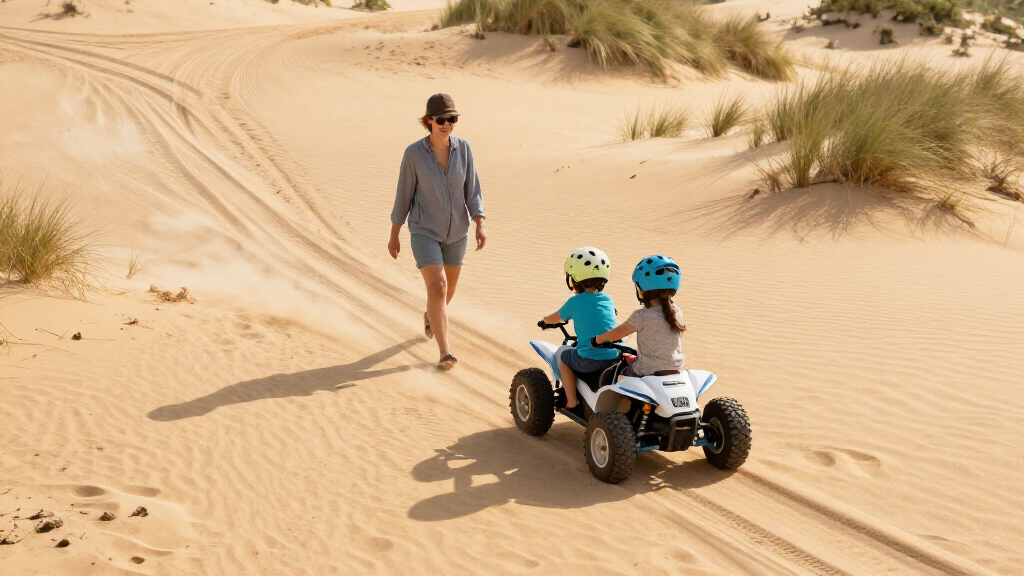
How We Picked
I ranked these options for the specific search behind ride-on sand dune buggy for kids: buyers want an outdoor vehicle that looks and feels buggy-like, but also need a realistic read on ground suitability, controls, seating, and supervision. I gave more weight to pneumatic tires, suspension, stated outdoor surfaces, and rider-operated brakes than to entertainment extras such as radio or Bluetooth.
I also distinguished a true single-seat buggy from a two-seat UTV. A UTV can make more sense for siblings or younger children who benefit from parental remote control, but passenger capacity alone does not make it a better choice for sand. The supplied descriptions do not establish that any model is appropriate for loose or deep sand, so I avoid treating tread, motor power, or “off-road” wording as proof of dune capability.
Where details conflict, I leave the uncertainty visible. The Nitoess listing gives two different motor descriptions, and runtime figures vary between the First Ride On versions. I ranked the products by the strengths buyers can compare with confidence, then included meaningful drawbacks and a clear skip profile for each. Age, load limits, surface guidance, and adult supervision still matter; buyers should check the current manufacturer instructions before riding.
Factors to Consider When Choosing Ride On Sand Dune Buggy For Kids
For this group, I would start with the intended surface and the number of riders—not the vehicle’s styling. A child’s dune-buggy look does not by itself establish that a ride-on can handle loose sand. The product details here support comparisons on tires, suspension, controls, seating, and stated surfaces, but they do not confirm deep-sand use for any model.
Match the tires and surface to the ride
The two Razor models list pneumatic tires and rear suspension, with outdoor surfaces including lawns, dirt, uneven pavement, or gravel. The First Ride On UTVs list large EVA tires and rear spring suspension, with grass, dirt, and gravel in their descriptions. The Nitoess instead recommends hard, even surfaces. These differences matter more than a generic off-road label: tire construction and stated surface guidance tell you what the manufacturer describes, but not how a vehicle will perform in deep, soft sand. I would ask the maker about the exact terrain before buying for beach or dune use.
Choose the right kind of control
The Razor buggies put the child in charge of a hand throttle and hand-operated rear disc brake. That setup suits a rider ready to manage direct controls. The First Ride On UTVs use a pedal throttle, gradual start, forward and reverse, and electronic brake, but no remote is listed. Nitoess is the clear choice if parental remote control is a priority; its surface recommendation and conflicting motor figures are reasons to limit that choice to suitable firm ground. Match the control system to the child’s ability, and supervise every ride.
Decide whether a passenger seat is useful
Both Razor products are single-seat buggies. The First Ride On models and Nitoess offer two seats, which can be appealing for siblings, but the stated load limit still applies to the combined riders and gear. A second seat adds weight and changes the vehicle’s purpose; it does not automatically improve traction or suitability for sand. If one child will ride alone, compare the more compact single-seat buggy style with the larger UTV dimensions. If two children will share a vehicle, check seat fit, belt arrangement, and total capacity before choosing.
Treat runtime as an estimate, not a guaranteed outing length
Battery figures vary: the Razor models list up to 40 minutes, the pink First Ride On lists approximately 25–45 minutes, and the Black Camo version lists 40–60 minutes depending on terrain. Nitoess lists an 8–12-hour charge time but no runtime in the supplied specifications. A stated maximum runtime is not a promise for every route; rider weight, surface, and driving style can affect how long a charge lasts. I would plan shorter sessions, follow the charging instructions, and avoid relying on a ride-on as transport for a long outing.
Check age, capacity, and the actual riding area
Age guidance differs: the Razor Dune Runner is listed for ages 8–12, the Razor Dune Buggy for age 8 and up, the First Ride On UTVs for children from age 6, and Nitoess for ages 36 months–12 years. These labels do not replace checking weight capacity, seat fit, and manufacturer instructions. Before a ride, choose an open, controlled area away from traffic, water, and steep drops. Use the supplied restraint correctly, provide protective gear suited to the activity, and keep an adult close—especially when the child is learning to operate the vehicle.
Frequently Asked Questions
Can any of these ride-on vehicles be used on deep sand dunes?
The supplied product details do not confirm deep-sand use for any of the five. The Razor models list pneumatic tires and surfaces such as lawns, dirt, uneven pavement, or gravel; the First Ride On UTVs list EVA tires and grass, dirt, and gravel; Nitoess recommends hard, even surfaces. I would not assume that any of them can climb or travel reliably on loose dunes without direct confirmation from the manufacturer.
Which option is the closest match to a traditional kids’ dune buggy?
I would start with the Razor Ground Force Dune Runner or the Razor Dune Buggy. Both are single-seat designs with pneumatic tires, rear suspension, and hand-operated rear disc brakes. The Dune Runner has the stronger stated motor and higher maximum speed, while the Dune Buggy adds a side cage and lists a 120-pound rider limit. Neither is described as suitable for deep sand.
Which model is best for two children?
The First Ride On Black Camo, First Ride On Pink, and Nitoess are the two-seat choices. Compare the combined rider weight with each vehicle’s stated capacity, and check that both children fit properly with the belts fastened. The Black Camo model lists 132 pounds maximum load, the pink model lists the same capacity, and Nitoess lists 200 pounds. Passenger capacity does not mean the vehicle is appropriate for every surface.
Which ride-on has a parental remote?
The Nitoess 24V UTV is the only product in this lineup whose description lists a 2.4GHz parental remote. It also recommends hard, even surfaces and has conflicting motor figures in its supplied details. Neither First Ride On model lists a remote, and the Razor buggies are described with child-operated controls. A remote can help an adult manage a ride, but it does not remove the need for close supervision.
How should I compare the listed battery runtimes?
Read runtime as an estimate, not a guaranteed session length. The Razor buggies list up to 40 minutes, the pink First Ride On lists approximately 25–45 minutes, and the Black Camo model lists 40–60 minutes depending on terrain. The Nitoess details give an 8–12-hour charging time but no runtime figure. Use the manufacturer’s charging instructions and expect actual run time to vary with the rider, surface, and driving conditions.
Conclusion
For a child who wants a single-seat outdoor buggy, I would choose the Razor Ground Force Dune Runner first: its pneumatic tires, rear suspension, 350-watt motor, and hand-operated disc brake make the strongest combined case in this lineup. Choose the Razor Dune Buggy instead if its side cage and open buggy form are a better fit and the lower stated motor output is acceptable. For siblings, the First Ride On Black Camo UTV has two seats and the longer runtime listed between the two First Ride On versions; the pink version is another two-seat option with a shorter stated runtime. Pick Nitoess when parental remote control matters most and the ride will stay on hard, even ground. Whichever buyer type fits, I would not treat any of these as confirmed for deep sand without checking with the manufacturer.