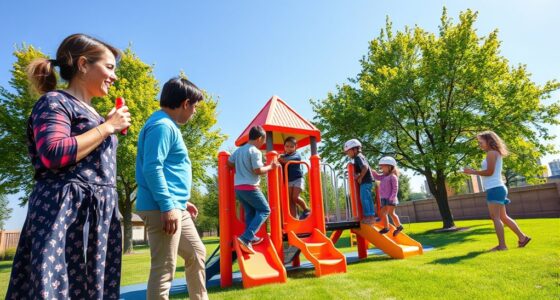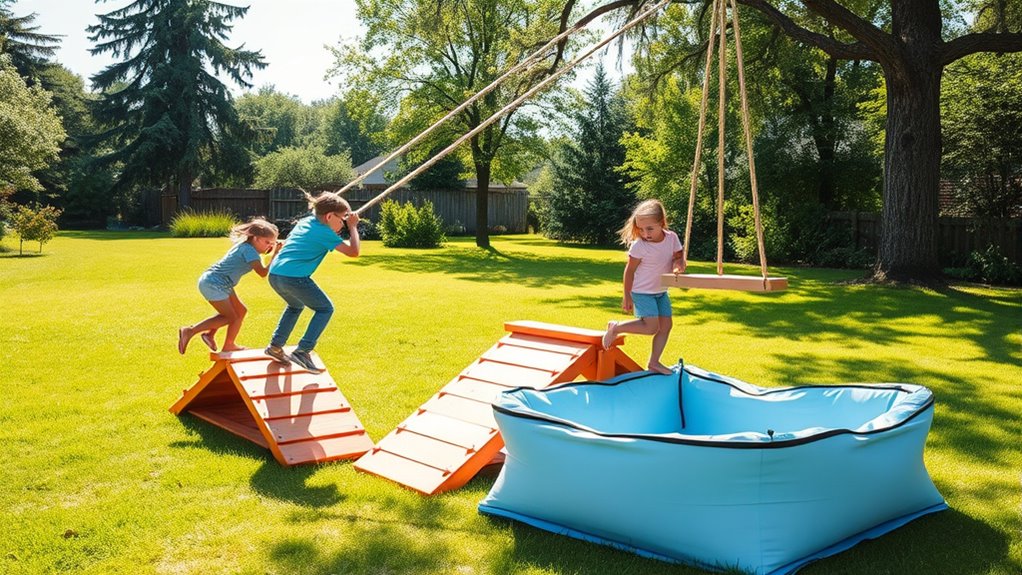

Designing backyard obstacle courses that teach physics allows you to combine fun movement with hands-on science. By incorporating elements like slopes, pulleys, and timed challenges, you help learners understand motion, force, and gravity practically. These courses keep participants active and engaged while demonstrating key physics principles. If you keep exploring, you’ll discover creative ways to integrate digital tools and privacy concepts, making science and technology part of your outdoor adventures.
Key Takeaways
- Design obstacle courses that demonstrate physics principles like motion, gravity, and force through hands-on challenges.
- Incorporate digital elements, such as cookies, to teach data management and online privacy during physical activities.
- Use physical challenges to illustrate scientific concepts, promoting experiential learning and problem-solving skills.
- Combine outdoor physical activities with digital literacy to create engaging, multidisciplinary educational experiences.
- Tailor obstacle courses to support kinesthetic learners and enhance understanding of physics in a fun, interactive setting.
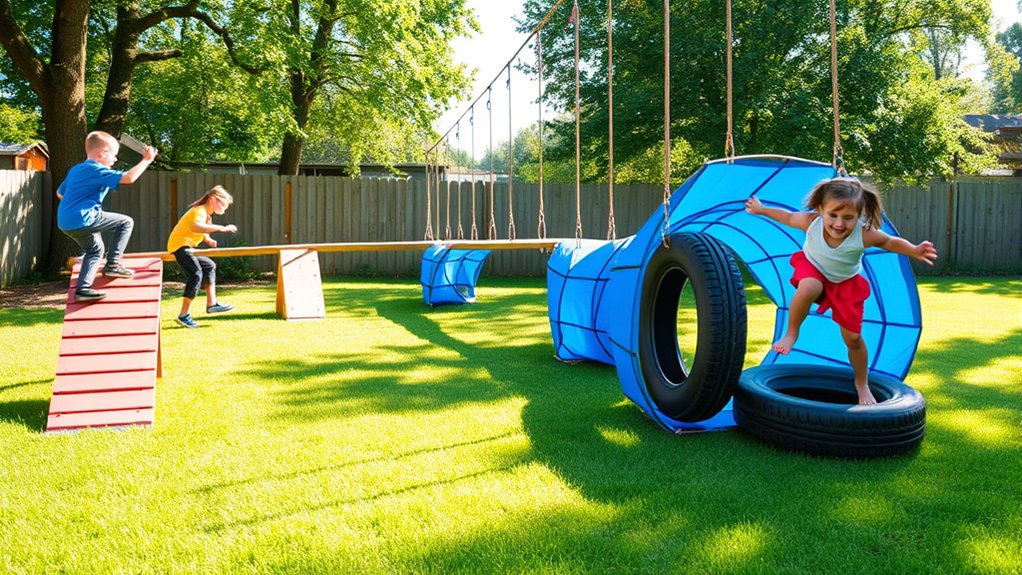
This demonstrates how engaging physical activities can be combined with educational elements to create a fun learning environment. Cookies are used to enhance website functionality, which can also relate to understanding online privacy and data management in digital learning tools.
Frequently Asked Questions
How Can Obstacle Courses Be Customized for Different Age Groups?
When designing obstacle courses, you can customize difficulty levels to suit different age groups by incorporating age-appropriate challenges. For younger kids, use softer materials and simpler tasks, while older children can handle more complex obstacles. You can also add adjustable elements like ramps or bridges, making the course adaptable. This way, you guarantee safety and engagement, providing an inclusive experience that promotes learning and physical activity for all ages.
What Safety Measures Are Recommended During Construction?
Oh, building a death trap disguised as fun? First, you better don safety gear—helmets, gloves, and pads—and follow strict supervision protocols. Double-check every bolt and rope, because a loose screw could turn your masterpiece into a disaster. Keep kids away during construction, and never leave them unsupervised during play. Remember, safety isn’t just a suggestion; it’s the foundation of a successful, harm-free adventure.
How Do Obstacle Courses Enhance Problem-Solving Skills?
You’ll find obstacle courses boost problem-solving skills by challenging you to think quickly and adapt. As you navigate, you improve balance training and agility, which helps you determine the best strategies to overcome obstacles. These courses push you to analyze each step, experiment with different approaches, and learn from mistakes. This active process sharpens your critical thinking, making you more resourceful and confident in tackling complex problems.
What Materials Are Best for Durable, Weather-Resistant Obstacles?
When selecting weatherproof materials for obstacle courses, focus on material durability to withstand the elements. You should consider using pressure-treated wood, PVC pipes, or galvanized steel, as these are highly resistant to weather damage. Rubber mats or outdoor-rated fabrics also add safety and longevity. By choosing these weatherproof materials, you guarantee your obstacles stay durable and safe, providing lasting fun and learning opportunities regardless of weather conditions.
How Can I Incorporate Technology Into Backyard Obstacle Courses?
You can incorporate technology into your obstacle course by adding augmented reality features that overlay digital challenges or hints through a smartphone or tablet. Wearable sensors can track participants’ movements and provide real-time feedback on speed, agility, or balance. This not only makes the course more engaging but also adds an educational layer, allowing you to analyze physics concepts like force and motion as players progress through the obstacles.
Conclusion
Now, imagine what’s next. As you build these obstacle courses, you’ll uncover physics secrets hiding in plain sight. Will your next challenge push the limits of what you thought possible? With every new obstacle, you get closer to mastering the forces that shape motion. Are you ready to turn your backyard into a science playground? The adventure’s just beginning—step up, and see what’s waiting around the corner. The physics are calling—are you ready to answer?