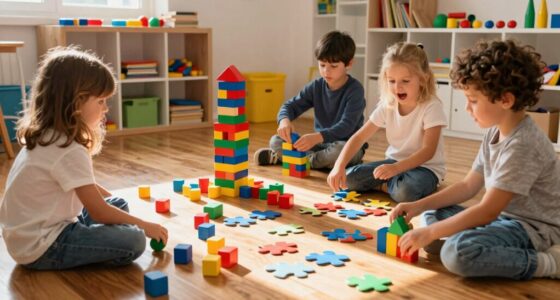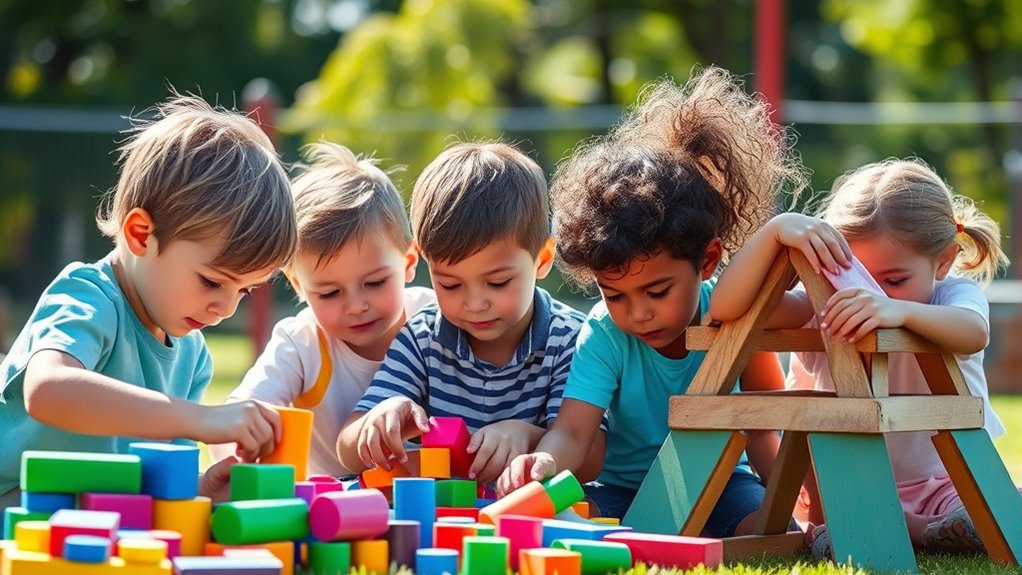

Children progress through play stages, starting with solitary play where they focus on individual activities and build independence. Then, they move to parallel play, playing alongside others without direct interaction, which helps recognize social cues. As they develop, they engage in more social exchanges, leading to cooperative play where they work and play together. Understanding this progression shows how your child’s social skills naturally grow; keep exploring to learn more about supporting their journey.

Turn the school run and nap time into listening time
- Thousands of audiobooks, podcasts and originals
- Listen on your phone, tablet or Echo — also offline
- Cancel anytime
Key Takeaways
- Play begins with solitary activities, promoting independence and foundational skill development.
- Children gradually recognize others’ presence, leading to initial social awareness.
- Parallel play involves children playing side-by-side without direct interaction, fostering social understanding.
- Unstructured play during parallel play offers low-pressure social experiences, enhancing social cues recognition.
- Caregivers and diverse play materials support natural progression from parallel to cooperative play.

As children become more comfortable, they start to engage in parallel play, where they play alongside others but not directly with them. This stage is important because it introduces the concept of social interaction without the pressure of cooperation. During this period, you might see children sharing toys or mimicking each other’s actions, gradually building awareness of others’ presence. Allowing unstructured play during this phase continues to be beneficial, as it provides opportunities for children to observe, imitate, and experiment with different social cues in a low-pressure environment. Your role remains supportive—offering a safe space and being available for guidance when needed, but not interfering excessively. Incorporating diverse play materials can enrich their experiences and promote inclusive social interactions.
As an affiliate, we earn on qualifying purchases.
Frequently Asked Questions
How Does Play Influence a Child’s Emotional Development?
Play helps you build a child’s emotional resilience by allowing them to explore feelings and cope with challenges in a safe setting. It also strengthens attachment security as they bond with caregivers and peers through shared activities. As your child engages in different types of play, they learn to manage emotions, express themselves, and develop confidence, all of which are essential for healthy emotional development.
What Are Signs a Child Is Ready for More Complex Play?
When a child is ready for more complex play, they start to “take the bull by the horns.” You’ll notice they keenly share toys and understand taking turns, showing they’re developing social skills. They may also begin to engage in pretend play, work together on tasks, and show interest in playing with others rather than alone. These signs indicate they’re ready to move into more cooperative, imaginative play.
How Can Parents Encourage Cooperative Play Effectively?
You can encourage cooperative play by modeling sharing strategies and encouraging interaction. Offer toys and activities that promote teamwork, like building blocks or group games, and praise your child when they share or cooperate. Sit nearby to guide and facilitate positive exchanges, helping them understand turn-taking and communication. Your active involvement and positive reinforcement will boost their confidence and help them develop essential social skills for cooperative play.
Are There Cultural Differences in Play Stages?
Yes, there are cultural differences in play stages. Cultural norms and play customs influence how children engage with peers and develop social skills. For example, some cultures emphasize group activities and cooperative play early on, while others focus on individual exploration. As a parent, understanding these differences helps you support your child’s social growth in a way that respects and incorporates their cultural background, fostering healthy development and meaningful interactions.
How Does Digital Play Impact Developmental Stages?
Digital play considerably influences developmental stages, with studies showing children spend up to 7 hours daily on screens. It enhances digital literacy but may limit real-world social skills. Virtual interactions can foster creativity and problem-solving, yet they might also reduce opportunities for physical, social play. You need to balance screen time, encouraging outdoor and cooperative play to support well-rounded development across all stages.
Conclusion
Just like a seed grows into a mighty tree, your child’s play journey blossoms from solitary exploration to cooperative fun. Each stage builds a strong foundation for social skills and imagination, shaping their world one step at a time. Embrace these moments as precious nutrients that nurture their development. Remember, with patience and encouragement, you’re helping them grow into confident, collaborative individuals—ready to thrive in the vast forest of life.
Halloween Picks
halloween
As an affiliate, we earn on qualifying purchases.