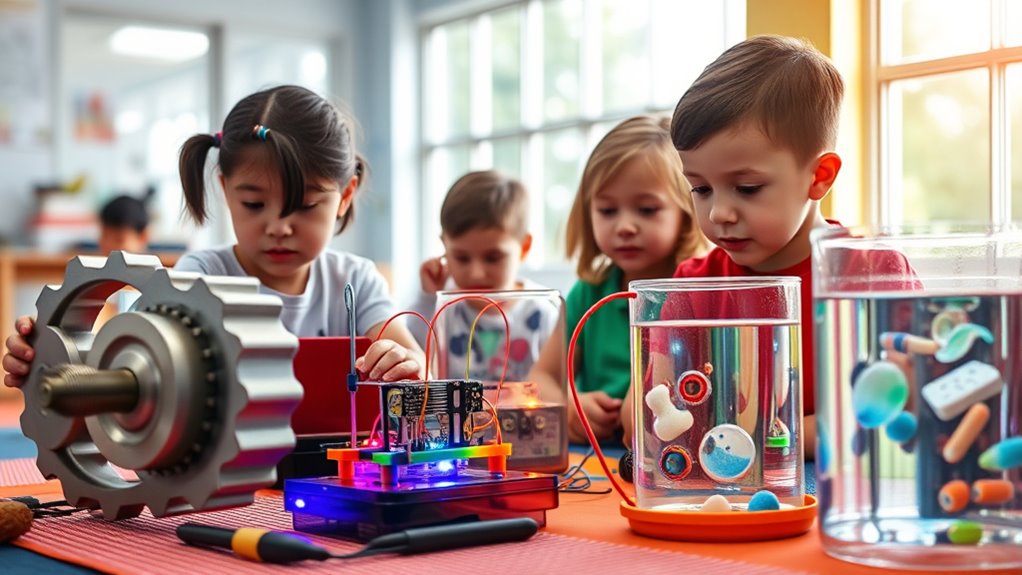

Implementing STEM play station rotations sparks curiosity by offering kids diverse, hands-on activities across science, technology, engineering, and math. As they move between stations, they actively experiment, explore concepts, and solve challenges, which keeps their interest high. This dynamic setup encourages exploration and builds confidence while fostering critical thinking. By rotating through different challenges, children develop a deeper understanding of STEM fields. To see how structuring these rotations boosts curiosity, keep exploring the exciting options available.
Key Takeaways
- Rotations expose children to diverse STEM activities, sparking curiosity through varied hands-on experiences.
- Moving between stations encourages exploration and helps children discover their interests within science, technology, engineering, and math.
- Rotational setups promote active engagement, motivating kids to solve different challenges and ask questions.
- Bouncing between stations fosters adaptability and critical thinking by approaching new tasks from different angles.
- Diverse and dynamic rotations sustain interest, nurturing a lifelong curiosity and passion for STEM disciplines.

STEM Play Stations are innovative learning environments designed to engage children in science, technology, engineering, and math through hands-on activities. These stations serve as dynamic spaces where kids can explore concepts actively, rather than passively absorbing information. When you set up a STEM Play Station, you’re creating a platform that offers diverse learning pathways, allowing children to pursue their interests and discover new skills at their own pace. The variety of activities encourages kids to experiment, problem-solve, and think critically, which are essential components of STEM learning. Each station is crafted to provide interactive challenges that stimulate curiosity and promote deeper understanding. Instead of simply observing, children are invited to manipulate objects, test hypotheses, and see the immediate results of their actions, making learning both engaging and meaningful.
With a focus on interactive challenges, these stations motivate kids to push their boundaries and develop resilience through trial and error. For example, a challenge might involve building a tower using only certain materials or designing a simple circuit to light a bulb. These activities demand hands-on participation, which helps solidify abstract concepts into tangible experiences. As children navigate these challenges, they learn to collaborate, communicate their ideas, and refine their strategies—all vital skills that grow naturally within this stimulating environment. The use of multiple learning pathways ensures that each child can engage with content in ways that suit their learning style, whether they prefer visual, tactile, or analytical approaches. This personalization of learning helps maintain interest and builds confidence as students see their progress through various activities.
Furthermore, the rotation of different STEM stations keeps the experience fresh and exciting, encouraging kids to explore multiple disciplines within a single session. When children move from one interactive challenge to another, they develop a broader understanding of STEM fields while also honing their problem-solving skills. You’ll notice that this setup promotes a sense of independence, as kids choose which stations to visit and how to approach each challenge. The varied activities also foster curiosity, prompting children to ask questions and seek out solutions actively. Incorporating remote hackathons as part of STEM education can expand access to collaborative challenges from anywhere, inspiring children to connect with peers globally. By integrating learning pathways with hands-on, interactive challenges, STEM Play Stations turn education into an adventure, inspiring young learners to explore the endless possibilities within science, technology, engineering, and math.
Frequently Asked Questions
How Can Parents Effectively Facilitate STEM Station Rotations at Home?
You can effectively facilitate STEM station rotations at home by using engagement strategies like hands-on activities and encouraging exploration. Keep resources organized in bins or designated areas to guarantee smooth transitions between stations. Set clear time limits and provide prompts to maintain focus and curiosity. By creating a structured yet flexible environment, you help your child stay motivated, engaged, and enthusiastic to learn through each rotation.
What Age Groups Benefit Most From STEM Play Stations?
Think of STEM play stations as a garden, thriving with different plants for each age. Young children, ages 3-5, bloom with curiosity, developing fine motor skills and basic problem-solving. In grades 1-3, kids grow stronger in critical thinking and early engineering. By ages 4-8, they reach key developmental milestones like creativity and collaboration. Tailoring activities guarantees each age group’s specific benefits, nurturing growth at just the right time.
Are There Specific Safety Guidelines for Setting up STEM Stations?
Yes, there are specific safety guidelines you should follow when setting up STEM play stations. Always make certain you have the right safety equipment, like goggles and gloves, to protect children. Keep stations supervised at all times to prevent accidents and ensure proper use of materials. Regularly inspect the setup for hazards, and set clear rules for safe behavior. These steps help create a secure environment that fosters curiosity and learning.
How Do STEM Stations Support Different Learning Styles?
You can support different learning styles by designing STEM stations that incorporate various activities targeting sensory engagement and learning preferences. Visual learners benefit from diagrams and colorful materials, while kinesthetic learners thrive with hands-on experiments. Auditory learners engage through discussions or sound-based tasks. By rotating activities that address these preferences, you foster curiosity, encourage active participation, and guarantee every student finds a way to connect with STEM concepts effectively.
What Are Low-Cost or DIY Options for Creating STEM Stations?
You can create DIY experiments and budget-friendly setups for STEM stations using everyday household items. Use recycled materials like cardboard, plastic bottles, and rubber bands to build simple machines or science experiments. Incorporate inexpensive tools like magnifying glasses, pipettes, or timers. You don’t need fancy equipment—focus on hands-on activities that spark curiosity. These cost-effective options make STEM accessible, fun, and engaging for all learners without breaking the bank.
Conclusion
As you guide children through these STEM play stations, you’re planting seeds of curiosity that will blossom into a love for learning. Each rotation is like turning a page in their adventure book, filled with discovery and excitement. By making these moments fun and engaging, you’re not just teaching; you’re igniting sparks that can light up their future. Keep exploring, and watch their curiosity grow into a bright, endless universe.