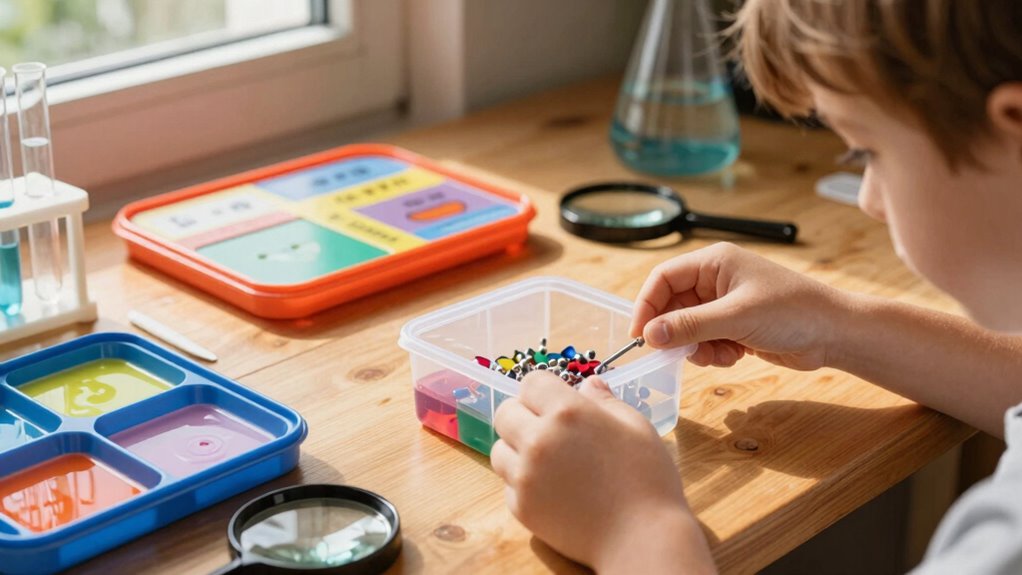

Science kits turn your everyday questions into fun experiments you can do at home. They give you all the needed materials and guide you through exploring concepts like why things happen or what if you change something. This hands-on approach helps you question, test, and understand science in real-life situations. As you experiment, you’ll see how theory connects with practice, fueling curiosity and learning. Keep exploring, and you’ll discover even more ways to make science part of your daily life.

Turn the school run and nap time into listening time
- Thousands of audiobooks, podcasts and originals
- Listen on your phone, tablet or Echo — also offline
- Cancel anytime
Key Takeaways
- Science kits turn everyday curiosities into hands-on experiments that deepen understanding of common phenomena.
- They encourage asking “what if” questions and exploring solutions through practical investigation.
- Kits connect real-world experiences with scientific principles, making abstract concepts tangible.
- They foster critical thinking by prompting hypothesis testing and problem-solving at home.
- Experiments reinforce learning and curiosity, inspiring ongoing exploration beyond routine questions.
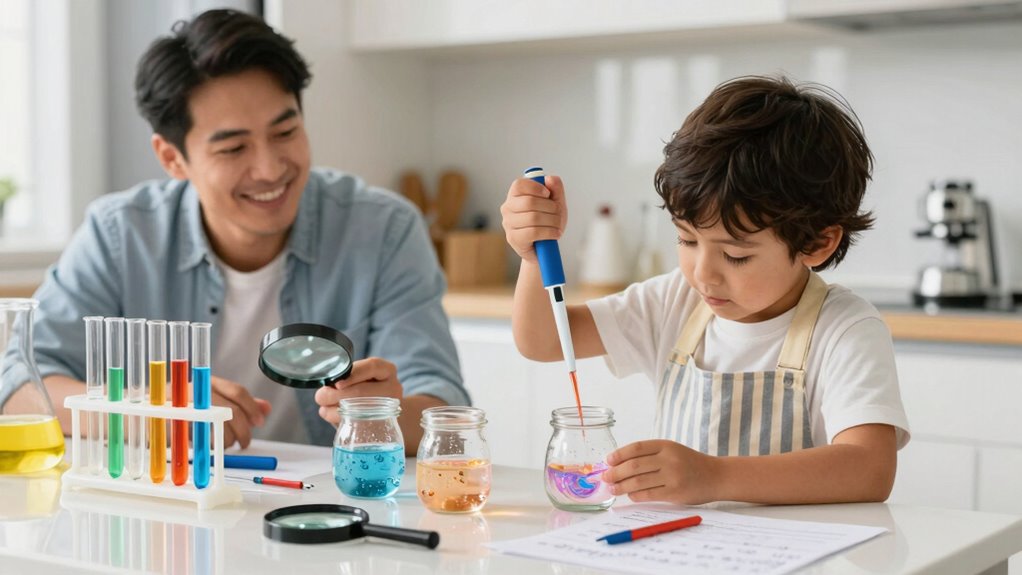
Have you ever wondered how to bring the excitement of a science lab right into your own home? With science kits for home, you can transform everyday questions into engaging DIY experiments that make learning both fun and meaningful. These kits are designed to spark curiosity and encourage hands-on exploration, making complex concepts easier to grasp. When you immerse yourself in these experiments, you’re not just following instructions—you’re actively investigating, hypothesizing, and discovering. This active engagement helps you see science as a dynamic process rather than just a series of facts, which is key to fostering a lifelong love of learning.
Science kits make it simple to turn common household items into tools for discovery. Whether you’re exploring chemical reactions with baking soda and vinegar or examining biological samples under a microscope, these kits provide all the necessary materials and guidance. As you perform DIY experiments, you’re encouraged to ask your own questions: Why does this happen? What if I change this variable? This approach develops critical thinking skills and deepens your understanding of scientific principles. Plus, it’s incredibly satisfying to arrive at an answer through your own investigation, reinforcing the practical application of what you’re learning.
Turn household items into discovery tools with science kits—ask questions, experiment, and deepen your understanding of science.
One of the greatest educational benefits of using science kits at home is that they bridge the gap between theory and practice. Instead of passively absorbing information from a textbook, you actively participate in the discovery process. This hands-on experience makes abstract concepts concrete, which is especially helpful for visual and kinesthetic learners. Additionally, these kits often include prompts and challenges that push you to think creatively and solve problems on your own. This kind of experiential learning not only improves comprehension but also builds confidence in your ability to understand and manipulate scientific phenomena. Understanding scientific principles in a practical context can inspire further exploration and curiosity. Incorporating experiments into your routine allows you to see firsthand how scientific theories are applied, making the learning process more engaging and memorable. Recognizing the importance of scientific inquiry helps deepen your appreciation for the ongoing nature of discovery. Developing an understanding of scientific concepts through hands-on activities can also make abstract ideas more tangible and approachable for learners of all ages.
home science experiment kits for kids
As an affiliate, we earn on qualifying purchases.
As an affiliate, we earn on qualifying purchases.
Frequently Asked Questions
Are Science Kits Suitable for All Age Groups?
Science kits are suitable for all age groups, fostering educational engagement and encouraging parental involvement. Younger children benefit from simple experiments that spark curiosity, while older kids and teens can tackle more complex projects, deepening their understanding. As you guide them, you help develop critical thinking skills and a love for learning. These kits adapt to different skill levels, making science accessible and fun for everyone in your family.
How Safe Are Science Kits for Young Children?
Science kits can be safe for young children when you prioritize chemical safety and provide close parental supervision. Think of it like walking a tightrope—your guidance keeps them balanced and secure. Always read labels carefully, use age-appropriate kits, and supervise experiments to prevent accidents. With your vigilant eye, kids can explore safely, turning curiosity into discovery without risking harm.
Can Science Kits Be Reused Multiple Times?
Yes, science kits can be reused multiple times, especially if they include reusable components like test tubes, beakers, or magnifiers. You should also invest in proper storage solutions to keep everything organized and in good condition. By maintaining and storing the kit carefully, you guarantee that you can enjoy ongoing experiments and explorations, making the most of your investment and fostering continuous curiosity and learning.
Do Science Kits Require Additional Materials or Tools?
Think of a science kit as a recipe—you might need additional ingredients or extra equipment to complete experiments. Usually, basic kits come with everything you need, but some projects require additional ingredients like food coloring or extra tools like tweezers. It’s a good idea to check the instructions beforehand, so you’re prepared. Sometimes, small household items can serve as extra equipment, enhancing your exploration without extra cost.
How Do Science Kits Promote Critical Thinking Skills?
Science kits promote your critical thinking skills by engaging you in experimental methods and hypothesis development. As you investigate, you learn to ask questions, predict outcomes, and analyze results. This hands-on approach encourages you to evaluate evidence critically, refine your ideas, and draw conclusions. By actively participating in experiments, you develop problem-solving abilities and a deeper understanding of scientific concepts, making learning both fun and intellectually stimulating.
Conclusion
Just like explorers venturing into uncharted territories, science kits turn your home into a world of discovery. They transform simple questions into exciting experiments, fueling your curiosity and nurturing a love for learning. As Newton once pondered gravity, you’ll find yourself captivated by the wonders around you. So, grab a kit, ask your questions, and watch everyday moments become extraordinary adventures—because the universe’s secrets are waiting to be uncovered right at your fingertips.
Cold & flu season Picks
humidifiers
As an affiliate, we earn on qualifying purchases.