
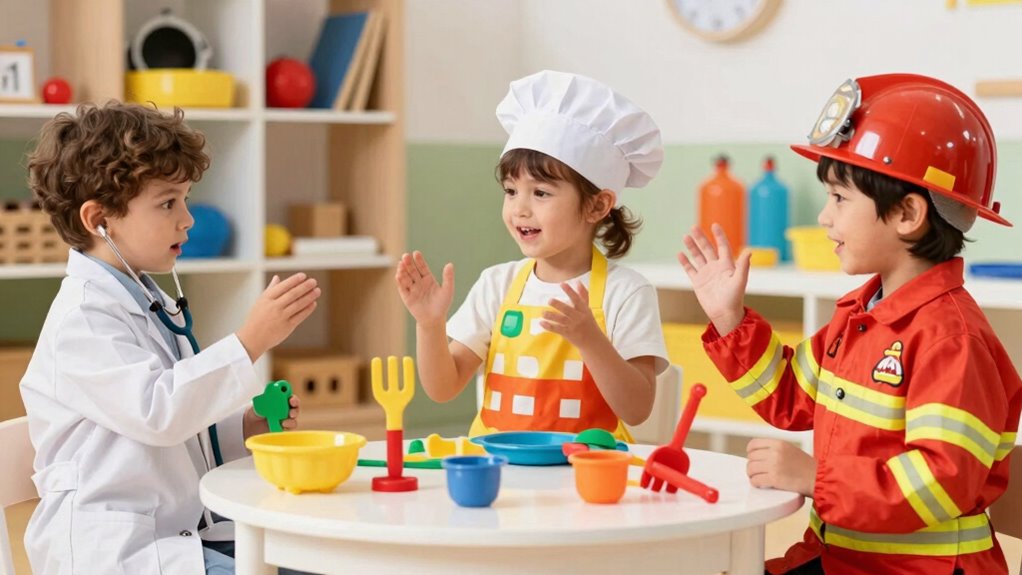

Pretend play helps you support your child’s language growth by giving them opportunities to practice vocabulary in real-life scenarios. As they assume roles and create dialogues, they improve communication and social skills, gaining confidence to express thoughts. It also enhances comprehension as they follow storylines and interpret language in context. Engaging in imaginative play makes learning fun and motivates your child to explore new words. Keep exploring, and you’ll discover more ways to boost their language development.

Turn the school run and nap time into listening time
- Thousands of audiobooks, podcasts and originals
- Listen on your phone, tablet or Echo — also offline
- Cancel anytime
Key Takeaways
- Encourages immersive practice of vocabulary in real-life scenarios through role play and storytelling.
- Builds social communication skills by practicing turn-taking, listening, and expressing ideas.
- Enhances comprehension by connecting language to personal experiences and interpreting story contexts.
- Increases motivation and engagement, making language learning enjoyable and fostering curiosity.
- Supports overall cognitive development by helping children understand social cues and complex sentences.

Have you ever wondered how pretend play influences your child’s language skills? When your little one engages in imaginative storytelling, they’re doing more than just having fun—they’re actively developing their language abilities. During pretend play, your child creates scenarios, assumes roles, and invents dialogues, which encourages them to practice vocabulary in meaningful contexts. This type of play offers an immersive environment where words come alive, helping your child understand how language functions in real-life situations. As they narrate stories or act out roles, they learn how to structure sentences, use descriptive words, and express ideas clearly. This process naturally promotes vocabulary expansion, as they seek out new words to fit their imaginative scenarios, deepening their language repertoire.
In these creative exchanges, your child learns to communicate more effectively. They experiment with different ways to express thoughts and feelings, gaining confidence in their ability to articulate themselves. As they pretend to be a doctor, chef, or superhero, they incorporate specific vocabulary related to those roles, broadening their word bank. This active use of language reinforces their understanding and recall of new terms. Plus, because pretend play involves social interaction—whether with peers, siblings, or even you—they develop essential conversational skills like turn-taking, listening, and asking questions. These social interactions also provide natural opportunities for children to practice pragmatic language skills, which are essential for meaningful communication. Engaging in imaginative storytelling also cultivates their ability to interpret and respond to social cues, further enhancing their overall communication skills.
Engaging in imaginative storytelling during pretend play also boosts your child’s comprehension skills. As they listen to others’ narratives or follow the flow of a story they’ve created, they learn to interpret language more effectively. This enhances their ability to understand complex sentences and infer meaning from context. Additionally, storytelling activities serve as a bridge for children to connect language with their own experiences, making learning more relevant and memorable. The storytelling element makes language more engaging and memorable, increasing the likelihood that your child will remember new words and concepts. Over time, this repeated exposure helps cement their understanding and encourages a richer, more expressive vocabulary.
Furthermore, pretend play makes language learning enjoyable, which motivates your child to explore words and ideas more enthusiastically. When they’re immersed in a world of their own creation, learning feels less like a chore and more like an adventure. This positive attitude toward language encourages ongoing curiosity and a desire to communicate more clearly. Overall, your child’s active participation in imaginative storytelling through pretend play plays a significant role in expanding their vocabulary, improving their conversational skills, and nurturing their love for language.
Products Worth Considering

Coway Airmega 250 Air Purifier for Large Rooms

Theragun Mini 3rd Generation Massage Gun – Travel Essential (Black)

Bowflex SelectTech 840 Adjustable Kettlebell
As an affiliate, we earn on qualifying purchases.
Frequently Asked Questions
At What Age Should Children Start Engaging in Pretend Play?
You can encourage your child to start engaging in pretend play as early as ages 2 to 3. During this time, their imaginative skills begin to flourish, and they love exploring different roles and scenarios. Pretend play boosts social interactions, helping them practice language skills like negotiating, describing, and storytelling. By engaging in these activities early, you support their creative growth and help develop essential communication abilities.
How Does Pretend Play Differ Across Various Cultures?
Ever wondered how pretend play varies across cultures? You’ll find that in some societies, cultural storytelling shapes play, emphasizing family roles or traditional tales, while others focus on playground traditions that highlight social norms. These differences influence how children imitate adults or create scenarios, enriching their language skills and cultural understanding. By exploring these variations, you gain insight into how diverse environments foster unique pretend play experiences, nurturing both language and cultural identity.
Can Pretend Play Benefit Children With Speech Delays?
Yes, pretend play can benefit children with speech delays by promoting speech improvement and enhancing social skills. When you encourage your child to engage in imaginative scenarios, they practice new words, sentence structures, and conversational skills. This interactive play boosts their confidence and helps them imitate social interactions, making it easier to develop language. Over time, this can lead to clearer speech and better social communication overall.
What Are Some Easy Pretend Play Ideas for Toddlers?
Imagine transforming your living room into a bustling bakery or a superhero city—easy pretend play ideas! You can set up imaginative scenarios with simple props like toy phones, costumes, or dishes. Role playing games like grocery shopping or doctor visits are perfect for toddlers. These activities boost language skills by encouraging kids to use new words, practice conversations, and explore their imagination in fun, engaging ways.
How Can Parents Encourage More Complex Pretend Scenarios?
To encourage more complex pretend scenarios, you can introduce imaginative storytelling and role-playing techniques. Encourage your child to create stories with multiple characters and settings, prompting them to think creatively. Use costumes, props, and prompts to inspire role playing, and join in to model language use. Ask open-ended questions to deepen their engagement, helping them develop vocabulary and narrative skills through richer, more detailed pretend play.
Conclusion
By engaging in pretend play, you’re opening a superpower that can turn your child’s language skills into a roaring, unstoppable force. As they imagine, speak, and create stories, they build vocabulary and sentence skills faster than you can say “supercalifragilisticexpialidocious.” Keep encouraging these imaginative adventures, because someday, their words will soar higher than the tallest skyscraper. Remember, you’re not just playing—you’re shaping a future language genius who’ll conquer the world with their words!