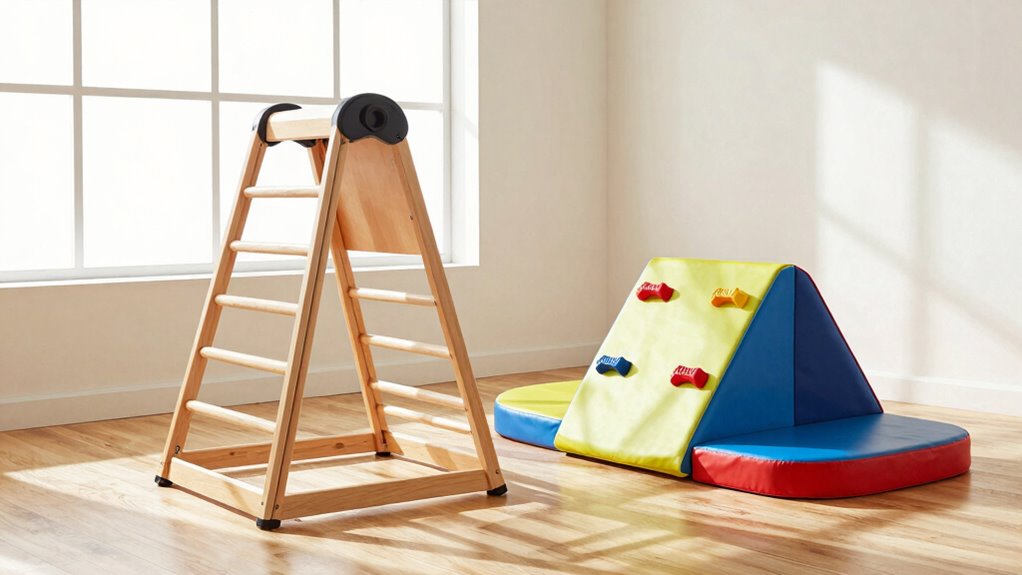

To choose between a Pikler triangle and an indoor climber, consider your child’s age, activity level, and your space. If your little one is just starting to explore climbing, a Pikler triangle offers safe, manageable steps and is compact for small spaces. For more active kids needing more challenge and multifunctionality, an indoor climber provides diverse features and vigorous play. Keep in mind safety and quality—this helps your child enjoy active, long-term play. If you want more tips, you’re in the right place.

Turn the school run and nap time into listening time
- Thousands of audiobooks, podcasts and originals
- Listen on your phone, tablet or Echo — also offline
- Cancel anytime
Key Takeaways
- Consider your child’s age and skill level; Pikler triangles suit beginners, while indoor climbers benefit more active, experienced children.
- Assess available space; Pikler triangles are compact and ideal for limited areas, whereas indoor climbers need more room.
- Determine your child’s activity preferences; choose Pikler for climbing basics or indoor climbers for diverse, vigorous play.
- Prioritize safety features and build quality to ensure long-term, secure use of either climbing structure.
- Think about versatility; Pikler is simple and portable, while indoor climbers offer multiple activities and functions.

Are you trying to decide between a Pikler triangle and an indoor climber for your child’s play space? Both options promote active play and development, but your choice will depend on your priorities for motor skill development and how you want to utilize your space. The Pikler triangle is designed to encourage climbing, coordination, and balance in a gentle, controlled way. It’s often compact, making it ideal for space optimization. Its simple, open structure allows your child to practice climbing at their own pace, helping improve their gross motor skills. Because it’s lightweight and easy to store, you can tuck it away when not in use, freeing up room for other activities. This makes it especially suitable if your space is limited or if you want a versatile piece that can be easily moved around.
Pikler triangles are compact, space-saving tools that promote safe, gradual climbing and motor skill development.
On the other hand, an indoor climber typically offers a broader range of activities, with features like slides, swings, and various climbing holds. It’s designed to engage children in more dynamic movements, which can further enhance motor skill development, particularly strength, balance, and spatial awareness. If your goal is to provide an all-encompassing play area that encourages vigorous activity and diverse movement patterns, an indoor climber might be the better choice. However, these units tend to be larger and require more space, so you should consider how much room you have available. While they may take up more space, they often serve as central play hubs that can grow with your child, offering multiple functionalities as they develop.
When deciding, think about your child’s current abilities and your long-term goals. If your child is just starting to explore climbing and you want a simple, safe, space-efficient option, the Pikler triangle is a smart pick. It helps build confidence and motor skills gradually without overwhelming your play area. If your child is more active and you want to challenge their coordination and strength with more complex climbing structures, an indoor climber provides a richer, more engaging experience. Keep in mind that safety is key; choose a sturdy, well-made option with appropriate safety features, regardless of which you pick.
Ultimately, your decision hinges on balancing motor skill development needs with space optimization. Both options support active play, but your home’s layout and your child’s interests will guide you in selecting the perfect fit. For example, understanding the benefits of climbing structures and their role in development can help you make an informed choice.
As an affiliate, we earn on qualifying purchases.
Frequently Asked Questions
Are Pikler Triangles Suitable for Outdoor Use?
Pikler triangles are generally not suitable for outdoor use because they lack outdoor durability and weather resistance. Exposure to rain, sun, and fluctuating temperatures can cause wood to warp or deteriorate and compromise safety. If you want an outdoor climbing option, look for equipment specifically designed for outdoor durability, made from weather-resistant materials like treated wood, metal, or plastic, ensuring safety and longevity in your outdoor space.
How Much Space Is Needed for Each Climbing Option?
Imagine your play area as a garden—space is your plot. A Pikler triangle needs a clear area for climbing height, typically about 3 feet wide and 4 feet tall, with minimal storage requirements. An indoor climber, like a sprawling vine, demands more room—usually 4-6 feet wide for safety and ample space for movement, along with storage for its components. Plan your space accordingly to make certain of safe, enjoyable play.
Can These Climbers Be Used by Multiple Children Simultaneously?
Yes, both climbers can be used by multiple children simultaneously, making them great for group play. However, supervision is essential to guarantee safety, especially with active kids. For individual use, these climbers help develop motor skills at your child’s own pace. If you’re planning for shared use, consider the size and sturdiness of the climber to accommodate several children comfortably and safely.
What Safety Features Should I Look for in Both Options?
You need to watch for safety features that guarantee your child’s well-being. Look for material durability—sturdy wood or strong metal that withstands active play—and a high weight capacity, so it remains secure as your child grows. Check for rounded edges, non-slip grips, and secure joints. These details might seem small, but they’re essential for safe, confident climbing adventures. Don’t overlook them; your child’s safety depends on it.
Are There Age Restrictions for Starting to Use These Climbers?
You should consider age appropriateness when starting your child on a Pikler triangle or indoor climber. Generally, young toddlers around 6 months to 2 years benefit from a Pikler triangle, which supports developmental benefits like coordination and confidence. Indoor climbers, suitable for slightly older children, promote strength and motor skills. Always check manufacturer guidelines for specific age recommendations and supervise closely to guarantee safety during use.
Conclusion
Ultimately, choosing between a Pikler triangle and an indoor climber is like picking your adventure partner—each has its own unique rhythm and charm. Think of the Pikler as a gentle, guiding breeze encouraging exploration, while the indoor climber is an exciting mountain ready to be conquered. Trust your child’s spirit and your home’s space to lead the way. Whichever you choose, you’re opening a world of discovery—an uncharted universe waiting just beyond the horizon.
Halloween Picks
halloween
As an affiliate, we earn on qualifying purchases.