

To calculate the drop speed of paper helicopters for business purposes, you need to time their descent from a fixed height and divide that distance by the time recorded. Consistent environmental conditions and multiple trials enhance accuracy. Adjusting design features like blade size, shape, or weight impacts the fall rate, which you can measure and compare. Understanding these principles helps optimize performance, and if you keep exploring, you’ll uncover more insightful ways to refine your paper helicopter designs.

Turn the school run and nap time into listening time
- Thousands of audiobooks, podcasts and originals
- Listen on your phone, tablet or Echo — also offline
- Cancel anytime
Key Takeaways
- Use consistent drop heights and timing to accurately measure helicopter descent speeds in a business or educational setting.
- Apply physics formulas to convert measured fall times into precise drop speed calculations.
- Design paper helicopters with optimized shapes and materials to demonstrate aerodynamic principles in a commercial or instructional context.
- Collect multiple trials to ensure reliable data for analyzing the impact of design modifications on drop speed.
- Incorporate the activity into STEM-based business models, marketing, or educational workshops to showcase physics concepts practically.
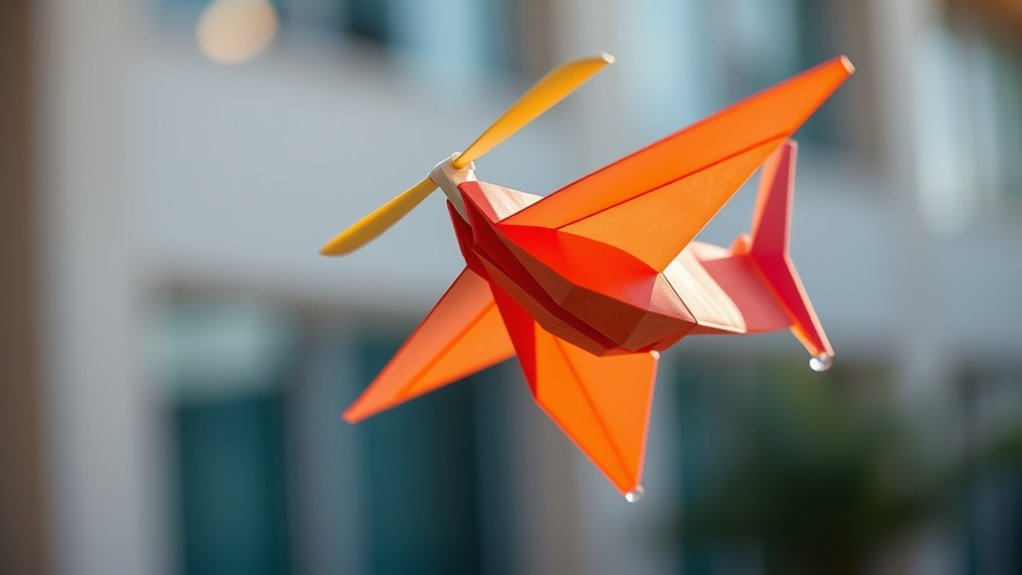
Creating paper helicopters is a simple and engaging activity that demonstrates basic principles of aerodynamics. When you design and drop these miniature flying devices, you’re exploring how objects move through the air, how air resistance affects descent, and how shape influences speed. To understand how fast your paper helicopter will fall, it’s essential to grasp the aerodynamic principles at play. These principles explain how air flows around the helicopter’s blades and body, creating lift, drag, and ultimately affecting its descent rate. The shape and size of the blades, along with the center of mass, dictate how smoothly and slowly your helicopter descends. For instance, wider blades increase surface area, which creates more drag and slows the fall, while narrower blades might lead to a faster descent.
Designing paper helicopters reveals how shape and size affect air resistance and descent speed.
Material durability plays a considerably role in how well your paper helicopter performs during repeated tests. You want a material sturdy enough to withstand multiple drops without tearing or bending out of shape, as deformed blades can alter the aerodynamic balance and, consequently, the drop speed. Standard construction paper often works well because it’s both lightweight and resilient, but thicker cardstock can provide even greater durability. Avoid flimsy tissue paper or very thin sheets, which tend to tear easily and won’t hold their shape after a few drops. When selecting your material, consider how the durability affects your ability to make consistent comparisons and measurements, since a warped or damaged helicopter won’t fly the same way twice.
Once you’ve chosen your materials and constructed your helicopter, you can start calculating its drop speed. This involves timing how long it takes to fall from a fixed height and then using basic physics formulas to determine the speed. Keep the environment consistent—use the same height, avoid windy conditions, and drop your helicopter from the same starting point each time. To improve accuracy, you can perform multiple trials and average the results. Additionally, understanding the impact of contrast ratio on the clarity and detail of your observations can help you better interpret how design modifications influence descent behavior. By understanding the aerodynamic principles involved, you can tweak your design—adjusting blade size, shape, or weight—to see how these changes influence the drop speed. It’s a practical way to connect theory with real-world application, helping you grasp how different factors, including material durability and design choices, impact the flight behavior of paper helicopters.
In the end, calculating the drop speed not only enhances your understanding of aerodynamics but also hones your experimental skills. It’s fascinating to see how small modifications can substantially alter descent time, illustrating the delicate balance between shape, material, and air resistance. With patience and careful observation, you’ll discover how to optimize your paper helicopter’s design for a slower, more controlled fall. This process makes physics tangible and fun, giving you insights into the forces that govern flight, all through a simple yet rewarding craft activity.
Frequently Asked Questions
How Does Air Density Affect Helicopter Drop Speed?
Air density impacts your helicopter’s drop speed because higher air pressure increases air density, which boosts wind resistance. When air is denser, your helicopter faces more force opposing its fall, slowing it down. Conversely, in lower air pressure, less wind resistance allows for a faster descent. So, as air density varies, expect changes in drop speed due to the differing levels of wind resistance acting on your helicopter.
Can Paper Helicopter Designs Be Optimized for Longer Fall Times?
Imagine your paper helicopter as a leaf gently descending in the breeze. To extend its fall time, you can harness aerodynamics principles through simple design modifications. By enlarging the blades, adding weight at the bottom, or adjusting angles, you improve air resistance and slow descent. These tweaks optimize the helicopter’s aerodynamics, allowing it to glide longer and demonstrating how thoughtful design enhances performance.
What Materials Besides Paper Can Improve Helicopter Stability?
You can improve helicopter stability by exploring materials beyond paper, like synthetic fibers and lightweight plastics. These materials are stronger and more flexible, which helps maintain balance during descent. Synthetic fibers, such as nylon or polyester, provide durability, while lightweight plastics like polypropylene or polystyrene reduce weight and increase control. Using these materials, you can design helicopters that glide more smoothly and stay stable throughout their fall.
How Does Humidity Influence the Descent of Paper Helicopters?
Did you know that high humidity can slow down paper helicopters? Humidity effects cause paper moisture to increase, making the material heavier and less aerodynamic. When you launch your paper helicopter in humid conditions, it tends to descend more slowly because the added moisture affects its stability and lift. So, in humid environments, expect a longer descent time, as the moisture weakens the paper’s ability to glide smoothly through the air.
Are There Safety Considerations When Testing High-Fall Paper Helicopters?
When testing high-fall paper helicopters, safety precautions are essential to prevent injuries. You should select a clear, controlled experimental environment away from people or fragile objects. Make certain the area below is free of obstacles, and use safety gear like glasses if necessary. Always supervise the experiment, especially if children are involved, and handle the helicopter carefully to avoid accidents during multiple drops.
Conclusion
Now that you’ve explored how to calculate your paper helicopter’s drop speed, you’re like a pilot confidently steering the skies of physics. Remember, understanding these calculations makes your creations soar smoothly and land gently, like a leaf drifting on the breeze. Keep experimenting and tweaking your designs—each trial is a step closer to mastering the art of controlled descent. With a little practice, you’ll be dropping those helicopters with the precision of a seasoned aviator.
Fall Picks
fall essentials
As an affiliate, we earn on qualifying purchases.