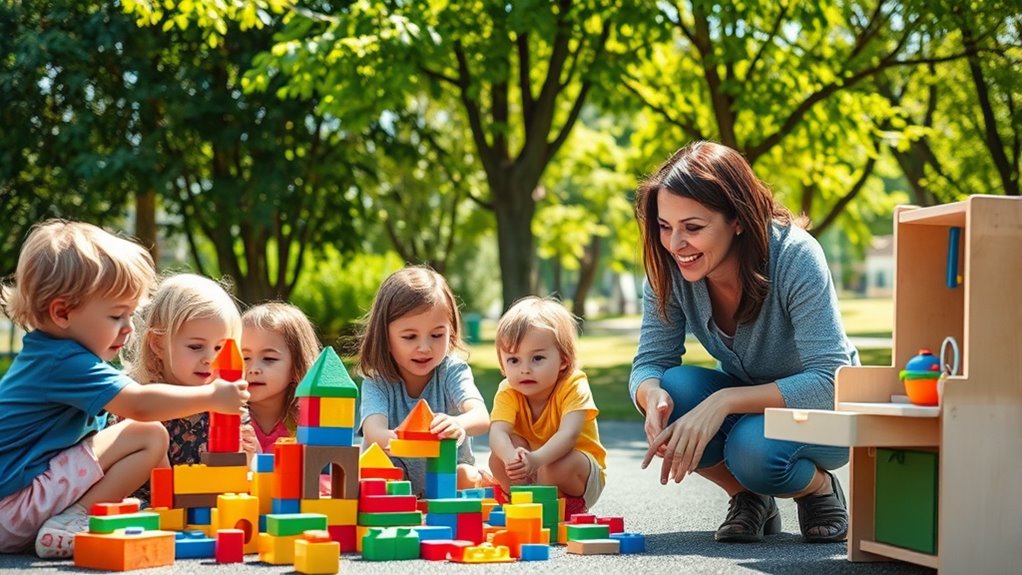

To observe play like a teacher, you focus intentionally on how children interact, explore, and handle challenges. Watch for signs of engagement such as curiosity, persistence, and collaboration. Notice different types of play—solitary, parallel, or social—and what they reveal about development. Pay attention to how children communicate, problem-solve, and manage emotions during play. By sharpening your observation skills, you’ll better understand each child’s growth and how to support their learning journey. Keep going to uncover more effective strategies.
Key Takeaways
- Focus on children’s behaviors, interactions, and engagement levels during play to assess development and learning.
- Observe how children initiate, collaborate, and solve problems to understand their cognitive and social growth.
- Note the types of play (solitary, parallel, social) to gauge developmental milestones and interests.
- Pay attention to emotional responses and self-regulation skills exhibited during play activities.
- Record specific observations to inform tailored activities that support individual developmental needs.
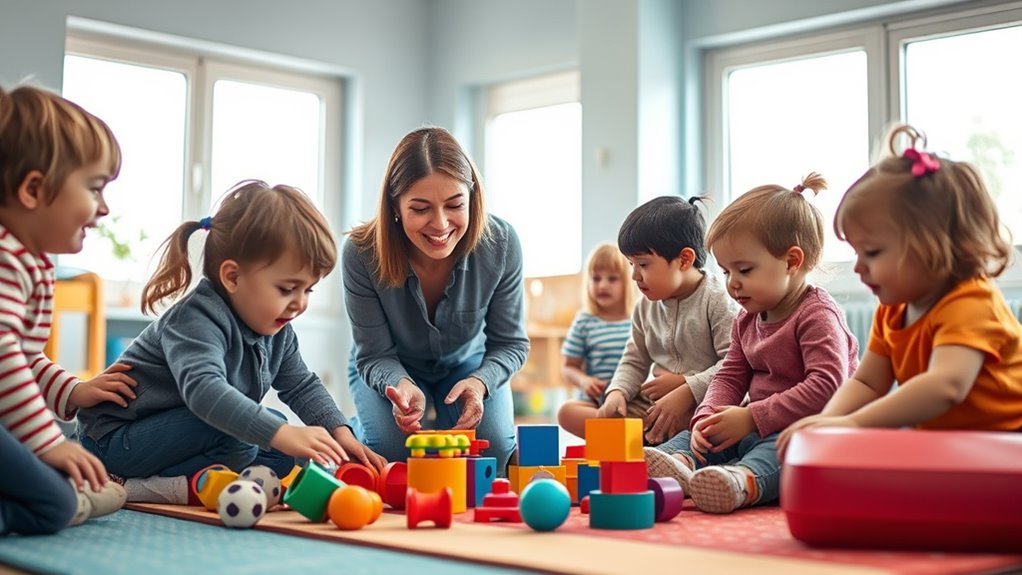
Have you ever wondered how teachers see play differently from parents or caregivers? When teachers observe play, they’re not just watching kids have fun; they’re paying close attention to how play contributes to a child’s overall development. Play development is a key aspect of early learning, and understanding it helps teachers gauge whether children are meeting developmental milestones. As a teacher, you look for signs that children are progressing through different stages of play, from simple exploratory behaviors to more complex, imaginative activities. This perspective allows you to see beyond the surface and recognize what a child’s play reveals about their cognitive, social, and emotional growth.
Student engagement is an essential factor in how teachers interpret play. You notice how involved each child is during their play, observing whether they’re fully immersed or distracted. Engaged children often show signs of curiosity, persistence, and enthusiasm, which tell you that they’re actively learning and making sense of their environment. You look for moments when children initiate play, collaborate with peers, or solve problems within their activities. These behaviors indicate high engagement and suggest that the child is developing important skills like communication, cooperation, and problem-solving. When observing, you’re also attentive to the different types of play—whether it’s solitary, parallel, or social—and how each type supports student engagement in unique ways.
By observing play through a teacher’s lens, you’re not only tracking individual progress but also understanding how children interact with their peers and their surroundings. You recognize that play is a fundamental context for learning, where children practice language, experiment with roles, and develop self-regulation. You notice how children handle challenges during play, which can reveal their level of resilience and adaptability. As you observe, you consider how different activities promote or hinder student engagement. For example, a well-structured, inviting environment encourages children to stay focused and explore more deeply. You also pay attention to whether children are comfortable leading or following during play, as both roles are important for development.
In essence, observing play like a teacher involves more than just watching kids have fun. It requires a careful, intentional eye on how play fosters development and keeps children engaged. Your observations help you tailor activities that support each child’s growth, ensuring that play remains a meaningful and educational experience. Additionally, incorporating elements like appropriate learning materials can enhance engagement and promote developmental milestones. By honing this skill, you become more attuned to each child’s needs, strengths, and areas for growth, making play a powerful tool for learning and development.
Frequently Asked Questions
How Can I Observe Play Without Disrupting Children’s Natural Behavior?
You can observe play without disrupting children’s natural behavior by blending into the environment and maintaining a low profile. Sit quietly nearby, allowing children to engage in playful activities and social interactions naturally. Use subtle cues like eye contact or gentle gestures to show your presence. Focus on their playful engagement and social interactions, avoiding interference. This way, you gain authentic insights while respecting their independence and spontaneity.
What Specific Play Behaviors Should I Focus on During Observation?
You should focus on different Types of play, like solitary, parallel, and cooperative, to understand children’s social and cognitive skills. Observe how they progress through Play development stages, from simple sensorimotor activities to complex pretend play. Notice their engagement, creativity, and problem-solving, which reveal their growth. By tracking these behaviors, you gain insights into their development, helping you support and nurture their play experiences effectively.
How Do I Document Observations Effectively for Later Analysis?
Perfectly pinpoint your play patterns with precise documentation. Use observation techniques like checklists, narrative notes, or tally sheets to capture behaviors clearly. Keep data recording consistent by date, activity, and context. Focus on specific actions, interactions, and emotional cues. Regularly review your notes to identify trends and themes. This systematic approach guarantees your observations are organized, objective, and ready for insightful analysis later.
What Are Common Challenges Faced When Observing Children at Play?
When observing children at play, you often face challenges like observer bias, which can skew your understanding of their actions, and time constraints that limit your ability to record everything thoroughly. Staying aware of personal biases helps you remain objective, while managing your time effectively allows for more focused observations. Using structured checklists or focus areas can help you maximize limited time and ensure more accurate, meaningful recordings.
How Can I Use Observation Data to Enhance Play-Based Learning?
Think of observation data as a treasure map guiding your play-based learning. By applying observation techniques, you uncover children’s interests and strategies, aligning them with play theories to deepen engagement. Use this insight to tailor activities, fostering curiosity and growth. Recognize patterns and adapt your approach, turning raw observations into a dynamic tool that transforms play into a powerful learning journey, enriching your teaching and children’s development.
Conclusion
By honing your habits and heightening your noticing skills, you’ll better understand children’s play patterns. Pay close attention, pause purposefully, and ponder their progress. Practice patience and provide positive praise to promote playful growth. With consistent curiosity and careful comprehension, you’ll confidently capture the core of their creative, collaborative, and curious activities. Remember, observing with an open mind and an attentive eye transforms play into a powerful, purposeful, and playful learning experience.