Math materials like number rods, golden beads, and geometric models help you make abstract ideas more concrete and engaging. These tools let you manipulate quantities, explore patterns, and understand shapes physically, which boosts your confidence and problem-solving skills. They turn complex concepts into visual and tactile experiences, making math more accessible and fun. If you keep exploring, you’ll discover how these materials can transform your learning approach and deepen your understanding of math fundamentals.

Get baby and family essentials delivered free — and shop member deals
- Fast, free delivery on millions of items
- Access to Prime Big Deal Days deals on October 6–7
- Prime Video, Amazon Music and more included
Key Takeaways
- Number rods and golden beads are tactile tools that help visualize arithmetic operations and number relationships effectively.
- These materials transform abstract mathematical concepts into concrete, manipulable objects for better understanding.
- Using these tools fosters pattern recognition, sequencing skills, and comprehension of mathematical progressions.
- The golden beads are especially useful for exploring place value, large numbers, and decimal systems.
- Incorporating a variety of math materials enhances engagement, confidence, and deepens conceptual comprehension in learners.
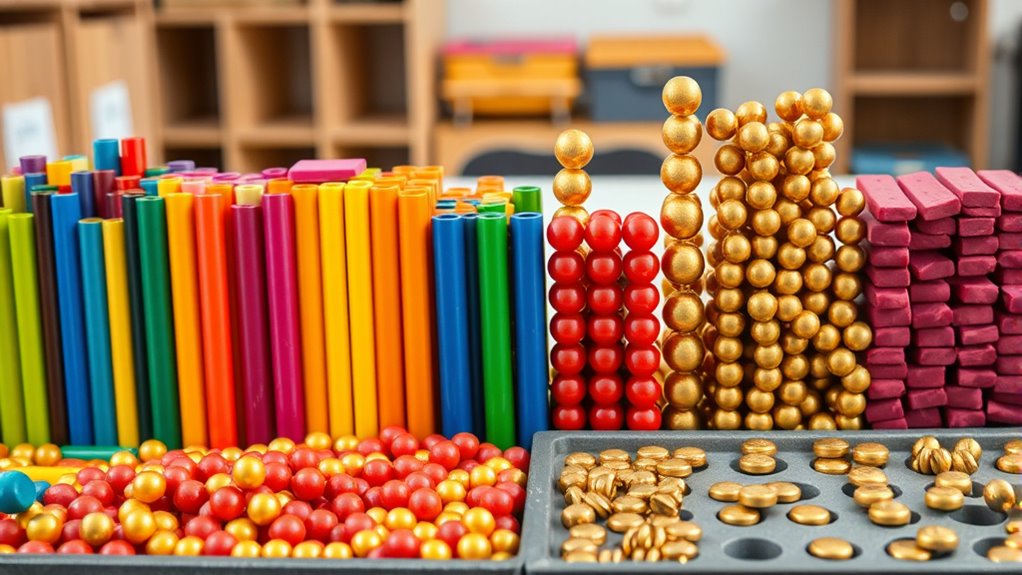
Have you ever wondered what tools can make learning math easier and more engaging? When it comes to understanding complex concepts, the right materials can transform abstract ideas into tangible experiences. For instance, number patterns become clearer when you use visual aids that reveal sequences and relationships naturally, rather than just memorizing rules. Geometry models are particularly effective because they let you build shapes and explore spatial relationships physically, making concepts like angles, symmetry, and congruence much more intuitive. These tools aren’t just helpful—they’re indispensable for deepening your understanding and keeping you motivated.
Number patterns often seem tricky at first, but with the right materials, they become fascinating puzzles. Using number rods or colored beads, you can physically manipulate the quantities to see how sequences develop. For example, arranging beads in increasing or decreasing order or creating repeating patterns helps you recognize the underlying structure without relying solely on rote memorization. These visual methods make it easier to identify arithmetic and geometric progressions, and they improve your ability to predict what comes next. Essentially, these materials turn abstract numerical sequences into hands-on experiments, giving you a clearer sense of how numbers relate to each other.
Using beads and rods makes understanding number sequences engaging and easier to grasp.
Geometry models are another essential part of effective math learning. These models, such as geometric solids or paper cutouts, allow you to explore shapes from multiple angles, literally. Instead of just visualizing three-dimensional objects in your mind, you can build and manipulate them, gaining insights into their properties. For example, using physical models of triangles, squares, or circles helps you understand concepts like area, perimeter, and symmetry more concretely. This tactile approach not only enhances comprehension but also makes learning more interactive and less intimidating. When you experiment with geometry models, you develop a spatial awareness that’s indispensable for higher-level math topics, like trigonometry and calculus.
Both number patterns and geometry models serve as bridges between theoretical ideas and real-world understanding. They enable you to see patterns in numbers and shapes, making abstract concepts more concrete. As you work with these tools, you gain confidence and develop problem-solving skills that extend beyond the classroom. Whether you’re discovering the beauty of a repeating pattern or constructing a model of a complex shape, these materials turn learning into an active, engaging process. Ultimately, they help you see math not just as a subject to memorize, but as a dynamic, visual language that you can explore and enjoy.
Frequently Asked Questions
How Do Math Materials Support Different Learning Styles?
Math materials support different learning styles by providing multisensory engagement, which helps you connect concepts through touch, sight, and sound. If you’re a kinesthetic learner, manipulating objects like number rods or golden beads allows you to explore math actively. These hands-on tools make abstract ideas concrete, catering to visual and tactile preferences, and helping you understand math more deeply and retain information longer.
What Safety Precautions Are Necessary for Young Children Using These Materials?
You should always supervise children closely when they use math materials to prevent accidents or misuse. Make sure that they handle items gently and understand proper handling procedures. Regularly sanitize the materials to maintain cleanliness and prevent the spread of germs. Keep the workspace organized and free of hazards, and remind children to wash their hands before and after use. These precautions help create a safe, healthy learning environment.
Can These Materials Be Adapted for Special Education Needs?
You can definitely adapt these materials for special education needs by incorporating sensory integration techniques and adaptive strategies. While some might worry about complexity, you’ll find that simple modifications, like textured beads or larger pieces, help children engage comfortably. Using sensory-friendly tools and tailored instructions, you make math accessible, inclusive, and enjoyable for all learners, fostering confidence and understanding through personalized approaches.
How Should Parents Introduce New Math Materials at Home?
When introducing math materials at home, you should start by demonstrating how to use each item gently and clearly. Follow with hands-on activities, encouraging your child to explore and ask questions. Use simple parent tips like praising effort and keeping sessions short and fun. Make it a positive experience, and gradually increase complexity as your child gains confidence, ensuring they stay engaged and motivated with the new materials.
What Is the Recommended Age Range for Each Type of Material?
You should consider age suitability and material complexity when choosing math materials. For young children, around ages 3-6, simple tools like number rods and sandpaper numbers work best to build foundational skills. As they grow, typically ages 6-9, introduce more complex materials like Golden Beads to develop understanding of place value and arithmetic. Always match the material’s complexity to your child’s developmental stage for effective learning.
Conclusion
By exploring math materials from number rods to golden beads, you deepen your understanding, enhance your skills, and build your confidence. These tools help you see patterns, grasp concepts, and foster curiosity. They encourage you to experiment, discover, and grow. Embrace these materials to challenge yourself, to inspire yourself, and to enjoy learning. With each step, you become more capable, more curious, and more passionate about math. Keep exploring, keep learning, and keep advancing.
Fall Picks
fall essentials
As an affiliate, we earn on qualifying purchases.