
Cause and effect play helps you see how your child’s actions lead to different outcomes, teaching them important skills like problem-solving, patience, and safety awareness. It encourages curiosity and exploration while building motor, cognitive, and social abilities. Your child learns to predict results, try new things, and understand boundaries. As they master these concepts, they grow more confident and independent. Keep exploring this fun learning approach to discover even more ways it benefits your child’s development.

Turn the school run and nap time into listening time
- Thousands of audiobooks, podcasts and originals
- Listen on your phone, tablet or Echo — also offline
- Cancel anytime
Key Takeaways
- Teaches children to understand relationships between actions and outcomes.
- Enhances problem-solving skills through trial and error exploration.
- Develops cognitive abilities like predicting and recognizing cause-and-effect connections.
- Promotes motor skills by manipulating objects to produce specific results.
- Encourages curiosity, experimentation, and safe exploration of their environment.
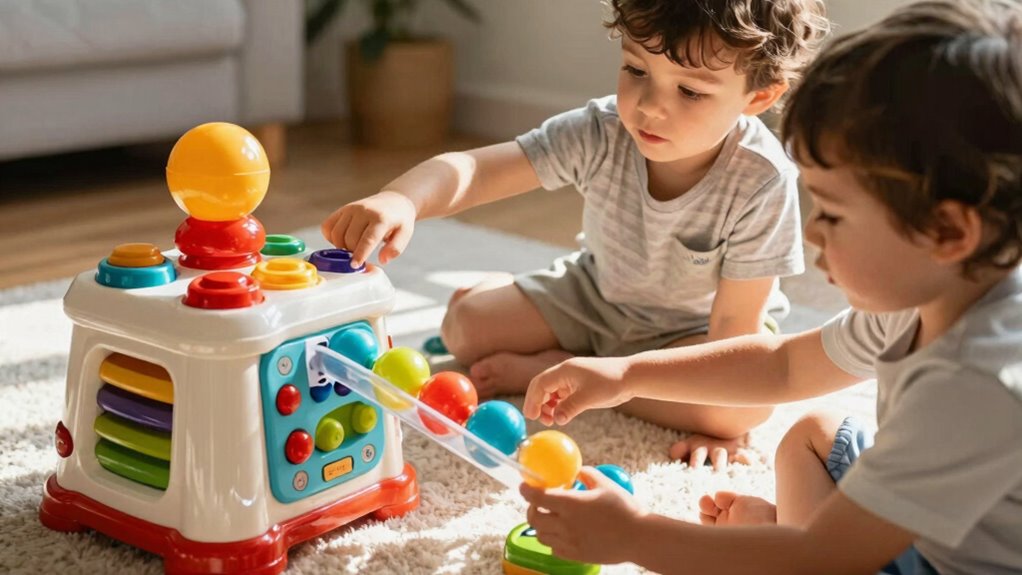
Have you ever wondered how children learn about the world around them? It’s through play, especially cause and effect play, that young children start to understand the relationships between their actions and the outcomes. When children press a button and a toy lights up or makes a sound, they’re not just entertained—they are actively exploring how their actions produce specific results. This type of play is fundamental in helping them grasp concepts like learning safety, knowing what is safe to touch or manipulate, and understanding boundaries. For example, a child might realize that pulling a toy’s cord causes a toy to move, teaching them about cause and effect, but also about the importance of being gentle and cautious with certain objects. These experiences are crucial in their journey to recognize what’s safe and what’s not, forming an early foundation for learning safety.
Cause and effect play teach children safety, boundaries, and the importance of being gentle with objects.
Engaging in cause and effect play also aligns with their developmental milestones. As children grow, their ability to understand and predict outcomes improves, and this kind of play nurtures that progression. At first, they might simply react to what happens—like dropping a ball and watching it bounce back. Over time, they start to anticipate outcomes, like knowing that pressing a button will activate a music box. This gradual development of cause and effect understanding helps them build problem-solving skills and boosts their confidence in interacting with their environment. It’s also a natural way for them to test hypotheses and learn from their experiences, which is essential during early childhood when their brains are rapidly developing. Recognizing cause and effect is a key component in their overall cognitive growth, especially as they begin to understand the connection between actions and outcomes. Additionally, understanding the role of repetition and variation in learning can deepen their grasp of causality.
Furthermore, cause and effect play encourages curiosity and exploration. You’ll notice children experimenting with different actions to see what happens, which fuels their desire to learn. It’s a safe space for trial and error, where they can understand the consequences of their behaviors in a controlled setting. Recognizing that playful experimentation supports their brain development emphasizes how this type of play is integral to building foundational skills. As they master these skills, they gain a sense of independence and control, which supports their overall growth and confidence. This type of play also promotes fine motor skills, as children often manipulate small objects or press buttons, and cognitive skills, as they connect actions with results. Understanding cause and effect also helps children develop patience and persistence as they observe and learn from repeated experiences. Additionally, engaging in cause and effect play can foster social skills when children share their discoveries and learn from others’ reactions. By observing and imitating peers, children enhance their social understanding and cooperative behaviors.
Through cause and effect play, children not only develop essential skills but also learn important lessons about safety, patience, and persistence. It’s a simple yet powerful way to foster their curiosity and help them reach key developmental milestones, all while having fun and discovering the world around them.
cause and effect toys for toddlers
As an affiliate, we earn on qualifying purchases.
As an affiliate, we earn on qualifying purchases.
Frequently Asked Questions
How Does Cause and Effect Play Vary Across Different Age Groups?
Cause and effect play varies across age groups as children reach developmental milestones. Younger children often experiment with simple actions, like dropping toys to see what happens, marking early play progression. As they grow, their play becomes more complex, involving problem-solving and understanding consequences. This progression helps them develop cognitive skills, fine motor abilities, and social understanding, all of which are essential for more advanced play and learning.
Can Cause and Effect Activities Be Adapted for Children With Special Needs?
Yes, you can adapt cause and effect activities for children with special needs by focusing on sensory integration and using adaptive strategies. You’ll want to simplify tasks, incorporate sensory stimuli, and provide clear, consistent cues. You’ll also benefit from using multi-sensory materials, offering visual or tactile supports, and creating a structured environment. These adaptations help children engage meaningfully, develop understanding, and build confidence through tailored cause and effect play.
What Are Some Common Challenges Children Face During Cause and Effect Play?
You might notice children struggle with understanding cause and effect during play, especially if toy safety isn’t guaranteed or the play environment isn’t age-appropriate. Frustration can happen if toys are too complex or unsafe, leading to less engagement. To help, create safe, stimulating play environments with simple, durable toys. Encourage patience and guide them gently, helping them grasp cause-and-effect relationships while making sure of their safety and comfort during play.
How Can Parents Encourage More Complex Cause and Effect Understanding?
Research shows that by age three, most children grasp simple cause-and-effect concepts. To encourage more complex understanding, you should provide activities that challenge them, like puzzles or science experiments. Parental encouragement plays a vital role—ask open-ended questions and offer opportunities for exploration. Focus on supporting their developmental milestones by gradually increasing difficulty, helping your child connect actions with outcomes, and fostering curiosity through hands-on play.
Are There Any Specific Toys That Best Promote Cause and Effect Learning?
You should look for toys like interactive puzzles and sensory bins to promote cause and effect learning. Interactive puzzles challenge children to match pieces, helping them understand how actions fit together. Sensory bins allow kids to experiment with different materials, seeing how their interactions cause changes. These toys engage children actively, encouraging them to explore consequences and develop problem-solving skills through hands-on play.
Conclusion
Cause and effect play acts like a key that reveals your child’s understanding of the world. It helps them see how their actions set off a chain of events, turning learning into an exciting adventure. Just like a domino toppling over, each cause leads to an effect, building their confidence and curiosity. By encouraging this play, you’re planting seeds of critical thinking that grow into a strong foundation for lifelong learning.
Fall Picks
fall essentials
As an affiliate, we earn on qualifying purchases.