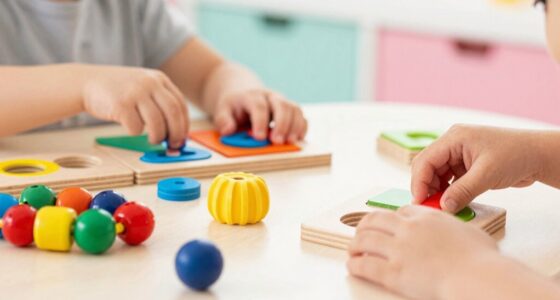
Block play is a powerful way to build essential STEM skills by encouraging you to analyze how pieces fit together, experiment with different configurations, and adjust when structures topple. It helps develop your spatial reasoning, visualization, and critical thinking, fostering resilience and creative problem-solving. Through trial and error, you learn perseverance and adaptability, laying the foundation for future challenges. Keep exploring, and you’ll discover how these play activities connect deeply to lifelong learning and innovation.

Turn the school run and nap time into listening time
- Thousands of audiobooks, podcasts and originals
- Listen on your phone, tablet or Echo — also offline
- Cancel anytime
Key Takeaways
- Block play enhances spatial reasoning skills crucial for understanding STEM concepts.
- It promotes creative problem-solving and experimentation, foundational for STEM innovation.
- Building and adjusting structures develop resilience and adaptive thinking vital in STEM fields.
- Engaging in block play fosters critical thinking, planning, and visualization skills for complex problem-solving.
- It connects playful exploration to real-world STEM skills, supporting future academic and career success.

Have you ever watched a child build a tower with blocks and wondered what they’re learning? It might seem like simple play, but it’s actually a powerful exercise in creative problem solving and developing spatial reasoning. When your child picks up those blocks and starts stacking them, they’re engaging in a process that fosters critical thinking and innovation. They learn to analyze how pieces fit together, experiment with different configurations, and adjust when things topple or don’t align. This kind of play encourages your child to think outside the box, trying new approaches until they succeed. It’s a natural, hands-on way to cultivate creative problem solving skills that will serve them well in many areas of life.
As they manipulate blocks of various shapes and sizes, your child practices spatial reasoning—the ability to visualize and understand how objects relate to each other in space. They learn to see the big picture while paying attention to details, like how a single block’s placement affects the stability of the entire structure. With every attempt, they refine their mental visualization skills, imagining what the finished tower will look like before they place the next piece. This mental exercise strengthens their capacity to solve complex problems later on, whether they’re figuring out how to fit furniture in a room or tackling math and science challenges. The more they play with blocks, the more their spatial reasoning develops, laying a foundation that’s essential for STEM education. Building with blocks also introduces children to toilet buying guides, which emphasize the importance of selecting the right tools and understanding how proper choices support overall well-being—an analogy for how thoughtful decision-making in early activities translates into future success.
Encouraging block play isn’t just about stacking; it’s about fostering a mindset of exploration and resilience. When a tower falls, your child learns to analyze what went wrong and try again—an essential part of creative problem solving. They experiment with different strategies, like balancing blocks on uneven surfaces or creating symmetrical patterns, which sharpens their ability to think critically and adapt. This process of trial and error builds confidence and perseverance, key traits for STEM success. As they build bridges, towers, or abstract structures, they’re not just having fun—they’re honing skills that will help them approach future challenges with curiosity and confidence.
In essence, block play is a simple yet profound activity that nurtures the skills necessary for STEM thinking. It’s about more than just play; it’s about shaping a child’s ability to think creatively, reason spatially, and approach problems with a resilient, solution-oriented mindset. Every block they stack is a step toward understanding how the world works and how they can navigate it with ingenuity and confidence.
As an affiliate, we earn on qualifying purchases.
Frequently Asked Questions
How Can Parents Encourage Block Play at Home?
You can encourage block play at home by providing a variety of building activities that inspire your child’s creative exploration. Set up a dedicated space with different types of blocks and challenge them to build structures or solve design problems. Join in their play, ask questions, and celebrate their ideas. This hands-on approach nurtures their STEM thinking skills while fostering imagination and problem-solving through engaging, fun building activities.
What Are the Best Types of Blocks for Different Ages?
Think of choosing blocks as selecting the right tools for a craft project. For younger children, soft foam or large plastic blocks help build stability and prevent frustration, sparking creative design. As they grow, wooden or interlocking blocks challenge their skills and promote fine motor development. Always select age-appropriate blocks that encourage experimentation, allowing your child to confidently build and explore their creativity while developing essential STEM skills.
How Does Block Play Influence Early Math Skills?
You can see that block play boosts early math skills by enhancing spatial reasoning and problem-solving abilities. As you encourage children to build and manipulate blocks, they learn to recognize shapes, sizes, and patterns. This hands-on activity also helps them understand concepts like balance, symmetry, and measurement. By engaging in block play, children develop critical thinking skills that form a strong foundation for future math learning and STEM success.
Can Block Play Improve Social Skills Among Children?
Oh, sure, just toss some blocks and watch social skills magically blossom! In reality, block play boosts social development by encouraging cooperative behavior, sharing, and turn-taking. As kids build towers together, they learn to communicate, negotiate, and resolve conflicts—crucial skills for life. So, yes, engaging in block play definitely helps children develop stronger social skills, transforming tiny architects into empathetic team players.
What Are Common Challenges Children Face During Block Play?
You might notice children face challenges during block play, especially with problem solving and spatial awareness. They may struggle to build stable structures or understand how different pieces fit together. These difficulties are common and part of learning. As they experiment and persevere, their problem-solving skills and spatial awareness improve. Supporting them with guidance and encouragement helps turn these challenges into valuable learning experiences.
Conclusion
As you watch children build with blocks, you’re witnessing a garden of curiosity and discovery blooming before your eyes. Block play isn’t just about stacking; it’s the roots of STEM thinking taking hold, nurturing creativity, problem-solving, and engineering skills. By encouraging this simple activity, you’re planting seeds that grow into confident, innovative minds. Remember, every block laid is a step toward a future where ideas take shape and dreams come to life.
Fall Picks
fall essentials
As an affiliate, we earn on qualifying purchases.