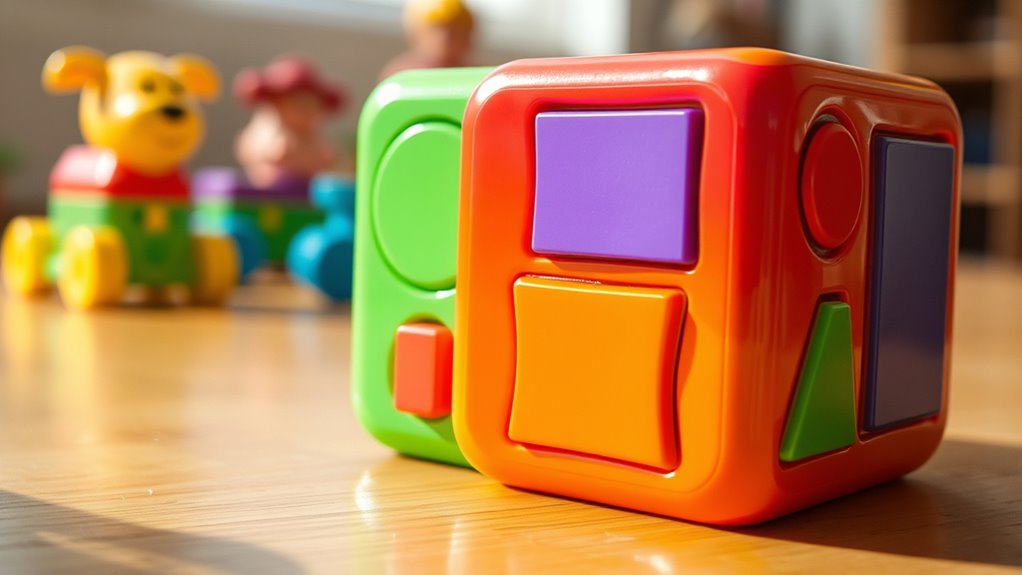

Shape sorter cubes range from simple first-shape toys to activity-rich options that add sensory play, stacking, or hammering. My best overall pick is the OombeeCube Toddler and Baby Shape Sorter for its baby-friendly approach, while Mushie’s Shape Sorting Box stands out for its Danish-made design and 12 shapes, and Fisher-Price Baby’s First Blocks is a straightforward starting point. The main tradeoffs are how challenging the shapes are, whether the toy offers play beyond sorting, and how easy it is for small hands to use and adults to maintain. Read on for the full breakdown of all 15 options and guidance on matching a sorter to your child’s stage and play style.

Turn the school run and nap time into listening time
- Thousands of audiobooks, podcasts and originals
- Listen on your phone, tablet or Echo — also offline
- Cancel anytime
Complete the kit


Key Takeaways
- Simple sorting is a distinct strength: amazon.com/dp/B01NCUSC7V?tag=healthykidplay-20&ascsubtag=dc-322980″ target=”_blank” rel=”nofollow sponsored noopener”>Fisher-Price Baby’s First Blocks keeps the task direct, while multi-activity cubes add variety at the cost of a less focused sorting experience.
- Materials and design separate the wooden picks: Mushie, Hellowood, Coogam, Amazon Basics, and QZMTOY offer wooden approaches, but their added features and block assortments differ.
- Not every sorter is a cube: The bus-shaped sorter and Melissa & Doug Match and Roll offer alternate forms that may appeal to children who respond better to themed or rolling play.
- Sensory play changes the kind of challenge: OombeeCube and Fat Brain Toys InnyBin emphasize tactile exploration, while conventional slots and blocks focus more directly on matching shapes.
- More pieces or activities do not automatically mean a better fit: The right choice depends on your child’s current ability, available play space, and whether you want a focused sorter or a toy with several play modes.
| OombeeCube Toddler and Baby Shape Sorter |  | Best for Travel | Recommended age: 10 months and up | Material: Food-grade, BPA-free silicone | Shapes included: 6 | VIEW ON AMAZON | See Our Full Breakdown |
| Mushie Shape Sorting Box for Toddlers, Made in Denmark, 12 Shapes, BPA-Free |  | Best for Shape Variety | Recommended age: 10 months and up | Number of shapes: 12 | Material: BPA-free, PVC-free, phthalate-free plastic | VIEW ON AMAZON | See Our Full Breakdown |
| Coogam Wooden Montessori Toys for Toddlers – Shape Sorting Cube with Hammer |  | Best for Active Play | Recommended age: 18 months and up | Number of blocks: 12 | Different shapes: 9 | VIEW ON AMAZON | See Our Full Breakdown |
| Aprilwolf Montessori Sensory Cube Toy for Ages 1–3 |  | Best for Tactile Exploration | Recommended age: 1–3 years | Toy type: Montessori sensory cube and shape sorter | Included blocks: 6 colorful shape blocks | VIEW ON AMAZON | See Our Full Breakdown |
| Fisher-Price Baby’s First Blocks |  | Best for Younger Beginners | Recommended age: 6 months and older | Number of blocks: 10 | Includes: Shape-sorter lid and storage bucket | VIEW ON AMAZON | See Our Full Breakdown |
| Bus Shape Sorter Toy – Kids Block Sorter with 16 Colorful Shapes for Toddlers 1-3 |  | Best for Push-Along Play | Design: Push-along bus with storage | Number of shapes: 16 | Recommended age: 12 months and older | VIEW ON AMAZON | See Our Full Breakdown |
| Baby Montessori Toys for 1 Year Old Boys and Girls – Multi Sensory Shape Sorter and Activity Cube |  | Best for Early Sensory Exploration | Material: ABS plastic | Age range: 6 months to 2 years | Included pieces: Shape blocks and elastic cord | VIEW ON AMAZON | See Our Full Breakdown |
| Amazon Basics Wooden Shape Sorter and Rainbow Stacker Baby Toy Set – Multicolor, 12 Months+ |  | Best Two-in-One Set | Material: Wood and plastic | Age range: 12 months and up | Certification: FSC Certified | VIEW ON AMAZON | See Our Full Breakdown |
| Fat Brain Toys InnyBin Shape Learning Toys, Sensory Toys for Babies and Toddlers, Baby Toys Ages 10 Months+ |  | Best Compact Sensory Pick | Number of blocks: 6 | Block size: 2 inches | Toy dimensions: 5.5 inches per side | VIEW ON AMAZON | See Our Full Breakdown |
| LiKee Montessori Activity Cube Shape Sorter |  | Best for Growing Fine-Motor Challenges | Brand: LiKee | Model name: LK-SSL | Manufacturer part number: HM-LK-SSL | VIEW ON AMAZON | See Our Full Breakdown |
| Play22 Baby Shape Sorter Toy – 18 Colorful Blocks, Learning Activity Cube |  | Best for Block Variety | Brand: Play22 | Model: 6009 | Material: BPA-free plastic | VIEW ON AMAZON | See Our Full Breakdown |
| LiKee Montessori Shape Sorter Cube for Ages 12 Months and Up |  | Best Compact Pick | Brand: LiKee | Model: LK-SSL | Material: Plastic | VIEW ON AMAZON | See Our Full Breakdown |
| Hellowood Wooden Shape Sorter Cube |  | Best Wooden Storage Design | Material: Wood | Included pieces: 8 shapes and 1 storage box | Features: Shape holes and soft rubber bands | VIEW ON AMAZON | See Our Full Breakdown |
| Melissa & Doug Match and Roll Shape Sorter |  | Best for Distinctive Shape Practice | Material: Wood | Recommended age: 12 months and up | Shapes included: Parallelogram, quatrefoil, square, diamond, oval, and pentagon | VIEW ON AMAZON | See Our Full Breakdown |
| QZMTOY Shape Sorter Toy with 19 Natural Solid Wood Blocks |  | Best for a Large Wooden Set | Brand: QZMTOY | Material: Solid wood | Number of pieces: 19 | VIEW ON AMAZON | See Our Full Breakdown |
| shape sorter cube | Material | Recommended age |
|---|---|---|
| OombeeCube Toddler and Baby Sh | Food-grade, BPA-free silicone | 10 months and up |
| Mushie Shape Sorting Box for T | BPA-free, PVC-free, phthalate-free plastic | 10 months and up |
| Coogam Wooden Montessori Toys | Solid wood with water-based paint | 18 months and up |
| Aprilwolf Montessori Sensory C | — | 1–3 years |
| Fisher-Price Baby’s First Bloc | — | 6 months and older |
| Bus Shape Sorter Toy | High-quality, safe materials | 12 months and older |
| Baby Montessori Toys for 1 Yea | ABS plastic | — |
| Amazon Basics Wooden Shape Sor | Wood and plastic | — |
| Fat Brain Toys InnyBin Shape L | BPA-free | — |
| LiKee Montessori Activity Cube | Plastic | 12 months and up |
| Play22 Baby Shape Sorter Toy | BPA-free plastic | 3 years and up |
| LiKee Montessori Shape Sorter | Plastic | 12 months and up |
| Hellowood Wooden Shape Sorter | Wood | 1 year and up |
| Melissa & Doug Match and Roll | Wood | 12 months and up |
| QZMTOY Shape Sorter Toy with 1 | Solid wood | — |
More Details on Our Top Picks
OombeeCube Toddler and Baby Shape Sorter
For families who want shape sorting beyond the playroom, the OombeeCube stands apart with six textured silicone shapes attached by short strings. That tethered design makes pieces harder to scatter during outings, while the soft, food-grade silicone suits mouthing and early hands-on exploration. It is aimed at children 10 months and up, with familiar shapes that introduce matching without a large set to manage. Compared with Fisher-Price Baby’s First Blocks, OombeeCube puts more emphasis on sensory texture and keeping pieces attached; Fisher-Price offers more blocks and a carry bucket. The tradeoff is limited variety: six shapes may hold less appeal as sorting skills grow. It also lacks the hammer play of Coogam’s wooden cube, and the tethered pieces still call for supervision.
Pros:- Tethered shapes are less likely to get misplaced during travel
- Food-grade, BPA-free silicone is soft and suitable for teething
- Textured pieces add sensory input alongside shape matching
- Designed for babies from 10 months
Cons:- Only six shapes, limiting sorting variety as skills develop
- No hammer, stacking, or electronic play features
- Short strings and small pieces still require adult supervision
Best for: Caregivers who want a compact, teething-friendly shape sorter for stroller, car, or visits away from home.
Not ideal for: Families seeking a larger set of shapes, varied play modes, or a sorter that can grow with an older toddler.
- Recommended age:10 months and up
- Material:Food-grade, BPA-free silicone
- Shapes included:6
- Shape types:Triangle, square, oval, circle, pentagon, double circle
- Safety features:Short strings and durable construction
- Play focus:Fine motor skills, shape recognition, and sensory development
Our verdict“Choose OombeeCube for portable, sensory-focused sorting; pick Fisher-Price Baby’s First Blocks if you want more loose pieces and a storage bucket.”
Mushie Shape Sorting Box for Toddlers, Made in Denmark, 12 Shapes, BPA-Free
The Mushie box is my pick for caregivers who want more matching practice in a straightforward format: its 12 shapes offer more variety than the six-piece OombeeCube or Aprilwolf sensory cube. Designed for ages 10 months and up, it uses soft-colored plastic that is free of BPA, PVC, and phthalates. That combination keeps the focus on repeated sorting and naming shapes, with room for language and early reasoning play. It is made in Denmark and suited to families who prefer a dedicated shape-sorting box over a toy with several different activities. The tradeoff is a narrower play style: unlike Coogam, it has no hammer or balls, and unlike Fisher-Price Baby’s First Blocks, the supplied information does not mention a carry handle or storage bucket. Its 12 pieces also need supervision around young children.
Pros:- 12 shapes provide more matching variety than the six-piece OombeeCube and Aprilwolf
- Plastic is BPA-free, PVC-free, and phthalate-free
- Soft colors support shape and color naming during play
- Made in Denmark
Cons:- Focused on one main activity, with no hammer or sensory-band play
- May be too simple for older children
- Pieces require supervision to reduce choking risk
Best for: Parents of toddlers who want a dedicated sorter with more shape-matching options and non-phthalate plastic.
Not ideal for: Buyers looking for a multisensory cube, hammer activity, or a clearly specified portable storage solution.
- Recommended age:10 months and up
- Number of shapes:12
- Material:BPA-free, PVC-free, phthalate-free plastic
- Made in:Denmark
- Play format:Shape sorting box
- Developmental focus:Cognitive reasoning, fine motor skills, language development, and STEM learning
Our verdict“Choose Mushie for a larger set of shapes in a dedicated box, but look to Coogam or Aprilwolf for more varied play actions.”
Coogam Wooden Montessori Toys for Toddlers – Shape Sorting Cube with Hammer
Coogam earns its place for toddlers ready to do more than drop blocks through openings. Alongside 12 blocks spanning nine shapes, it includes a hammer and balls, adding a purposeful striking activity to shape recognition and hand-eye practice. The solid-wood construction with water-based paint gives it a different feel from the plastic Mushie box and silicone OombeeCube, while its 18 months and up age recommendation suits children who can handle more involved play. This added activity is the main reason to choose it over simpler sorters. The tradeoff is that hammer play needs room and close adult attention, and the small pieces are not suited to unsupervised use. Compared with Fisher-Price Baby’s First Blocks, Coogam offers more active play but is intended for older toddlers.
Pros:- Hammer and balls add an active play mode beyond sorting
- 12 blocks cover nine different shapes
- Solid wood with water-based paint
- Supports fine motor skills, shape recognition, and hand-eye coordination
Cons:- Recommended for 18 months and up, so it is less suitable for younger babies
- Small parts require close supervision
- Hammer play can be less convenient in quiet or compact spaces
Best for: Caregivers of children 18 months and older who want shape sorting paired with supervised hammer-and-ball play.
Not ideal for: Families shopping for a young baby, a travel-friendly set, or a toy that needs little adult oversight.
- Recommended age:18 months and up
- Number of blocks:12
- Different shapes:9
- Material:Solid wood with water-based paint
- Included items:Hammer, shape blocks, and balls
- Play focus:Fine motor skills, shape recognition, and hand-eye coordination
Our verdict“Choose Coogam for an older toddler who is ready for supervised hammer play as well as sorting, rather than a simple baby-first cube.”
Aprilwolf Montessori Sensory Cube Toy for Ages 1–3
Aprilwolf is the sensory-first choice in this group: its six textured blocks pair shape sorting with pushing and pulling through elastic bands and openings. That gives toddlers ages 1–3 more tactile exploration than the straightforward Mushie box, though Mushie supplies twice as many shapes for matching practice. The elastic openings make the cube feel less like a conventional sorter and more like an activity toy, which may suit children who enjoy testing how objects move through spaces. Its stated BPA-free material safety is useful, but the product details do not specify the cube’s dimensions or construction material. That missing information makes it harder to judge portability and durability against OombeeCube’s silicone build. With just six blocks, it also offers less shape variety than Mushie or Coogam.
Pros:- Six different textures add tactile exploration to sorting
- Elastic bands and openings encourage pushing and pulling
- Combines shape and color recognition with spatial reasoning
- Designed for ages 1–3
Cons:- Only six included shape blocks
- Cube dimensions and its specific construction material are not provided
- Less focused on shape variety than Mushie’s 12-shape set
Best for: Caregivers of toddlers who enjoy tactile play and pushing objects through flexible openings as well as basic sorting.
Not ideal for: Buyers who need clearly stated dimensions and materials, or who prioritize a large assortment of shapes.
- Recommended age:1–3 years
- Toy type:Montessori sensory cube and shape sorter
- Included blocks:6 colorful shape blocks
- Textures:6 different textures
- Features:Elastic bands and openings
- Material safety:BPA-free
- Developmental focus:Tactile exploration, color recognition, spatial reasoning, and fine motor skills
Our verdict“Choose Aprilwolf when tactile and push-through play matter more than having a wide range of shapes or fully specified construction details.”
Fisher-Price Baby’s First Blocks
For an early introduction to sorting, Fisher-Price Baby’s First Blocks has the youngest stated starting age in this lineup: 6 months and older. The 10 colorful blocks can be sorted, stacked, or dropped through a shape-sorter lid, then stored in the bucket with its carry handle. That all-in-one format gives caregivers a simple way to bring play along and tidy the pieces afterward. Compared with OombeeCube, it offers more loose blocks and a storage container, while OombeeCube’s tethered silicone shapes are better suited to reducing lost pieces and adding texture. Fisher-Price keeps the shapes and colors basic, so it is less varied than Mushie’s 12-shape set or Coogam’s nine shape types. The blocks may also be small for some children, making supervision important.
Pros:- Recommended from 6 months, earlier than the other products in this batch
- 10 blocks support sorting, stacking, and drop-through play
- Storage bucket includes an easy-carry handle
- Introduces colors and shapes alongside fine motor practice
Cons:- Shapes and colors are basic compared with Mushie’s 12-shape set
- Blocks may be small for some children and need supervision
- Does not include the textured or elastic-band play found in OombeeCube and Aprilwolf
Best for: Families introducing sorting to a baby from six months who want blocks that also stack and store in a carry bucket.
Not ideal for: Buyers seeking textured silicone pieces, a broad assortment of shape types, or an activity for older toddlers.
- Recommended age:6 months and older
- Number of blocks:10
- Includes:Shape-sorter lid and storage bucket
- Storage feature:Easy-carry handle
- Play modes:Sorting, stacking, and dropping blocks through the lid
- Developmental focus:Color and shape recognition, fine motor skills, and problem-solving
Our verdict“Choose Fisher-Price for a young baby’s first sorting set with stacking and easy storage, rather than a more sensory or shape-rich cube.”
Bus Shape Sorter Toy – Kids Block Sorter with 16 Colorful Shapes for Toddlers 1-3
The push-along bus gives this sorter a play pattern the box-style cubes in this roundup lack: toddlers can carry it by its handle, roll it, then put the 16 colorful shapes into matching slots. That combination can make basic shape practice feel more active, while the storage compartment keeps pieces together between play sessions. Compared with the Amazon Basics Wooden Shape Sorter and Rainbow Stacker, this pick favors portability and rolling play over having a second stacking activity. Its learning scope is intentionally simple, though: it focuses on basic shapes and colors rather than offering the varied sensory tasks of the LiKee Montessori Activity Cube. Some slots may fit tightly, so a child who gets frustrated by matching may need help. Older toddlers may outgrow the basic sorting challenge.
Pros:- Push-along design adds movement play beyond a stationary sorter cube.
- Sixteen shapes provide multiple chances to practice color and shape matching.
- Storage compartment helps keep the pieces together.
- Carry handle supports portability around the home.
Cons:- Basic shapes and colors may not hold an older toddler’s interest for long.
- Some shapes may fit tightly in their slots, which can frustrate beginners.
Best for: Families with toddlers who enjoy push-along toys and want a portable first sorter with pieces that store inside.
Not ideal for: Caregivers looking for a more challenging sorter, varied sensory activities, or easier shape insertion for a child who dislikes tight-fitting slots.
- Design:Push-along bus with storage
- Number of shapes:16
- Recommended age:12 months and older
- Material:High-quality, safe materials
- Play features:Shape sorting and push-along play
- Storage:Storage compartment
- Portability:Carry handle
Our verdict“Choose this bus for a portable, movement-focused introduction to shape sorting, not for a more advanced or sensory-rich challenge.”
Baby Montessori Toys for 1 Year Old Boys and Girls – Multi Sensory Shape Sorter and Activity Cube
This activity cube is aimed at the youngest learners in the group, pairing shape sorting with textured blocks for tactile exploration. Its stated age range begins at 6 months, earlier than the 10-month starting age listed for the Fat Brain Toys InnyBin, which may appeal to families seeking a sensory toy for an infant approaching toddlerhood. Smooth-edged ABS plastic is described as durable and skin-friendly, but the product data also calls for supervision because of small parts; that caveat matters when buying for babies. The learning remains focused on basic shapes, colors, and textures, so this is not the pick for a child ready for more varied tasks. Compared with the LiKee Montessori Activity Cube, its standout is the stated sensory texture emphasis rather than adjustable-difficulty band pulling.
Pros:- Textured blocks add tactile exploration alongside shape sorting.
- Stated age range starts at 6 months.
- ABS plastic construction is described as having smooth edges.
- Combines color recognition with basic shape practice.
Cons:- Limited to basic shapes and colors, which may lose appeal as skills advance.
- Small parts require adult supervision.
Best for: Caregivers of babies and young toddlers who want a basic sorter that pairs shape and color practice with tactile blocks.
Not ideal for: Families seeking a toy for older toddlers, a more complex activity cube, or unsupervised play with small pieces.
- Material:ABS plastic
- Age range:6 months to 2 years
- Included pieces:Shape blocks and elastic cord
- Features:Sensory textures, color recognition, and shape sorting
- Construction:Smooth-edged design
- Play type:Manual activity cube
Our verdict“Pick this cube for supervised early sensory and shape play, but choose a more challenging activity toy as your toddler grows.”
Amazon Basics Wooden Shape Sorter and Rainbow Stacker Baby Toy Set – Multicolor, 12 Months+
The appeal here is range within a simple format: a wooden shape sorter shares the set with a rainbow stacker, giving toddlers two ways to practice grasping, matching, and arranging. That makes it a more versatile choice than the Bus Shape Sorter Toy, which centers on sorting and rolling, while the Fat Brain Toys InnyBin puts more emphasis on tactile block play. The materials are listed as wood and plastic, and the set is FSC Certified; buyers who want an all-wood toy should note that it is not wood alone. The activities suit early learners rather than children looking for changing difficulty or more advanced sorting. Small pieces also call for supervision, so this is not a leave-out toy for households with younger siblings.
Pros:- Two distinct activities offer more play variety than a sorter alone.
- Supports fine motor practice through sorting and stacking.
- Combines shape and color recognition in one set.
- FSC Certified materials are listed.
Cons:- Wood-and-plastic construction may disappoint buyers seeking an all-wood set.
- Small parts require supervision around young children.
- The activities may be too simple for older toddlers.
Best for: Families with toddlers aged 12 months and up who want both a traditional sorter and a stacking activity in one set.
Not ideal for: Buyers seeking a single-material wooden toy, a more advanced challenge, or pieces that can be left within reach of younger siblings.
- Material:Wood and plastic
- Age range:12 months and up
- Certification:FSC Certified
- Colors:Multicolor
- Included:Shape sorter box and stacking pieces
- Play activities:Shape sorting and rainbow stacking
Our verdict“Choose this set if you want one early-learning toy to cover both sorting and stacking, and can supervise its small pieces.”
Fat Brain Toys InnyBin Shape Learning Toys, Sensory Toys for Babies and Toddlers, Baby Toys Ages 10 Months+
The InnyBin is the most compact choice here, measuring 5.5 inches per side, and its six chunky, textured blocks keep the play focused on grasping and tactile exploration. At two inches each, the blocks are described as chunky, while the sorter’s small footprint suits families short on play space. Compared with the 16-piece Bus Shape Sorter Toy, this is a simpler set with fewer pieces and no push-along feature; compared with the Amazon Basics set, it trades stacking variety for a concentrated sensory activity. The BPA-free material is a stated advantage, but the product data does not list multiple activities or increasing difficulty. Its limited scope may suit babies and younger toddlers better than children who already want a more involved sorting challenge.
Pros:- Compact 5.5-inch cube fits easily into smaller play areas.
- Six textured blocks encourage tactile exploration.
- Two-inch blocks are described as chunky for handling.
- Made with BPA-free material.
Cons:- Six blocks offer a narrower sorting selection than the 16-piece bus.
- The listed play focus is limited to sensory and fine motor development.
- No electronic or interactive features are described.
Best for: Families with limited play space who want a compact, tactile toy for babies and toddlers aged 10 months and up.
Not ideal for: Buyers seeking many shapes, multiple play modes, or a sorter that offers a growing challenge for older toddlers.
- Number of blocks:6
- Block size:2 inches
- Toy dimensions:5.5 inches per side
- Material:BPA-free
- Age:10 months and up
- Block feature:Textured
Our verdict“Choose the InnyBin for compact, hands-on sensory play; pick a larger or more varied sorter if your child needs broader challenges.”
LiKee Montessori Activity Cube Shape Sorter
The LiKee stands out for combining shape sorting with bands that have varying pulling difficulty, adding a hands-on challenge beyond matching pieces to openings. That gives it a different learning focus from the Amazon Basics Wooden Shape Sorter and Rainbow Stacker, which provides two play activities but does not list adjustable band challenges. At 4 x 4 x 4 inches and 0.2 kg, this is a small, lightweight cube for a toddler’s play area or travel bag. Its plastic construction may not suit shoppers who prefer the wood-and-plastic format of the Amazon Basics set, and the product data describes just one cube design. Manual play keeps the activity direct, but the single format may become familiar once a child has mastered its tasks.
Pros:- Varying band-pulling difficulty adds a fine-motor challenge beyond basic matching.
- Combines sensory blocks with shape sorting.
- Compact 4-inch cube is lightweight at 0.2 kg.
- Manual play supports hands-on practice without electronic features.
Cons:- Plastic construction may not appeal to buyers who prefer wooden toys.
- The product is described as a single activity cube, limiting variety.
- A child who masters the band and sorting tasks may want a more varied toy.
Best for: Caregivers of toddlers aged 12 months and up who want a compact manual cube with varied band-pulling difficulty alongside shape play.
Not ideal for: Buyers who prefer wooden toys, want several distinct play activities, or need a large collection of pieces.
- Brand:LiKee
- Model name:LK-SSL
- Manufacturer part number:HM-LK-SSL
- Recommended age:12 months and up
- Material:Plastic
- Dimensions:4 x 4 x 4 inches
- Weight:0.2 kg
- Included components:Shape blocks and sensory blocks
- Operation mode:Manual
Our verdict“Choose this compact cube for a toddler who is ready to practice pulling and sorting, but look elsewhere for wooden materials or broader activity variety.”
Play22 Baby Shape Sorter Toy – 18 Colorful Blocks, Learning Activity Cube
With 18 colorful blocks, this Play22 cube offers more pieces to sort than the six-shape Melissa & Doug Match and Roll, making it a better fit for families who want a larger set for repeated matching and counting play. Its compact, nearly six-inch plastic cube is easy to store, and the lid’s sorting openings give toddlers a straightforward way to connect each block with a shape. The listed learning goals span color recognition, counting, coordination, and problem-solving, though the core activity remains shape sorting rather than a range of play modes. BPA-free plastic is a practical alternative to the wooden Hellowood and QZMTOY cubes, but buyers who prefer wood may favor those models. The manufacturer’s 3+ age recommendation is also older than many comparable sorters, so check age guidance before choosing it for a younger toddler.
Pros:- Includes 18 colorful blocks for varied sorting and counting practice.
- BPA-free plastic construction.
- Compact cube measures about six inches across.
- Shape sorting can support coordination, color recognition, and early problem-solving.
Cons:- Manufacturer recommends it for ages 3 and up, which may not suit buyers seeking a first sorter for a younger toddler.
- Listed weight of 0.27 g appears inconsistent with the product dimensions.
- Offers a focused sorting activity rather than multiple distinct play modes.
Best for: Families seeking a plastic shape sorter with a larger block set for supervised matching, color-naming, and counting activities.
Not ideal for: Caregivers shopping specifically for a younger toddler, or buyers who prefer wooden construction and a clearly stated weight.
- Brand:Play22
- Model:6009
- Material:BPA-free plastic
- Dimensions:5.91 x 5.91 x 5.87 inches
- Recommended age:3 years and up
- Blocks:18 colorful blocks
- Educational objectives:Color recognition, counting, hand-eye coordination, logical thinking, motor skills, STEM, and sorting
Our verdict“Choose the Play22 if block quantity and plastic construction matter more than an earlier age recommendation or wooden materials.”
LiKee Montessori Shape Sorter Cube for Ages 12 Months and Up
At just 4 x 4 x 4 inches, this LiKee is the smallest clearly dimensioned cube in this group, making it easier to tuck away than the roughly six-inch Play22 and QZMTOY sorters. Its 10-piece set includes shape blocks and sensory blocks, so it offers a little more tactile variety than a basic sorter without adding batteries or complicated mechanisms. That compact scale suits a small play area, although it also means fewer pieces than Play22’s 18-block set. The 12-month age guidance makes it a more age-accessible option on paper than Play22, which is listed for ages 3 and up; adult supervision is still sensible around small blocks. The listing says it supports patience but also contains a contradictory reference to impatience, leaving the specific benefit unclear.
Pros:- Compact 4-inch cube is easy to store.
- Includes 10 shape and sensory blocks.
- No batteries or power source required.
- Listed for ages 12 months and up.
Cons:- Smaller piece count than the Play22 sorter’s 18 blocks.
- Listed for indoor use only.
- Product description gives contradictory information about patience and impatience.
Best for: Caregivers in small homes who want a compact, manual sorter with sensory blocks and a stated age range starting at 12 months.
Not ideal for: Buyers who want a large block collection, outdoor play, or more specific information about the sensory features.
- Brand:LiKee
- Model:LK-SSL
- Material:Plastic
- Recommended age:12 months and up
- Unit count:10
- Included components:Shape blocks and sensory blocks
- Dimensions:4 x 4 x 4 inches
- Power:Manual; no batteries required
- Usage:Indoor
Our verdict“Pick the LiKee when compact storage and a small sensory-enhanced set matter more than having the most blocks.”
Hellowood Wooden Shape Sorter Cube
The Hellowood stands apart from the plastic LiKee and Play22 with a wooden box, eight shapes, and soft rubber bands that form part of the sorting and storage design. That combination gives the cube a distinct tactile feel and keeps the pieces together when play is done, while the smooth, rounded surfaces and water-based paint address common material concerns for wooden toys. It is a more restrained set than QZMTOY’s 19-piece cube, which suits buyers who prefer a simpler sorting task over a larger collection. The tradeoff is clear: eight shapes offer less variety, and small pieces call for age-appropriate supervision. Its age guidance starts at one year, but families should still match use to their child’s handling skills.
Pros:- Wooden box gives the sorter a sturdy, tactile construction.
- Includes eight shapes for focused matching practice.
- Soft rubber bands are part of the sorting and storage design.
- Uses smooth, rounded surfaces and non-toxic water-based paint.
Cons:- Eight shapes offer less variety than the 19-piece QZMTOY cube.
- Small shapes require age-appropriate supervision.
- The listing does not provide dimensions for judging storage size.
Best for: Families who prefer a wooden sorter with a built-in way to contain and store its shapes.
Not ideal for: Buyers seeking a large assortment of blocks or a toy that can be left with a child who still mouths small pieces.
- Material:Wood
- Included pieces:8 shapes and 1 storage box
- Features:Shape holes and soft rubber bands
- Finish:Non-toxic water-based paint
- Recommended age:1 year and up
- Sorting format:Shapes fit into matching holes
Our verdict“Choose Hellowood for a compact wooden sorting-and-storage design, not for the biggest block selection.”
Melissa & Doug Match and Roll Shape Sorter
Rather than competing on piece count, the Melissa & Doug Match and Roll focuses on six named shapes, including a parallelogram and quatrefoil. That makes it a useful choice for caregivers who want to introduce less familiar outlines, while the wooden construction offers a different feel from the plastic Play22 and LiKee cubes. The listed age starts at 12 months and up, giving it broader early-toddler positioning than Play22’s age-3 recommendation. Its limits are just as plain: the supplied details describe shape sorting as the main activity, with no larger accessory set or added sensory components like LiKee’s. Older children may outgrow the matching challenge, and the listing does not give dimensions or a piece count beyond the six shapes named.
Pros:- Includes six shapes, including a parallelogram and quatrefoil.
- Wooden construction provides an alternative to plastic cubes.
- Listed for children 12 months and up.
- Supports shape and color recognition, sorting, and manual dexterity.
Cons:- Sorting is the central activity, with no additional play modes specified.
- May be too simple for older children.
- Dimensions and a total piece count are not provided in the supplied details.
Best for: Caregivers looking for a wooden first sorter that introduces a range of recognizable and less common shapes.
Not ideal for: Families wanting many blocks, sensory add-ons, or a sorter with enough complexity to hold an older child’s interest.
- Material:Wood
- Recommended age:12 months and up
- Shapes included:Parallelogram, quatrefoil, square, diamond, oval, and pentagon
- Play format:Shape sorting
- Educational skills:Shape and color recognition, sorting, problem-solving, and manual dexterity
Our verdict“Pick Match and Roll for early shape recognition and distinctive outlines, rather than a high-piece-count or multi-activity cube.”
QZMTOY Shape Sorter Toy with 19 Natural Solid Wood Blocks
For buyers who want a wooden cube with plenty to sort, QZMTOY’s 19 solid-wood blocks outnumber Hellowood’s eight shapes and Melissa & Doug’s six named shapes. Its 6.3-inch body is larger than the compact LiKee, while the slide-off lid and carrying strap make it easier to put away or take along. Non-toxic paint and a handcrafted finish suit shoppers drawn to traditional wooden toys, though the product is still a single-player sorting activity rather than a shared game. Age information needs careful reading: the listing names 18 months and up but also says the manufacturer recommends 3+, so it is less straightforward for families shopping for a younger toddler. Small pieces also call for supervision.
Pros:- Includes 19 colorful geometric wooden blocks.
- Solid-wood construction with non-toxic paint.
- Slide-off lid and carrying strap support storage and portability.
- Larger piece assortment than the Hellowood and Melissa & Doug sorters.
Cons:- Age guidance differs between 18 months and the manufacturer’s 3+ recommendation.
- Small pieces may pose a choking hazard for children below the recommended age.
- Designed for single-player use.
Best for: Families who want a substantial wooden shape sorter with a larger block selection and a strap for carrying.
Not ideal for: Caregivers who need unambiguous age guidance, want multi-child play, or prefer a compact cube with fewer small pieces.
- Brand:QZMTOY
- Material:Solid wood
- Number of pieces:19
- Dimensions:6.3 x 6.3 x 6.5 inches
- Weight:0.77 kg
- Age range:Listed as 18 months and up; manufacturer recommendation is 3+ years
- Features:Slide-off lid, carrying strap, handcrafted finish, and non-toxic paint
- Color:Multicolor
Our verdict“Choose QZMTOY for the lineup’s largest wooden block set, provided its age guidance and single-player format suit your household.”

How We Picked
I compared these 15 shape sorter cubes and related sorters by how clearly they support shape matching, how approachable they appear for the intended age range, and what kind of play they add beyond fitting pieces through openings. I also weighed material and design details, such as wooden construction, sensory elements, extra activity features, and the amount of sorting variety indicated by each product’s description. These factors matter because a larger assortment or busier activity cube can be useful for some children but distracting for others.
The ranking favors options with a clear role and a useful balance of play value, usability, and focused sorting. Simple choices earn consideration for first attempts; sensory and activity-based picks suit families seeking more than shape matching; and sets with more pieces may appeal when children are ready for added variety. Since the lineup includes cubes, boxes, a bus, a rolling sorter, and a flexible shape-learning toy, I judged each against its intended use rather than treating every format as interchangeable.
Factors to Consider When Choosing Shape Sorter Cubes
Before choosing a sorter, I would match the toy’s challenge and format to how your child plays now—not just the age label or number of pieces. These factors can help you weigh a focused first sorter against a more involved toy that may stay interesting in different ways.
Match the sorting challenge to your child’s current skills
A first sorter should invite trial and error without making every attempt feel like guesswork. Look at how many shapes are included and whether the openings are easy to distinguish; a larger assortment can add variety but may be harder for a beginner to manage. Children who already recognize common shapes may enjoy more pieces or less obvious matches. Adults can also make a toy easier at first by offering only a few blocks and adding the rest later. Avoid choosing solely by a suggested age, since hand control and persistence vary. A clear, repeatable task may hold attention longer than a more complex set at the start.
Choose between focused sorting and multi-activity play
A classic cube gives shape matching the center of attention, while activity cubes may combine sorting with sensory features or other actions. Extra play modes can help when a child moves quickly between activities, but they may distract a child who is still learning how pieces match openings. Think about whether you want one toy with several uses or a simple task that is easy to bring out and put away. Multi-activity designs can also take up more room and have more parts to keep track of. For a first purchase, a focused sorter is often easier to understand; a broader activity toy makes more sense when variety is a priority.
Consider the feel and care needs of the materials
Wood and plastic create different play experiences, but neither material alone tells you how well a toy will suit your home. A wooden sorter may appeal if you prefer a solid, traditional feel, while plastic options can suit families seeking a lighter set or colorful pieces. Check the maker’s cleaning guidance rather than assuming every surface or block can be washed the same way. If the toy will see frequent floor play, storage and wipe-down needs can matter as much as appearance. Also look for age guidance and product safety information, particularly for toys with multiple loose pieces. Choose based on your household’s care routine, not material labels alone.
Think about loose pieces, storage, and play space
Blocks are easy to scatter, and a set with more shapes can create a bigger cleanup task. Before buying, consider where the pieces will be stored and whether the sorter keeps them together when play ends. A self-contained cube or box may suit a small play area, while a bus or rolling format can call for more room to move it around. If you often take toys between rooms or on trips, size and the chance of losing pieces deserve extra attention. A toy with many parts is most useful when you have a reliable place to put them. The simplest set to store may get used more often than a larger one that is hard to reset.
Decide when added features are worth choosing
Paying for more pieces or extra play actions makes sense only if those features match your child’s interests and current abilities. A hammering feature, sensory openings, stacking, or rolling can broaden play, but they also change the task and may not matter to a child who mainly enjoys matching shapes. Ask whether each added feature will be used regularly or merely makes the product sound more versatile. For a child who loses interest after one activity, variety can be useful; for a child who likes repetition, a simpler design may be a better fit. Avoid treating feature count as a measure of learning value. The strongest choice is the one that gives your child a reason to return to it.
Frequently Asked Questions
Should I choose a simple shape sorter or an activity cube for a first sorter?
I would start with a simple sorter if your child is just learning to match pieces to openings or tends to focus on one task at a time. An activity cube may suit a child who enjoys switching between different kinds of play, but added features can distract from learning the basic match. You can also make a multi-piece set simpler by offering only a few blocks initially. Think about whether your main goal is repeated shape practice or broader play in one toy. That distinction matters more than the number of activities listed on the package.
Are wooden shape sorter cubes better than plastic ones?
Wood is not automatically better; the best material depends on your preferences, care routine, and the specific design. Wooden options can appeal if you want a traditional, solid-feeling toy, while plastic picks may offer a lighter feel or a more colorful presentation. Compare the shape openings and ease of handling rather than deciding by material alone. Check the manufacturer’s cleaning directions, since care methods can differ across products. Product safety guidance and age suitability should also factor into the decision.
Does a larger number of shapes make a sorter more useful?
More shapes can offer added variety once a child is ready to recognize and match a wider range, but they can make an early sorting task harder to manage. A smaller set may be more inviting for a beginner because there are fewer pieces and matches to learn at once. Consider whether your child enjoys repeated practice or asks for new challenges quickly. You can often pace a larger set by introducing a few pieces at a time, if the toy allows it. Choose based on the child’s interest and skill, not the piece count alone.
What should I prioritize if the sorter will be used in a small home or taken along?
Focus on how easily the pieces stay together, how much room the toy needs during play, and whether its shape is convenient to carry. A compact box or cube may be easier to store than a larger themed or multi-activity design. Loose blocks can be the main source of hassle when a toy moves between rooms, so consider where you will keep them. Check the product’s dimensions and storage details before deciding. A smaller, simpler set may be more practical if space and cleanup are your main concerns.
When is a sensory or hammering sorter a better choice than a standard cube?
A sensory sorter may be a better match when your child enjoys touching, pushing, or exploring different textures as much as matching shapes. A hammering design suits families looking to add an active action to block play, though that feature may not appeal to every child. Standard cubes keep the task more focused and can make shape matching easier to repeat. Think about which actions your child chooses during other play before paying for extra features. If sorting practice is the priority, choose the clearer task; if variety keeps your child engaged, an added activity may be worthwhile.
Conclusion
For the broadest fit in this lineup, I’d start with OombeeCube Toddler and Baby Shape Sorter as my best overall pick, especially for buyers drawn to sensory play alongside sorting. Fisher-Price Baby’s First Blocks is my best value-style choice for families who want a direct, uncomplicated introduction, while Mushie Shape Sorting Box is my premium-style pick for shoppers prioritizing its Danish-made design and 12-shape set. For beginners who want the task kept simple, Fisher-Price is the clearest starting point. If your child prefers movement and a themed format, consider the Bus Shape Sorter; for sensory exploration, compare OombeeCube with Fat Brain Toys InnyBin. I’d choose the toy whose format suits your child’s play style, rather than paying extra attention to piece count or activity count alone.
Cold & flu season Picks
humidifiers
As an affiliate, we earn on qualifying purchases.