When searching for gross motor skill games, parents and educators want options that are engaging, safe, and effective at developing coordination and physical confidence. The National Geographic Kids Stepping Stones & Balance Beams stands out as the best overall choice for its versatile indoor/outdoor design and durable construction. For those seeking portable play, the Wiggle N Giggle Travel Card Game offers fun movement activities in a compact format. However, many products face tradeoffs between price, complexity, and age appropriateness. Continue reading for a detailed breakdown of these options to help you find the perfect fit for your child’s needs.

Turn the school run and nap time into listening time
- Thousands of audiobooks, podcasts and originals
- Listen on your phone, tablet or Echo — also offline
- Cancel anytime
Complete the kit


Key Takeaways
- The top picks balance durability, versatility, and age-appropriate challenges to support different developmental stages.
- Products that combine multiple activities, like obstacle courses and balance games, tend to offer more comprehensive gross motor development.
- Portable and indoor-friendly options provide flexibility but often sacrifice the complexity or size of larger obstacle sets.
- Price varies widely; investing in higher-quality materials typically results in longer-lasting equipment but at a premium cost.
- Ease of setup and storage is a common deciding factor, especially for parents with limited space or time.
| National Geographic Kids Stepping Stones & Balance Beams |  | Best Overall for Kids | Recommended age: 3 years and up; listed range 36-72 months | Set size: 12 course pieces | Piece mix: 4 stepping stones, 4 straight beams, 4 curved beams | VIEW ON AMAZON | See Our Full Breakdown |
| Wiggle N Giggle Travel Card Game |  | Best Travel Game | Recommended age: 3 years and up | Card count: 108 cards | Number of decks: 3 | VIEW ON AMAZON | See Our Full Breakdown |
| edxeducation Joey Jump |  | Best for Catching Skills | Recommended age: 2 years and up | Game type: Stomp-and-catch launch board | Core movements: Stomping, launching, tracking, catching, and jumping | VIEW ON AMAZON | See Our Full Breakdown |
| SmartYeen Stepping Stones |  | Best Simple Balance Set | Age range: Toddler | Set size: 8 stepping stones | Included accessory: Color spinner | VIEW ON AMAZON | See Our Full Breakdown |
| Learning Resources Crocodile Hop Floor Game |  | Best Learning Crossover | Recommended age: 3 years and up | Player count: 1-4 | Mat size: 100 x 30 in | VIEW ON AMAZON | See Our Full Breakdown |
| Maze Balance Board for Kids and Toddlers with Labyrinths and Balls |  | Best Balance Challenge | Material: PP and PE plastic | Weight Support: Up to 140 lbs | Tilt Angle: 30 degrees | VIEW ON AMAZON | See Our Full Breakdown |
| Multi-Game Hopscotch Set with Toss Bean Bags for Kids |  | Best for Group Play | Game Format: 2-in-1 hopscotch and bean bag toss | Plastic Rings: 10 | Connectors: 15 | VIEW ON AMAZON | See Our Full Breakdown |
| Quilinz Move and Match Game |  | Best for Mindful Movement | Wooden Discs: 18 | Dice: 1 color die and 1 number die | Primary Material: Wood | VIEW ON AMAZON | See Our Full Breakdown |
| GOODLYSPORTS Hopscotch & Bean Bag Toss |  | Best Preschool Obstacle-Course Starter | Game Format: 2-in-1 hopscotch and bean bag toss | Plastic Rings: 10 | Attachments: 10 | VIEW ON AMAZON | See Our Full Breakdown |
| Peaceable Kingdom Monkey Around First Game for Toddlers |  | Best First Gross Motor Game | Recommended Age: 2 years and up | Game Type: First board game with movement prompts | Play Style: Interactive toddler-and-parent play | VIEW ON AMAZON | See Our Full Breakdown |
| hand2mind Green Indoor Scooter Board with Handles |  | Best for Seated Core Play | Product type: Sit-down scooter board | Dimensions: Approximately 16.5 x 11.25 x 3.75 inches | Maximum capacity: 175 pounds | VIEW ON AMAZON | See Our Full Breakdown |
| HEY! PLAY! Hopscotch Rings Game |  | Best Portable Hopscotch Game | Game type: Configurable hopscotch ring set | Ring count: 10 | Connector count: 15 | VIEW ON AMAZON | See Our Full Breakdown |
| B. Toys Balance & Groove Set | 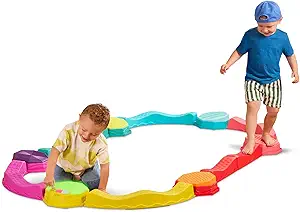 | Best Sensory Balance Course | Product type: Modular musical balance course | Sensory stones: 5 | Wavy beams: 8 | VIEW ON AMAZON | See Our Full Breakdown |
| TECKMICO 10-Pack Stepping Stones for Kids |  | Best Stackable Obstacle Course | Product type: Balance stepping-stone obstacle course | Stone count: 10 | Recommended age: 3 to 8 years | VIEW ON AMAZON | See Our Full Breakdown |
| gross motor skill game | Recommended age |
|---|---|
| National Geographic Kids Stepp | 3 years and up; listed range 36-72 months |
| Wiggle N Giggle Travel Card Ga | 3 years and up |
| edxeducation Joey Jump | 2 years and up |
| SmartYeen Stepping Stones | — |
| Learning Resources Crocodile H | 3 years and up |
| Maze Balance Board for Kids an | 3 years and up |
| Multi-Game Hopscotch Set with | 3-5 years |
| Quilinz Move and Match Game | — |
| GOODLYSPORTS Hopscotch & Bean | 3-5 years |
| Peaceable Kingdom Monkey Aroun | 2 years and up |
| hand2mind Green Indoor Scooter | — |
| HEY! PLAY! Hopscotch Rings Gam | 3 years and older |
| B. Toys Balance & Groove Set | 3 years and older |
| TECKMICO 10-Pack Stepping Ston | 3 to 8 years |
More Details on Our Top Picks
National Geographic Kids Stepping Stones & Balance Beams
I rank the National Geographic Kids Stepping Stones & Balance Beams as my top pick because it covers more gross motor patterns than a stones-only set. For kids ages 3+, four stepping stones, four straight beams, and four curved beams support jumping, careful foot placement, direction changes, and course planning. Compared with the SmartYeen Stepping Stones, the added beams create longer balance sequences, while the foam die and four activity cards give adults ready-made ways to vary play. I also give it the lead for its 150-pound capacity, stackable parts, and rubber bases. The tradeoff is a larger spread of hard pieces than a card or floor-mat game, and the maker advises against wet surfaces. Buyers wanting only a compact jumping path may find the SmartYeen set simpler.
Pros:- Stones plus straight and curved beams train varied movement patterns
- Foam die and four activity cards add structured challenges
- Non-slip rubber bases suit dry indoor and outdoor surfaces
- Stackable pieces support users up to 150 pounds
Cons:- Twelve hard pieces require more setup and floor space than card games
- Outdoor use is limited when surfaces are wet
- More cumbersome to transport than Wiggle N Giggle
Best for: I would choose this for families with kids ages 3 to 6 who want one configurable set for balance, jumping, coordination, and imaginative obstacle courses.
Not ideal for: I would skip it in homes with very little clear floor space or for wet-surface play, since the 12 pieces need room and are not recommended on wet ground.
- Recommended age:3 years and up; listed range 36-72 months
- Set size:12 course pieces
- Piece mix:4 stepping stones, 4 straight beams, 4 curved beams
- Accessories:Foam color die and 4 Play & Learn cards
- Maximum supported weight:150 lb
- Materials:Plastic and rubber
- Surface compatibility:Indoor or outdoor; not recommended on wet surfaces
- Item weight:2.24 kg
- Listed dimensions:16.93 x 4.72 x 10 in
Our verdict“I would make this the lead pick for kids because it provides the broadest mix of balance, jumping, and course-building play in this group.”
Wiggle N Giggle Travel Card Game
I place Wiggle N Giggle in the travel slot because its 108 cards across three prompt decks turn animal movements, secondary motions, and tasks into many combinations without bulky equipment. It asks kids ages 3+ to coordinate more than one action, so the gross motor challenge comes from sequencing the body rather than balancing on an object. Compared with Learning Resources Crocodile Hop, this game packs far smaller and suits camping, playdates, or hotel-room movement breaks; it also works with one child or a group. I rank it below the equipment-based picks for skill depth, since cards provide no raised surface, resistance, or catching target. Younger children may need an adult to read and combine prompts, and energetic groups still need safe open space. For portable variety, it offers the broadest prompt mix here.
Pros:- Three decks create many movement combinations
- Compact card format travels more easily than obstacle equipment
- Works with one child or a group
- Combines whole-body movement with animal vocabulary
Cons:- Younger players may need an adult to read and combine prompts
- Cards cannot provide the balance challenge of raised stones or beams
- Active prompts still require a clear play area
Best for: I would choose this for traveling families with kids ages 3+ who want a compact movement game for solo play, playdates, and group gatherings.
Not ideal for: I would skip it for kids who need targeted balance or catching practice, or who cannot follow card-based directions without adult help.
- Recommended age:3 years and up
- Card count:108 cards
- Number of decks:3
- Deck types:Animal Movement, Secondary Movement, and Task/Action
- Player count:1 or more
- Included instructions:1 instruction card
- Activity format:Combine an animal movement, body movement, and task
- Learning focus:Active play, coordination, motor skills, and animal vocabulary
Our verdict“I would pick Wiggle N Giggle for kids who need portable movement variety, but not as a substitute for hands-on balance equipment.”
edxeducation Joey Jump
I give edxeducation Joey Jump the catching-specialist role because its stomp board links a leg drive to tracking and catching a soft beanbag. That sequence develops lower-body force, timing, and hand-eye coordination in one repeatable activity, with leverage positions that change the launch height as a child’s control improves. The National Geographic obstacle course offers broader balance and route-building, but Joey Jump targets a skill those stones do not: judging a moving object’s path. It also supports solo turns or group play indoors and outdoors, and the textured board adds traction. I rank it behind the larger obstacle set because its play pattern is much narrower; repeated stomp-and-catch rounds may lose appeal for kids who prefer imaginative courses. Beanbags can also fly beyond the play zone, and children still need clear space around the board. This is purposeful catching practice, not an all-purpose movement kit.
Pros:- Connects leg movement, visual tracking, and catching in one activity
- Variable leverage points adjust beanbag launch height
- Textured board and soft beanbags support child-focused practice
- Suitable for solo, group, indoor, or outdoor play
Cons:- Stomp-and-catch play is less varied than a configurable obstacle course
- Missed catches can send beanbags outside the play area
- Does not provide sustained balance or route-planning practice
Best for: I would choose this for preschool and kindergarten kids who need focused practice with catching, launch control, timing, and hand-eye coordination.
Not ideal for: I would skip it for families seeking varied obstacle courses or quiet apartment play, since the activity is narrow and involves stomping and flying beanbags.
- Recommended age:2 years and up
- Game type:Stomp-and-catch launch board
- Core movements:Stomping, launching, tracking, catching, and jumping
- Skill focus:Gross motor control, agility, and hand-eye coordination
- Launch adjustment:Variable leverage points
- Board surface:Textured for added traction
- Targets:Soft, durable beanbags
- Board material:Durable plastic
- Play locations:Indoor and outdoor
Our verdict“I would choose Joey Jump for kids working specifically on catching and timing rather than broad obstacle-course play.”
SmartYeen Stepping Stones
I choose SmartYeen Stepping Stones for families who want straightforward balance practice without beams, cards, or a long rule set. The eight lightweight plastic stones can be spaced closely for cautious steps or farther apart for jumps, while rubber edging and textured tops address grip on indoor and outdoor surfaces. A color spinner adds a simple direction-following game. Compared with the National Geographic Kids Stepping Stones & Balance Beams, SmartYeen is easier to understand at a glance and has fewer parts to stack, carry, and store. That simplicity also caps progression: eight same-format stones create fewer course shapes than a 12-piece mix of straight and curved beams. I would also expect the spinner to produce less varied play than activity cards, and hard raised pieces still call for an uncluttered landing area. It is the cleaner basic choice, not the richest obstacle system.
Pros:- Eight stones can be arranged for easier steps or wider jumps
- Textured tops and rubber edging improve grip
- Lightweight, stackable construction simplifies storage
- Included spinner turns color matching into a movement game
Cons:- Eight same-format stones offer fewer layouts than a mixed beam set
- Spinner provides less activity variety than cards or multi-deck games
- Hard raised stones require a clear landing area and attentive setup
Best for: I would choose this for families with toddlers who want an uncomplicated first set for stepping, jumping, color matching, and basic balance practice.
Not ideal for: I would skip it for older kids who need varied course geometry or families seeking guided activities beyond a simple color spinner.
- Age range:Toddler
- Set size:8 stepping stones
- Included accessory:Color spinner
- Materials:Plastic and rubber
- Grip features:Textured tops and non-slip rubber edging
- Play locations:Indoor and outdoor
- Storage design:Stackable
- Item weight:2.17 kg
- Listed dimensions:10 x 9 x 1.7 in
Our verdict“I would buy the SmartYeen set for kids who need a simple introduction to balance without the added complexity of beams or layered rules.”
Learning Resources Crocodile Hop Floor Game
I rank Learning Resources Crocodile Hop as the best learning crossover because movement is tied directly to colors, shapes, numbers 1-10, counting, and directions. Its 100-by-30-inch vinyl mat, two inflatable cubes, and 40 animal markers can guide one to four kids through structured hops and problem-solving tasks, which gives preschool teachers and homeschool families more curriculum value than the free-form SmartYeen Stepping Stones. Compared with Wiggle N Giggle, the large printed path makes each destination visible instead of relying only on card prompts, a helpful difference for early learners. I place it below the raised balance sets for pure gross motor development because a flat mat offers less balance challenge. It also demands a long strip of floor, takes more setup than cards, and inflatable cubes can be less convenient than solid components. My ranking favors it when learning goals matter as much as active play.
Pros:- Combines gross motor play with colors, shapes, counting, and numbers
- Large visual path gives early learners clear movement destinations
- Supports one to four players
- Forty animal markers and an activity guide support structured lessons
Cons:- The 100-inch mat requires a long clear section of floor
- Flat vinyl provides less balance difficulty than raised stones or beams
- Inflatable cubes require setup before play
Best for: I would choose this for preschool teachers, homeschool families, and parents who want kids to practice early academics while hopping and following directions.
Not ideal for: I would skip it in small rooms or for kids who need a demanding balance workout, since the 100-inch flat mat needs substantial floor length.
- Recommended age:3 years and up
- Player count:1-4
- Mat size:100 x 30 in
- Cubes:2 inflatable 5-inch cubes
- Game markers:40 animal markers
- Instructions:Activity guide included
- Learning focus:Colors, shapes, numbers 1-10, counting, directions, and problem solving
- Usage:Indoor floor game
- Item weight:0.75 kg
Our verdict“I would choose Crocodile Hop for kids who learn best while moving, especially when preschool concepts matter more than advanced balance work.”
Maze Balance Board for Kids and Toddlers with Labyrinths and Balls
I rank the Maze Balance Board as the strongest balance-and-focus challenge in this group because children must control both their posture and a moving ball. The 30-degree tilt creates a more demanding coordination task than the National Geographic Kids Stepping Stones & Balance Beams, which focuses more on foot placement across a course. Its three interchangeable labyrinths give kids a reason to repeat the activity, while the 140-pound limit accommodates a broad range of young players. The tradeoff is a steeper learning curve: some three-year-olds may struggle to balance while tracking the ball. It also offers less variety than the GOODLYSPORTS set, and outdoor play calls for a flat, grippy surface plus close adult supervision.
Pros:- Combines whole-body balancing with visual tracking and concentration
- Three labyrinth boards provide more replay value than a single fixed maze
- Supports children and larger users up to 140 pounds
- CPSC-certified plastic construction suits frequent active play
Cons:- Coordinating the board and ball may be too difficult for some three-year-olds
- Provides a narrower range of movements than an obstacle-course set
- Needs supervision and a level, slip-resistant surface
Best for: Families with kids ages 3 and up who want a focused balance activity that also exercises coordination and concentration
Not ideal for: Young toddlers who become frustrated by multitask challenges or homes without a clear, stable play surface
- Material:PP and PE plastic
- Weight Support:Up to 140 lbs
- Tilt Angle:30 degrees
- Recommended Age:3 years and up
- Labyrinth Boards:3
- Balls:3
- Safety Certification:CPSC
Our verdict“I recommend this for kids who are ready for a more concentrated balance challenge rather than a fast, free-form movement game.”
Multi-Game Hopscotch Set with Toss Bean Bags for Kids
I favor the Multi-Game Hopscotch Set for preschool groups because its 10 rings and 10 bean bags support more shared activity than many basic hopscotch kits. Compared with GOODLYSPORTS Hopscotch & Bean Bag Toss, it supplies five more connectors and four more bean bags, making it easier to build varied paths and keep several kids involved. Hopping develops balance and leg control, while target tossing adds hand-eye coordination without demanding separate equipment. The reconfigurable course also gives adults room to adjust difficulty. Its limits are age and stability: children beyond the three-to-five range may outgrow the simple games, and plastic rings can shift or wear on rough outdoor surfaces. It is more social than the Maze Balance Board but offers a less concentrated balance workout.
Pros:- Ten bean bags make the set practical for turn-taking and group games
- Fifteen connectors allow more course arrangements than the GOODLYSPORTS set
- Combines jumping, balance, aim, and hand-eye coordination
- Works in suitable indoor and outdoor play areas
Cons:- The activities may feel too simple for children older than the stated age range
- Plastic components may wear faster on abrasive outdoor surfaces
- Loose rings require supervision because they can move during energetic play
Best for: Preschools, playgroups, and families with several children ages 3-5 who need an adaptable movement game
Not ideal for: Older kids seeking a difficult agility course or families planning frequent use on rough pavement
- Game Format:2-in-1 hopscotch and bean bag toss
- Plastic Rings:10
- Connectors:15
- Bean Bags:10
- Recommended Age:3-5 years
- Material:Plastic
- Play Locations:Indoor and outdoor
- Color Style:Vibrant multicolor
Our verdict“I recommend this for groups of young kids who will benefit from varied hopping and tossing activities with plenty of pieces to share.”
Quilinz Move and Match Game
I place the Quilinz Move and Match Game in the mindful movement slot because it connects yoga poses, balance, coordination, and social play without requiring a large course. Its 18 wooden discs and two dice create more prompt combinations than a simple movement card deck, giving families room to vary each session. Compared with Peaceable Kingdom Monkey Around, Quilinz is less centered on parent-toddler bonding and more suited to flexible group movement. It is also quieter and easier to contain than the Multi-Game Hopscotch Set. That calmer format brings a tradeoff: kids who want running, jumping, or competitive targets may find it lower-intensity. Toddlers may need an adult to interpret each activity, and the wooden pieces demand more care outdoors than an all-plastic set.
Pros:- Blends balance and coordination work with calmer yoga-based movement
- Eighteen discs and two dice support varied activity combinations
- Encourages children to move and interact as a group
- Requires little floor space or setup equipment
Cons:- Provides less vigorous gross motor activity than hopscotch or obstacle courses
- Toddlers may need adult help understanding and performing the prompts
- Wooden components may not tolerate moisture or heavy outdoor wear as well as plastic
Best for: Families, classrooms, and small groups seeking calm gross motor practice through yoga, matching, and balance prompts
Not ideal for: Highly energetic kids who prefer obstacle courses, fast jumping games, or competitive throwing activities
- Wooden Discs:18
- Dice:1 color die and 1 number die
- Primary Material:Wood
- Intended Players:Kids and toddlers
- Activities:Yoga poses and movement prompts
- Skills Practiced:Balance, coordination, and social play
- Play Locations:Indoor and outdoor
Our verdict“I recommend Quilinz for kids who respond well to guided, social movement and need a calmer alternative to high-energy gross motor games.”
GOODLYSPORTS Hopscotch & Bean Bag Toss
I position GOODLYSPORTS Hopscotch & Bean Bag Toss as the best preschool obstacle-course starter because its rings can become hopscotch rows, agility stations, or throwing targets. That flexibility helps children practice jumping, balance, route planning, and aim without committing to bulky play equipment. Compared with the HEY! PLAY! Hopscotch Rings Game, GOODLYSPORTS adds six bean bags, broadening the activity beyond footwork. The Multi-Game Hopscotch Set remains better for groups because it has more connectors and bean bags; this is the smaller shared-play kit. Its ring-based layout also lacks the raised challenge of National Geographic Kids Stepping Stones & Balance Beams. Plastic rings may slide on smooth floors or suffer wear on rough ground, so the rearrangeable design works best with adult setup and supervision.
Pros:- Supports hopscotch, agility drills, obstacle-course layouts, and target tossing
- Reconfigurable rings let adults vary routes and movement patterns
- Six bean bags add upper-body coordination to the jumping activities
- Compact pieces work in suitable indoor and outdoor spaces
Cons:- Includes fewer connectors and bean bags than the Multi-Game Hopscotch Set
- Flat rings provide less balance difficulty than stepping stones or beams
- Rings may shift on smooth floors and wear on abrasive outdoor surfaces
Best for: Parents and preschool teachers who want a simple, reconfigurable course for kids ages 3-5
Not ideal for: Large groups needing many bean bags or children ready for raised, demanding balance equipment
- Game Format:2-in-1 hopscotch and bean bag toss
- Plastic Rings:10
- Attachments:10
- Bean Bags:6
- Bean Bag Colors:2
- Recommended Age:3-5 years
- Course Style:Reconfigurable patterns
- Play Locations:Indoor and outdoor
Our verdict“I recommend this as an approachable first obstacle-course set for preschool kids who need varied jumping and tossing practice.”
Peaceable Kingdom Monkey Around First Game for Toddlers
I rank Peaceable Kingdom Monkey Around as the best first gross motor game because it turns toddler-friendly actions into shared play with a parent. The cards prompt balancing, hopping, marching, hugs, and high fives, while the banana beanbag introduces catching and tossing at an adjustable pace. Compared with Wiggle N Giggle, which begins at age three, Monkey Around reaches younger children at age two and gives adults clearer ways to assist emerging skills. It also covers a broader developmental mix than Quilinz Move and Match, pairing movement with body-part recognition, listening, spatial language, and vocabulary. The main limitation is adult participation; this is not an independent activity. It also lacks the vigorous repetition of hopscotch, and children who want competition or elaborate courses may lose interest.
Pros:- Designed specifically around the abilities and attention span of two-year-olds
- Covers balancing, hopping, marching, catching, and body awareness
- Parent participation supports children who need help completing movements
- Adds listening, spatial concepts, matching, and vocabulary to physical play
Cons:- Requires an engaged adult rather than supporting independent play
- Offers less vigorous exercise than hopscotch or an obstacle course
- Simple prompts may not hold the attention of older or competition-focused kids
Best for: Parents seeking a guided first movement game for a two-year-old who is still developing balance, listening, and catching skills
Not ideal for: Families wanting independent play, competitive rules, or a high-energy game for several older children
- Recommended Age:2 years and up
- Game Type:First board game with movement prompts
- Play Style:Interactive toddler-and-parent play
- Included Accessory:Banana beanbag
- Movement Activities:Balancing, hopping, marching, catching, hugs, and high fives
- Motor Skills:Gross motor development and coordination
- Learning Areas:Spatial concepts, body-part matching, listening, and vocabulary
- Awards:Oppenheim Platinum, PAL, and Parents’ Choice Silver
Our verdict“I recommend Monkey Around for parents who want a supportive, age-appropriate introduction to gross motor games for kids starting at age two.”
hand2mind Green Indoor Scooter Board with Handles
I rank the hand2mind Scooter Board as the strongest choice for kids who prefer rolling and gliding to hopping. Its seated movement works the core, coordination, and steering control, giving it a different gross-motor focus from the TECKMICO Stepping Stones, which center on upright balance. Recessed safety handles help keep fingers away from the wheels, while the 175-pound capacity allows a wider range of children to participate. The durable plastic body also suits shared PE or therapy settings where cleanup matters. This is less versatile than the B. Toys Balance & Groove Set because it offers one basic movement platform rather than a configurable course. It also needs a smooth, hard floor; carpet, uneven pavement, and tight rooms limit the fun. I see it as a focused movement tool, not a complete obstacle-course kit.
Pros:- Seated scooting develops core strength, coordination, and steering control
- Safety handles keep hands farther from the rolling wheels
- Plastic wheels are designed not to damage hard floors
- 175-pound capacity accommodates a broad range of children
Cons:- Works poorly on carpet and uneven outdoor surfaces
- Provides fewer game variations than a modular balance course
- Rolling play requires clear space and attentive supervision
Best for: Elementary-age kids, PE classes, and therapy spaces seeking seated movement that builds core strength and bilateral coordination
Not ideal for: Homes with mostly carpet or limited open floor space, since the board needs a smooth hard surface for controlled rolling
- Product type:Sit-down scooter board
- Dimensions:Approximately 16.5 x 11.25 x 3.75 inches
- Maximum capacity:175 pounds
- Body material:Hard plastic
- Wheel material:Plastic
- Safety feature:Integrated handles that keep fingers away from wheels
- Recommended surfaces:Gym floors, hard indoor floors, basements, and smooth blacktop
- Available models:Blue, purple, green, and heavy-duty red
Our verdict“I recommend this for kids who need engaging seated core and coordination play on a smooth indoor floor.”
HEY! PLAY! Hopscotch Rings Game
The HEY! PLAY! Hopscotch Rings Game earns its place through portability and easy rearrangement. Ten rings and 15 snap connectors let kids build straight, branching, or invented jumping paths, so the game trains balance, leg strength, and movement planning without a permanent chalk layout. Compared with the hand2mind Scooter Board, this set encourages upright jumping and can move between a living room, driveway, park, or sidewalk. It is also simpler than the B. Toys Balance & Groove Set, making it easier to pack but less sensory-rich. I would choose it for families wanting quick indoor-outdoor setup rather than a substantial obstacle course. The 11-inch rings may feel restrictive for bigger feet, and the product data does not identify a non-slip base. Connectors also keep the layout together but reduce the freedom to space rings independently.
Pros:- Ten rings support varied hopping and jumping patterns
- Fifteen snap connectors hold custom layouts together
- Portable design works indoors and outdoors
- Open-ended configurations encourage kids to invent movement games
Cons:- Eleven-inch rings can be small landing targets for bigger children
- No non-slip base is identified in the product data
- Loose rings and connectors require setup and collection after play
Best for: Families with kids ages 3 and older who want a lightweight jumping game that travels between indoor and outdoor play areas
Not ideal for: Older or larger children needing generous landing targets, or homes where slick floors make unsecured plastic rings a concern
- Game type:Configurable hopscotch ring set
- Ring count:10
- Connector count:15
- Ring diameter:11 inches
- Connector length:3.25 inches
- Material:Plastic
- Recommended age:3 years and older
- Use locations:Indoor and outdoor
- Color:Multicolored
Our verdict“I favor this set for kids who want portable hopscotch variety without the bulk of a raised balance course.”
B. Toys Balance & Groove Set
I place the B. Toys Balance & Groove Set highest for kids who stay engaged through sound, texture, and changing challenges. Eight wavy beams, five sensory stones, and one musical pod create a modular balance route that works coordination more broadly than the single-action hand2mind Scooter Board. Against the TECKMICO Stepping Stones, this set adds connected beams and musical feedback, making the course feel more guided and varied. Compatibility with B. Toys Balance & Build and Balance & Hops sets also leaves room for expansion. That richer play design brings tradeoffs: it occupies more floor space, has more pieces to arrange, and is described for indoor use rather than park or backyard sessions. Younger kids may also need hands-on supervision while learning the raised path. I rank it as the most engaging structured course, but not the easiest set to store or carry.
Pros:- Combines balance, sensory, and musical play in one course
- Modular pieces support many configurations and difficulty changes
- Eight beams create more varied movement than stepping stones alone
- Compatible with two other B. Toys balance sets
Cons:- Indoor-only positioning limits where families can use it
- Fourteen course components require more setup and storage space
- Young children may need close supervision on configured paths
Best for: Kids ages 3 and older who respond well to musical feedback, sensory surfaces, and frequently changing indoor balance courses
Not ideal for: Families seeking a compact outdoor game or a fast one-piece activity with almost no setup
- Product type:Modular musical balance course
- Sensory stones:5
- Wavy beams:8
- Musical pods:1
- Total course pieces:14
- Recommended age:3 years and older
- Use location:Indoor
- Compatible sets:B. Toys Balance & Build and Balance & Hops
Our verdict“I would pick this for kids who need sensory and musical variety to stay involved in indoor gross-motor play.”
TECKMICO 10-Pack Stepping Stones for Kids
The TECKMICO 10-Pack Stepping Stones is my pick for families who want a longer balance route that still stores neatly. Ten separate stones give kids room to build winding paths, color games, races, and increasing gap challenges, supporting balance, coordination, and distance judgment. Unlike the connected HEY! PLAY! Hopscotch Rings, these pieces can be spaced freely and offer a textured stepping surface with a non-slip rubber base. The B. Toys Balance & Groove Set supplies more sensory and musical variety, but TECKMICO is better suited to moving between home, school, parties, and the park. Its stackable design is the key practical advantage. The tradeoff is a less guided experience: there are no game cards, beams, music, or connectors, so adults may need to invent activities. The supplied data also omits stone dimensions and weight capacity, leaving fit for larger kids less certain.
Pros:- Ten stones create longer and more varied obstacle routes
- Textured tops and non-slip rubber bases support steadier footing
- Stacking design makes transport and storage easier
- Indoor-outdoor construction suits home, park, school, and party play
Cons:- No dimensions or maximum weight capacity are supplied
- Lacks guided games, connectors, beams, or musical feedback
- Independent pieces may shift if placed on unsuitable surfaces
Best for: Families, preschools, and activity leaders wanting a portable 10-stone course for kids ages 3 to 8 across indoor and outdoor settings
Not ideal for: Buyers who need published dimensions or weight limits, or kids who need prompts and musical feedback to sustain play
- Product type:Balance stepping-stone obstacle course
- Stone count:10
- Recommended age:3 to 8 years
- Stepping surface:Textured
- Base:Non-slip rubber
- Color count:10 bright colors
- Use locations:Indoor and outdoor
- Storage design:Stackable
Our verdict“I recommend this set for kids ages 3 to 8 who need a portable, freely configurable balance course with compact storage.”
How We Picked
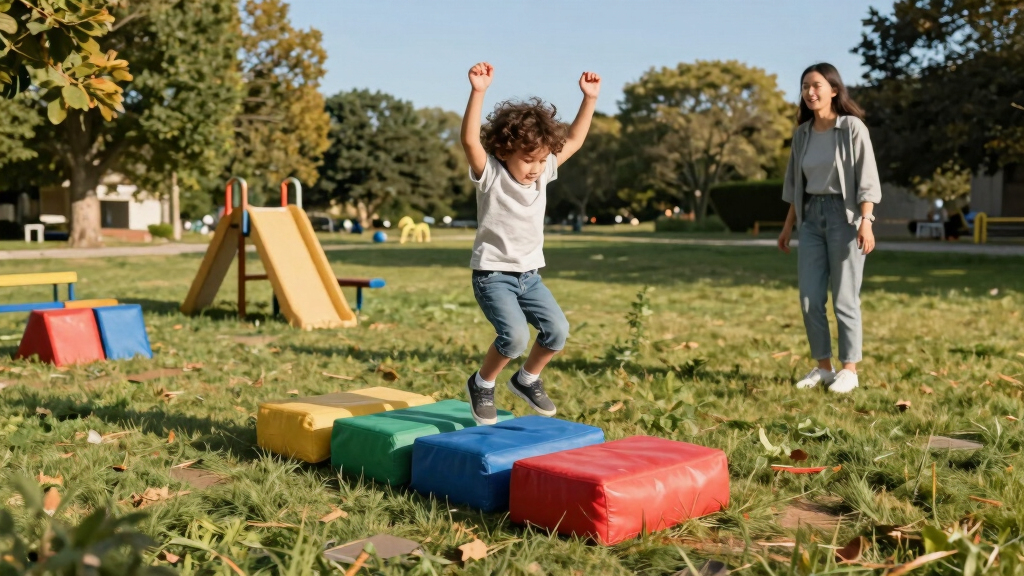
I evaluated these gross motor skill games based on several key criteria: build quality, safety features, age appropriateness, versatility (indoor and outdoor use), and overall value. Products that promote active engagement with minimal setup and durable materials earned higher rankings. I also looked for options that offered a variety of activities to support different motor skills, from balance to coordination. The ranking reflects a balance between affordability and quality, aiming to recommend choices suitable for a range of budgets and needs, especially for children. Each product was compared for its ability to deliver safe, fun, and meaningful physical development opportunities.Factors to Consider When Choosing Gross Motor Skill Games
Choosing the right gross motor skill game involves considering several factors that impact both safety and developmental value. The ideal product should match your child’s age and skill level, offer durability for active play, and be versatile enough for indoor and outdoor use. It’s also worth prioritizing equipment that can grow with your child or be easily stored away. Understanding these broader considerations helps avoid common pitfalls like overspending on overly complex equipment or selecting items that are too advanced or too simple for your child’s current abilities.Age Appropriateness and Skill Level
Selecting a game suitable for your child’s age ensures they stay engaged without frustration or safety risks. Younger children need simple, sturdy equipment that promotes basic balance and coordination, while older kids can benefit from more challenging obstacle courses or multi-step activities. Overly complex setups may intimidate younger kids, whereas overly simple options might bore older children. Always check age recommendations and consider your child’s current motor skills when choosing a game.
Durability and Safety
Since gross motor games involve active movement, durability is essential. Look for high-quality, non-slip surfaces, sturdy materials, and secure construction to prevent accidents. Cheaper plastic or foam products may wear quickly or become unsafe over time. Investing in equipment with good safety features, like rounded edges and non-slip bases, protects your child during vigorous activity and extends the product’s lifespan.
Versatility and Storage
Multi-use equipment that transitions from indoor to outdoor play broadens your options and maximizes value. Compact, lightweight options are easier to store and transport, making them ideal for families with limited space or those who travel. Consider whether the equipment can be easily assembled, disassembled, and stored without damage, which influences how often your child can use it and how well it fits into your daily routine.
Price and Long-Term Value
While budget options are tempting, investing in higher-quality equipment often results in better safety, durability, and engagement. Cheaper products may need replacement sooner or lack the features to support growth. Evaluating the cost-per-use helps determine whether a pricier item offers better long-term value, especially if you plan to use it regularly or across multiple children.
Ease of Setup and Maintenance
Active play equipment should be straightforward to set up and take down, especially if frequent storage is needed. Products that require minimal assembly save time and reduce frustration. Easy-to-clean surfaces or washable materials also contribute to ongoing safety and hygiene, making maintenance a practical consideration for busy families.
Frequently Asked Questions
What age range are gross motor skill games suitable for?
Most gross motor skill games are designed for children aged 2 to 8, with specific activities tailored to different developmental stages. Toddlers benefit from simple balance stones and soft obstacle courses, while preschoolers and early elementary children enjoy more complex challenges like maze boards and multi-step obstacle courses. Always check the product’s recommended age range to ensure safety and engagement, and consider your child’s current skills when choosing a game.
Can I use outdoor gross motor games indoors?
Many gross motor games are versatile enough for indoor use, especially those made from foam, rubber, or lightweight plastic. Indoor options are ideal for colder months or limited outdoor space, but they often have smaller footprints and less complex features. When using outdoor equipment indoors, ensure you have enough space and a non-slip, safe surface to prevent accidents. Some outdoor-focused equipment may require modifications or additional safety measures for indoor environments.
How do I choose a game that grows with my child’s abilities?
Look for multi-level or adjustable equipment that can be modified as your child’s skills develop. Products with modular features or multiple activity modes provide ongoing challenge and engagement. For example, balance beams with adjustable height or obstacle courses that can be expanded or rearranged help your child progress without needing to buy new equipment frequently. Prioritizing flexibility ensures you get more value over time.
Are electronic or digital gross motor games worth considering?
While electronic options can add interactive features and variety, many children benefit most from physical, hands-on play that encourages real movement. Electronic games might include sensors or augmented reality, but these often require batteries or screens, which can distract from active engagement. For developing gross motor skills, non-electronic equipment like balance beams, obstacle courses, and outdoor games generally provide more direct physical benefits and are more durable over time.
What safety features should I look for in gross motor skill equipment?
Safety features include non-slip bases, rounded edges, soft padding, and sturdy construction. Equipment that moves or shifts easily should have secure grips or weights to prevent tipping. Avoid sharp corners, fragile materials, or thin plastic parts that could break or cause injury. Ensuring the product meets safety standards and is age-appropriate helps create a safe environment for active, vigorous play.
Conclusion
For parents seeking the best overall value, the National Geographic Kids Stepping Stones & Balance Beams offers durability and versatility suitable for most families. Those on a tighter budget may find the Wiggle N Giggle Travel Card Game a fun, portable option. For families new to active play, the Peaceable Kingdom Monkey Around First Game provides gentle introduction with parent involvement. If you’re looking for a premium setup, consider equipment that combines multiple activities or adjustable features. Ultimately, prioritize safety, age-appropriateness, and your child’s interests to choose the perfect gross motor skill game.
Halloween Picks
halloween
As an affiliate, we earn on qualifying purchases.