If you’re starting out, I recommend versatile lenses like zooms with wide apertures—think 18-55mm or 24-70mm—great for many shots and low-light situations. Macro lenses, like the 60mm F2.8, are perfect for close-up details, while longer focal lengths are awesome for portraits or wildlife. Autofocus speed and optical stabilization are also key for sharp images. Stick around, and you’ll find all the expert tips to choose the perfect gear for your style.
Key Takeaways
- Prioritize versatile zoom lenses like 18-55mm for beginner flexibility and ease of use.
- Choose lenses with wide maximum apertures (e.g., f/1.8) for better low-light performance and creative depth.
- Consider autofocus speed and image stabilization features for sharp, professional-looking images.
- Match lens compatibility with your camera system, ensuring proper mount and sensor size (APS-C or full-frame).
- Start with affordable, multi-purpose lenses and upgrade gradually based on evolving photography needs.
| Canon EOS 2000D Rebel T7 DSLR Camera Bundle | 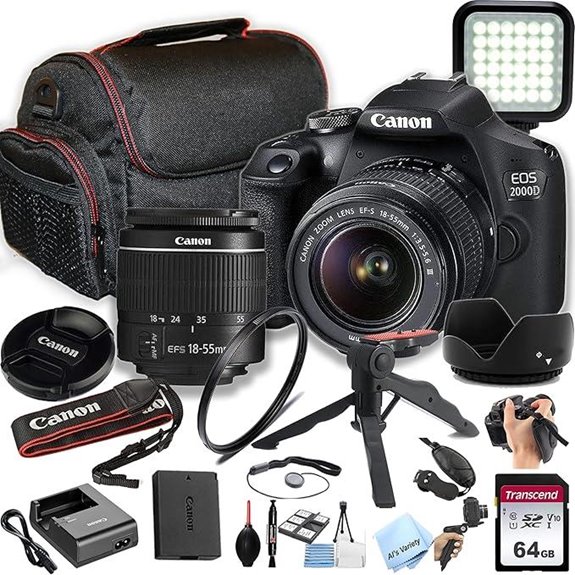 | Best Entry-Level DSLR | Mount Type: Canon EF-S mount | Focus Type: Autofocus | Focal Length: 18-55mm | VIEW LATEST PRICE | See Our Full Breakdown |
| Canon EOS 4000D DSLR Camera Kit with Accessories |  | Best All-In-One Kit | Mount Type: Canon EF-S mount | Focus Type: Autofocus | Focal Length: 18-55mm | VIEW LATEST PRICE | See Our Full Breakdown |
| Canon EOS Rebel T7 DSLR Camera with 18-55mm Lens | 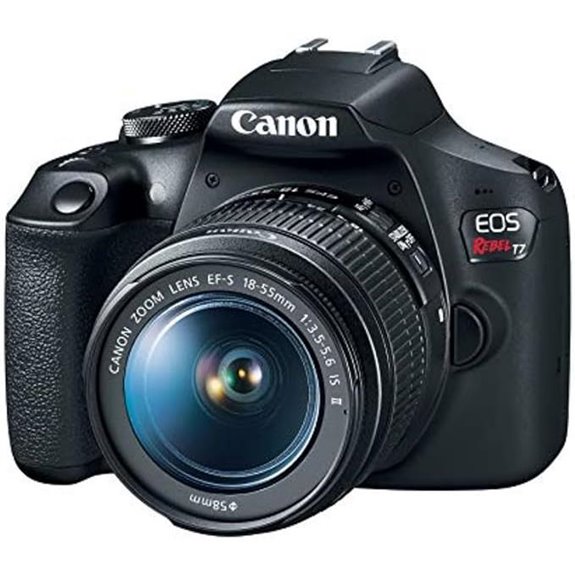 | User-Friendly DSLR | Mount Type: Canon EF/EF-S mount | Focus Type: Autofocus | Focal Length: 18-55mm | VIEW LATEST PRICE | See Our Full Breakdown |
| Canon EOS R100 Mirrorless Camera Kit |  | Compact Mirrorless Choice | Mount Type: RF-S mount | Focus Type: Autofocus | Focal Length: 18-45mm | VIEW LATEST PRICE | See Our Full Breakdown |
| Canon EOS Rebel T7 DSLR Camera Kit | 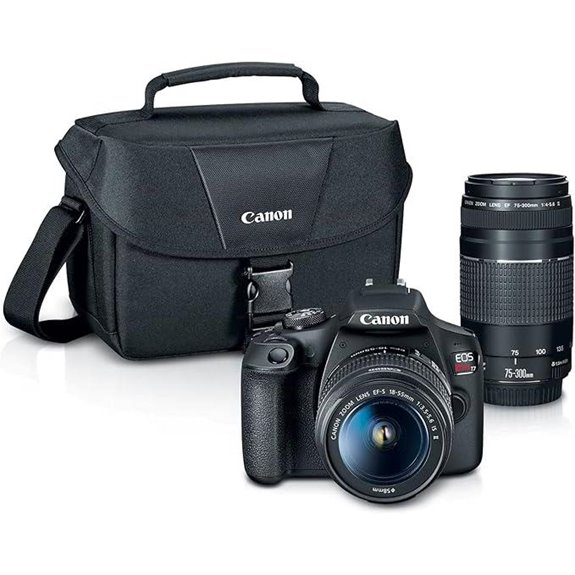 | Versatile DSLR Bundle | Mount Type: Canon EF/EF-S mount | Focus Type: Autofocus | Focal Length: 18-55mm & 75-300mm | VIEW LATEST PRICE | See Our Full Breakdown |
| Canon EOS Rebel T7 DSLR Camera Bundle with Accessories |  | Complete Beginner Set | Mount Type: Canon EF/EF-S mount | Focus Type: Autofocus | Focal Length: 18-55mm | VIEW LATEST PRICE | See Our Full Breakdown |
| 7artisans 60mm F2.8 Macro Lens for Sony APS-C Cameras |  | Macro Specialty Lens | Mount Type: Sony E-mount | Focus Type: Manual focus | Focal Length: 60mm | VIEW LATEST PRICE | See Our Full Breakdown |
More Details on Our Top Picks
Canon EOS 2000D Rebel T7 DSLR Camera Bundle
If you’re just starting out with DSLR photography, the Canon EOS 2000D Rebel T7 Bundle is an excellent choice to kick off your journey. It features a 24.1MP APS-C CMOS sensor and DIGIC 4+ processor, delivering sharp, detailed images. The 3.0-inch LCD monitor and optical viewfinder offer flexible composing options, while built-in Wi-Fi and NFC make sharing photos easy. It supports Full HD 1080p video and has an ISO range up to 12800 for low-light shots. The bundle includes the versatile EF-S 18-55mm lens, a 64GB memory card, tripod, and accessories, giving you everything you need to explore photography.
- Mount Type:Canon EF-S mount
- Focus Type:Autofocus
- Focal Length:18-55mm
- Aperture Range:f/3.5-5.6
- Intended Use:Macro/General
- Special Features:Built-in ED element
- Additional Feature:Built-in Wi-Fi with NFC
- Additional Feature:Internal livestream recording
- Additional Feature:Comprehensive accessory bundle
Canon EOS 4000D DSLR Camera Kit with Accessories
The Canon EOS 4000D DSLR Camera Kit with Accessories is an excellent choice for beginners who want a versatile and user-friendly entry into photography. It features an 18.0MP APS-C CMOS sensor and DIGIC 4+ processor, delivering sharp images and full HD video. The kit includes an EF-S 18-55mm lens with autofocus and optical viewfinder, making framing easy. It supports Wi-Fi for quick sharing and comes with useful accessories like a tripod, filters, and a memory card. With guided auto modes and manual controls, it’s perfect for learning the basics and progressing as a photographer. Plus, the renewed model offers a 1-year warranty, ensuring confidence in your purchase.
- Mount Type:Canon EF-S mount
- Focus Type:Autofocus
- Focal Length:18-55mm
- Aperture Range:f/3.5-5.6
- Intended Use:General/Beginner
- Special Features:ED element, compact
- Additional Feature:Supports Canon Connect app
- Additional Feature:Includes photo/video editing software
- Additional Feature:International version availability
Canon EOS Rebel T7 DSLR Camera with 18-55mm Lens
For beginners looking to explore photography with confidence, the Canon EOS Rebel T7 DSLR Camera with 18-55mm Lens offers an excellent combination of simplicity and quality. Its 24.1-megapixel CMOS sensor captures sharp, detailed images, while the DIGIC 4+ processor guarantees fast performance. The camera features a 9-point autofocus system and an optical viewfinder with about 95% coverage, making it easy to compose shots accurately. Plus, built-in Wi-Fi and NFC let you share your photos effortlessly. Whether you’re shooting stills or Full HD videos, this camera provides versatile capabilities in a user-friendly package perfect for those just starting out.
- Mount Type:Canon EF/EF-S mount
- Focus Type:Autofocus
- Focal Length:18-55mm
- Aperture Range:f/3.5-5.6
- Intended Use:General/Beginner
- Special Features:Compact, versatile
- Additional Feature:Compatible with EOS Utility Webcam
- Additional Feature:Excludes EF-M lenses
- Additional Feature:9-Point AF system
Canon EOS R100 Mirrorless Camera Kit
The Canon EOS R100 Mirrorless Camera Kit stands out as an ideal choice for beginners seeking a compact, user-friendly camera with impressive image quality. Its lightweight design makes it easy to carry and handle, perfect for those just starting out. The 24.1 MP APS-C sensor delivers sharp, detailed photos with a natural bokeh effect, enhancing your creative shots. It supports 4K video and slow-motion, offering versatile recording options. With the DIGIC 8 processor and fast autofocus with eye and face detection, capturing moments becomes effortless. Whether you’re into photography or videography, this kit combines simplicity and performance, making it a smart choice for beginners.
- Mount Type:RF-S mount
- Focus Type:Autofocus
- Focal Length:18-45mm
- Aperture Range:f/4.5-6.3
- Intended Use:General/Videography
- Special Features:Image stabilization
- Additional Feature:4K video recording
- Additional Feature:Dual Pixel AF system
- Additional Feature:Compact lightweight design
Canon EOS Rebel T7 DSLR Camera Kit
If you’re starting out in photography and want a reliable, versatile camera, the Canon EOS Rebel T7 DSLR Camera Kit is an excellent choice. It features a 24.1 Megapixel CMOS sensor that delivers sharp, detailed images, perfect for beginners. The kit includes two lenses—an 18-55mm and a 75-300mm—giving you flexibility for both wide-angle shots and zoomed-in details. With built-in Wi-Fi and NFC, sharing your photos is quick and easy. Its optical viewfinder, along with autofocus systems like AI Servo AF, makes capturing moments straightforward. Plus, it records Full HD 1080p videos, making it a well-rounded entry-level DSLR.
- Mount Type:Canon EF/EF-S mount
- Focus Type:Autofocus
- Focal Length:18-55mm & 75-300mm
- Aperture Range:Variable (f/3.5-5.6 & f/4.5-6.3)
- Intended Use:General/Versatile
- Special Features:Includes telephoto lens option
- Additional Feature:Eye detection AF
- Additional Feature:Supports EOS Utility Webcam
- Additional Feature:Includes two lenses
Canon EOS Rebel T7 DSLR Camera Bundle with Accessories
Looking for an easy-to-use DSLR bundle that offers both quality and versatility? The Canon EOS Rebel T7 DSLR Camera Bundle is a great choice. It features a 24.1MP APS-C CMOS sensor, DIGIC 4+ processor, and a 3-inch LCD monitor, making it simple to capture sharp photos and full HD videos. The kit includes an EF-S 18-55mm lens, extra battery, two 64GB memory cards, and useful accessories like a bag, flash, and remote. With built-in Wi-Fi and NFC, sharing and remote control are seamless. Its user-friendly auto modes and feature guide make it perfect for beginners looking to explore photography confidently.
- Mount Type:Canon EF/EF-S mount
- Focus Type:Autofocus
- Focal Length:18-55mm
- Aperture Range:f/3.5-5.6
- Intended Use:General/Versatile
- Special Features:Extra-low dispersion element
- Additional Feature:Scene Auto, Basic+, Creative modes
- Additional Feature:Feature guide included
- Additional Feature:1-Year manufacturer warranty
7artisans 60mm F2.8 Macro Lens for Sony APS-C Cameras
For beginner photographers using Sony APS-C mirrorless cameras, the 7artisans 60mm F2.8 Macro Lens stands out as an excellent choice thanks to its lightweight design and versatile focal length. Weighing only 342 grams and measuring 80.5mm, it’s easy to handle during extended shoots. Its manual focus allows precise control, perfect for macro, portraits, or still life. The lens features internal focusing and a minimum focus distance of 0.175m, capturing fine details and textures. With an advanced optical design, including an ED lens, it reduces aberrations for sharp, clear images. Plus, it’s compatible with various Sony models, making it a flexible, budget-friendly option for beginners.
- Mount Type:Sony E-mount
- Focus Type:Manual focus
- Focal Length:60mm
- Aperture Range:F/2.8
- Intended Use:Macro/Close-up
- Special Features:Manual focus, macro capability
- Additional Feature:Internal focusing system
- Additional Feature:Built-in ED lens
- Additional Feature:Lightweight, portable design
Factors to Consider When Choosing Camera Lenses for Beginners

When choosing a camera lens as a beginner, I consider my budget and what focal lengths suit my style. I also look at aperture options for better low-light shots, along with autofocus speed for quick captures. Finally, I check compatibility to make sure the lens works seamlessly with my camera.
Budget Constraints
Setting a realistic budget is essential for choosing the right camera lens as a beginner. I recommend balancing your needs with the cost of different lens types, like kit lenses versus prime or macro lenses. Starting with a versatile zoom lens, such as an 18-55mm, offers great value and flexibility without breaking the bank. Keep in mind that higher-quality lenses with advanced features tend to be much pricier, so focus on essential features within your budget. You might also find bundled deals or kits that include a lens and accessories, which can save you money upfront. Remember, investing in an affordable lens now allows you to upgrade later as your skills and budget grow, making this a smarter, more sustainable approach.
Focal Length Needs
Choosing the right focal length is essential for beginners because it directly influences the types of photos you’ll capture. An 18mm to 55mm range offers great versatility, covering wide-angle and standard shots. If you prefer landscapes or architecture, shorter focal lengths like 18-24mm help you capture expansive scenes. For portraits or detail shots, longer focal lengths above 50mm are ideal, providing better subject separation and background blur. Prime lenses with fixed focal lengths, such as 35mm or 50mm, encourage learning composition and often deliver sharper images at a lower cost. Understanding your focal length needs helps you select lenses that match your photography style and subjects. This knowledge ensures you invest in the right gear and grow your skills effectively.
Aperture Flexibility
Aperture flexibility plays a key role in how versatile and creative your photography can become. A lens’s aperture size, indicated by the f/number, controls how much light enters the camera. Lower numbers like f/1.8 let in more light, ideal for low-light situations, while higher numbers like f/16 restrict light and increase depth of field. Wide maximum apertures, such as f/1.4 or f/2.8, give you more control over exposure and background blur. Variable aperture lenses change their maximum aperture as you zoom, which can impact exposure and depth at different focal lengths. Prime lenses often have larger, constant apertures, offering better control over background softness. Lenses with adjustable aperture blades enable finer control over out-of-focus areas, boosting creative possibilities.
Autofocus Speed
Since quick autofocus is essential for capturing sharp images and staying in the moment, I always look for lenses with high autofocus speeds when shopping for beginner gear. Fast autofocus allows you to lock onto subjects quickly, reducing motion blur and missed shots, especially in dynamic scenes. It also helps in tracking moving subjects, making action shots much easier. For video, a lens with rapid autofocus ensures smooth focus shifts during recording, enhancing overall quality. Modern autofocus systems often use advanced tech like phase detection or dual pixel AF, which respond faster and more accurately. For beginners, choosing a lens with quick autofocus minimizes manual adjustments, streamlining the shooting process and boosting confidence. It’s a key feature for capturing sharp, professional-looking images effortlessly.
Compatibility Options
When selecting a lens, verifying its compatibility with your camera body saves you time and frustration later on. First, check that the lens mount matches your camera, whether it’s Canon EF-S, Sony E-mount, or another type. Next, confirm if the lens is designed for APS-C or full-frame sensors to avoid issues like vignetting or unwanted cropping. It’s also important to ensure the lens supports your camera’s autofocus system, especially with DSLRs that have specific AF requirements. Consider the lens’s maximum aperture and focal length to match your photography style and sensor size. Lastly, decide if you prefer manual focus, autofocus, or both—some lenses offer flexibility, which can be beneficial for beginners exploring their shooting preferences. Compatibility guarantees smooth performance and better results.
Image Stabilization
Image stabilization is an essential feature for beginners because it helps reduce blurriness caused by hand movement, especially in low-light situations. There are two main types: optical image stabilization (OIS) built into the lens and sensor-shift stabilization within the camera body. Lens-based stabilization is particularly effective for telephoto lenses and macro photography, where camera shake is more noticeable. Using stabilized lenses allows you to experiment with slower shutter speeds without sacrificing image clarity, opening up more creative possibilities. It also minimizes the effort needed to capture sharp photos, making it easier for beginners to achieve professional-quality results. Whether you choose lens-based or sensor stabilization, this feature considerably enhances your ability to take clear, crisp images in a variety of conditions.
Versatile Use
Choosing a versatile camera lens is all about covering a range of focal lengths to handle different shooting situations. I look for lenses like 18-55mm or 24-70mm, which work well for landscapes, portraits, and everyday shots. A moderate aperture, such as f/3.5-5.6, helps me manage low-light conditions and create pleasing background blur. Optical stabilization is essential for sharp images, especially when shooting handheld. I also consider compatibility with various camera mounts and the ability to adapt to different lenses, so I can expand my creative options later. Selecting a lens that offers macro, wide-angle, and standard focal lengths minimizes the need for multiple lenses. This versatility makes it easier for beginners to explore different genres without feeling limited.
Frequently Asked Questions
What Are the Best Budget-Friendly Lenses for Beginners in 2026?
If you’re looking for budget-friendly lenses, I recommend starting with a versatile kit zoom lens like the Canon EF-S 18-55mm or Nikon AF-P DX 18-55mm. These are affordable, easy to use, and great for everyday photography. Additionally, a 50mm prime lens like the Canon EF 50mm f/1.8 or Nikon AF-S FX NIKKOR 50mm f/1.8 offers excellent image quality at a low price, perfect for portraits and low-light shots.
How Do I Choose the Right Lens for Different Photography Styles?
Think of choosing a lens as picking the right tool for the job. I start by considering my photography style: for portraits, I prefer a prime lens with a wide aperture; for landscapes, a wide-angle lens works best. If I’m shooting action, I opt for a telephoto. Matching the lens to your style helps you capture the shot you envision. Trust your instincts and experiment to find your perfect match.
Are Third-Party Lenses Reliable for Beginner Photographers?
Yes, third-party lenses can be reliable for beginners, and I’ve used several with good results. They often offer great quality at a lower price than brand-name lenses, making them a solid choice as you’re learning. Just make sure to check compatibility with your camera, read reviews, and buy from reputable brands. With a bit of research, third-party lenses can definitely help you grow as a photographer.
How Important Is Lens Aperture When Starting Out?
The lens aperture is a big deal when you’re starting out because it controls how much light hits your camera sensor. A wider aperture, like f/1.8, is great for low-light scenes and creating a beautiful background blur. It’s the bread and butter for capturing sharp, stunning images. While not the only factor, understanding aperture helps you get creative and makes your photos stand out. It’s worth paying attention to!
What Maintenance Tips Keep Beginner Lenses Performing Well?
To keep your beginner lenses performing well, I recommend regularly cleaning the glass with a soft, microfiber cloth and using a blower to remove dust. Avoid touching the glass with your fingers and store your lenses in a padded case when not in use. I also make sure to keep the lens caps on and avoid extreme temperature changes to prevent damage and guarantee sharp images every time.
Conclusion
Choosing the right lens is like planting a seed—you nurture it, and with care, it blooms into stunning photos. Whether you’re starting with a versatile kit or a specialized macro lens, each choice shapes your photography journey. Remember, it’s not just about the gear but the passion you pour into capturing moments. Trust your instincts, experiment freely, and watch your skills blossom into a vibrant, beautiful garden of images.