
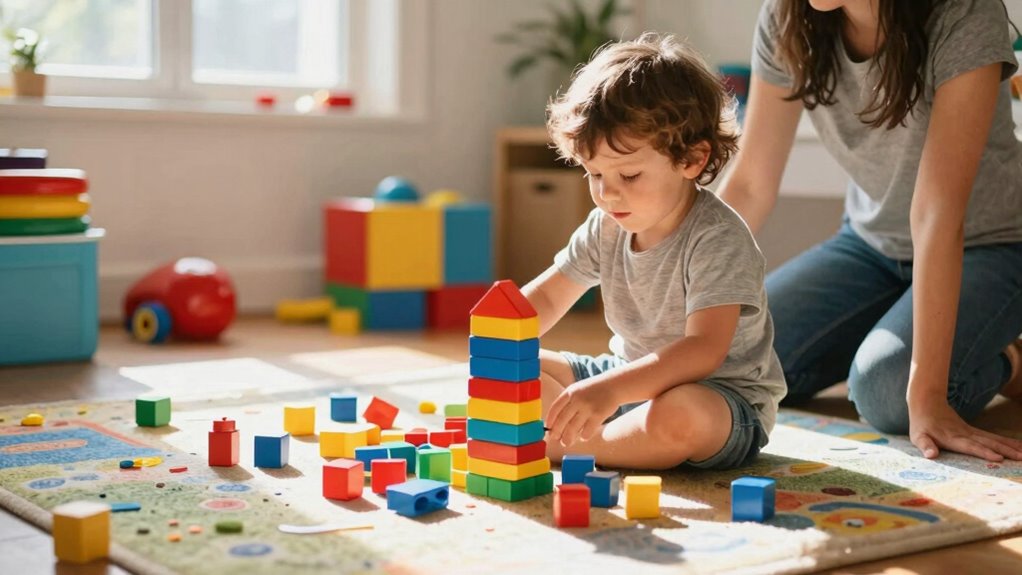

Play helps you develop key executive functions like problem-solving, self-regulation, and cognitive flexibility. When children figure out how to rebuild a tower or create stories, they practice planning and adjusting their approach. Play also teaches patience, turn-taking, and managing emotions, which strengthens their ability to regulate behavior and feelings. If you want to discover how play continues to support your child’s growth and learning, keep exploring these important connections.

Turn the school run and nap time into listening time
- Thousands of audiobooks, podcasts and originals
- Listen on your phone, tablet or Echo — also offline
- Cancel anytime
Key Takeaways
- Play activities promote planning, organization, and problem-solving skills essential for executive functioning.
- Engaging in play helps children develop self-regulation, impulse control, and emotional management.
- Play encourages cognitive flexibility and adaptability through role-switching and scenario changes.
- Persistent play challenges build resilience, perseverance, and strategic thinking.
- Overall, play supports the development of critical executive functions necessary for academic and social success.

Have you ever wondered how play influences your child’s ability to think, plan, and regulate their behavior? When your child engages in play, they’re not just having fun—they’re exercising their executive functions in real time. Playful problem solving is a core part of this process. As children navigate a game or toy, they learn to analyze problems, consider different solutions, and decide on the best course of action. For example, when a child builds a tower and it topples, they figure out how to rebuild it more carefully next time. This constant cycle of trial, error, and adjustment strengthens their ability to plan and adapt, which are vital executive functions. Engaging in diverse play environments can also expose children to biodiversity, encouraging them to explore and learn about different living things and ecosystems.
Play fosters problem-solving, adaptability, and planning skills essential for your child’s cognitive growth and success.
Imaginative planning takes play to an even deeper level. When your child invents stories or creates pretend scenarios, they’re practicing mental organization and foresight. They imagine the outcome of their actions, plan steps to achieve goals, and manage multiple ideas simultaneously. This kind of play fosters flexible thinking, helping them switch between different roles or scenarios smoothly. By pretending to be a firefighter or a chef, they develop the capacity to think ahead and anticipate consequences, skills that translate into everyday life challenges.
As your child develops these skills through play, they’re also honing their self-regulation. When they’re engaged in a game, they learn to wait their turn, follow rules, and manage frustration if things don’t go as planned. These moments of emotional regulation are essential for their social interactions and overall emotional health. Play provides a safe space to practice these skills without real-world consequences, reinforcing their ability to control impulses and stay focused.
Furthermore, play encourages persistence and resilience. When your child encounters obstacles in a game or activity, they learn to persevere, problem-solve, and adjust their strategies. These experiences directly support executive functions like working memory and cognitive flexibility. Over time, as they repeatedly face and overcome challenges during play, they build confidence and cognitive strength that benefits their academic and personal growth.
In essence, play isn’t just leisure—it’s a vital foundation for developing executive functions. Through playful problem solving and imaginative planning, your child learns to think critically, organize their thoughts, and regulate their behavior. As a parent, encouraging diverse and engaging play opportunities can significantly support their cognitive and emotional development, setting the stage for success in many areas of life.
children's problem-solving building blocks
As an affiliate, we earn on qualifying purchases.
As an affiliate, we earn on qualifying purchases.
Frequently Asked Questions
How Can Parents Improve Executive Function Skills Through Play?
You can improve your child’s executive function skills through play by encouraging creative problem solving, which challenges their thinking and decision-making abilities. Incorporate games that require planning and strategy to boost their organizational skills. Additionally, choose activities that promote emotional regulation, such as role-playing or cooperative games, helping them manage feelings and develop self-control. These play strategies foster stronger executive functions, supporting their overall cognitive and emotional growth.
What Are Common Signs of Executive Function Difficulties During Play?
You might notice some children struggle with play, showing signs like difficulty staying focused on playroom activities or frequently losing track of their toys. They may have shorter attention spans or get easily distracted, making it hard to organize their play environment. Such signs hint at executive function challenges. You can support them by creating structured play routines, helping improve their attention span and encouraging better playroom organization over time.
Does Play Influence Long-Term Executive Function Development?
Yes, play influences long-term executive function development by helping you transfer skills like problem-solving, self-control, and flexibility. Through different types of play, you build resilience, learning to adapt and manage challenges over time. This ongoing process strengthens executive functions, making you better equipped to plan, organize, and regulate your behavior in real-life situations. Play serves as a crucial foundation for developing skills essential for future success.
Are Certain Types of Play Better for Developing Executive Function?
Certain types of play are better for developing executive functions, especially those that involve problem-solving, planning, and social interaction. For example, unstructured play encourages creativity and flexibility, while games with rules boost self-regulation and working memory. These types of play offer key developmental benefits, helping you strengthen skills like attention, impulse control, and cognitive flexibility—crucial elements for successful daily functioning and learning.
How Does Executive Function Impact Social Interactions in Play?
Your executive function shapes your social interactions during play, often in subtle ways. It influences your social awareness, helping you pick up on others’ feelings, and emotional regulation, keeping you calm and focused. As you navigate play, these skills determine whether you connect smoothly or stumble over misunderstandings. Mastering your executive function not only improves your social skills but also makes play more rewarding and meaningful.
Conclusion
Understanding how executive function influences play reveals just how crucial these skills are for development. When you encourage activities that challenge planning, flexibility, and self-control, you’re helping children build essential life skills. Notably, a study shows that kids with strong executive function skills are 40% more likely to succeed academically and socially. So, by supporting play that fosters these abilities, you’re setting the stage for their future success—making play not just fun, but fundamentally important.
Halloween Picks
halloween
As an affiliate, we earn on qualifying purchases.