
When you pour water or place objects in water, you see how they sink or float based on buoyancy—the balance between weight and water displacement. Floating objects push aside enough water to support their weight, while sinking ones don’t displace enough. Water also responds to container shapes, showing fluid dynamics in action. Understanding these forces helps explain everyday water play, and if you keep exploring, you’ll uncover even more fascinating physics behind water behaviors.

Turn the school run and nap time into listening time
- Thousands of audiobooks, podcasts and originals
- Listen on your phone, tablet or Echo — also offline
- Cancel anytime
Key Takeaways
- Objects float or sink based on buoyant force versus their weight, influenced by shape and material.
- Pouring water raises the water level, demonstrating displacement and fluid adaptation to container shape.
- Floating objects displace a volume of water weighing more than themselves, maintaining balance.
- Water play activities illustrate physics concepts like buoyancy, displacement, and fluid dynamics.
- Changes in an object’s weight or shape affect how much water it displaces and whether it floats or sinks.

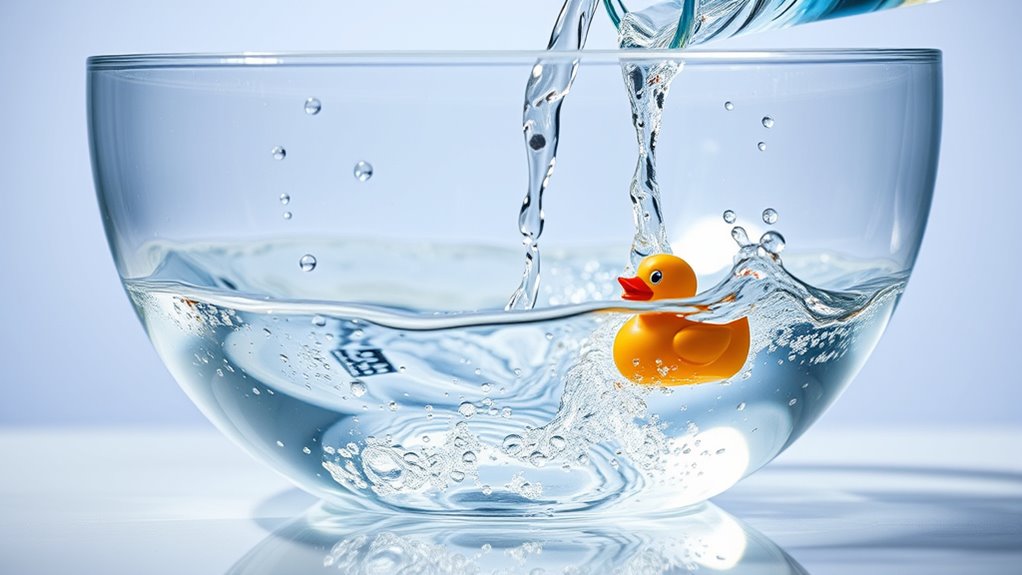
Water play isn’t just fun; it also reveals fascinating physics principles in action. When you toss a toy into the pool or watch a rubber duck bob along the surface, you’re observing buoyancy principles at work. Buoyancy explains why some objects float while others sink, and it all comes down to the balance of forces acting on an object submerged in water. When you place an object in water, it displaces a volume of water equal to the part of the object submerged. This water displacement creates an upward force called the buoyant force, which opposes gravity. If the buoyant force is greater than or equal to the weight of the object, it floats; if not, it sinks. This interplay of forces is fundamental to understanding why certain objects stay afloat while others don’t.
Objects float or sink based on displaced water and buoyant force balancing gravity.
As you pour water from one container to another, you’re witnessing water displacement firsthand. When you pour water into a glass, the level rises because the water molecules occupy space, pushing the existing water to the sides or up the container walls. This process isn’t just about pouring; it’s about how water moves and adapts to the shape of its container. The water’s volume remains constant, but the shape and surface level change based on the container’s geometry. The same principle applies when you fill a swimming pool or a small cup—they all involve water displacement, which illustrates how fluids respond to their container’s shape and the amount of water added.
Playing with floating objects, like boats or plastic figures, highlights the balance between the weight of the object and the water displacement it causes. For instance, a boat floats because it displaces a volume of water weighing more than the boat itself. The boat’s shape and material influence how much water it displaces and, consequently, whether it floats or sinks. If you load the boat with extra weight, it sinks lower, displacing more water to support the added mass. Conversely, removing weight causes the boat to rise, displacing less water. This dynamic illustrates how water displacement and buoyancy principles work together to keep objects afloat.
In essence, when you’re engaged in water play, you’re not just having fun—you’re exploring fundamental physics concepts. Understanding buoyancy principles and water displacement helps explain everyday phenomena like floating and sinking. It also encourages curiosity about how things interact with water in natural and engineered systems. For example, the shape and material of objects significantly influence their buoyancy and behavior in water. So, next time you splash around, remember that beneath the surface, physics is guiding your play, revealing the elegant balance of forces that makes water play so enthralling and insightful.
As an affiliate, we earn on qualifying purchases.
Frequently Asked Questions
How Does Water Temperature Affect Buoyancy?
You’ll notice that warmer water makes objects less buoyant, while cooler water increases buoyancy. This happens because of density variation caused by thermal expansion; as water heats up, it expands and becomes less dense. Conversely, cooler water contracts, increasing its density. When water’s density changes, it directly impacts buoyancy, making objects more likely to float in cold water and sink in warmer water.
Can Objects Float or Sink Based on Shape Alone?
Think of a boat and a pebble; their shape influences whether they float or sink. You see, an object’s shape affects how water interacts with it, but it’s primarily the density difference that determines sinking or floating. A well-shaped object can displace more water, helping it stay afloat if its density is less. So, shape alone can’t decide—it’s how shape influences density and water displacement that makes the difference.
Why Do Some Objects Float While Others Sink?
Some objects float while others sink because of density differences and material properties. When you place an object in water, if its density is less than water’s, it floats; if it’s more, it sinks. Material properties like porosity and composition affect density. You can test this by observing how different objects behave in water—light, less dense items float, while heavy, dense ones sink.
How Does Water Viscosity Influence Pouring Behavior?
You’ll notice that water’s viscosity affects how it pours; higher viscosity means thicker water, which flows more slowly and has a slower pour rate. Conversely, lower viscosity makes water flow more easily and quickly. When you pour, viscosity influences the flow pattern and speed, so thicker liquids tend to pour in a steadier, more controlled manner, while thinner liquids pour faster and with less resistance.
Are There Practical Ways to Control Sinking or Floating?
Think of controlling sinking or floating as steering a ship through waters of density. You can do this by manipulating the water’s density through temperature or adding substances like salt. Material selection also plays a key role; choose objects with density less than water to make them float, or denser materials to sink. These practical methods allow you to master water’s dance, guiding objects effortlessly through its liquid embrace.
Conclusion
As you explore water play physics, you become a master of the dance between sinking, floating, and pouring. Each splash and ripple reveals nature’s silent symphony, where forces work in harmony like a well-orchestrated ballet. By understanding these principles, you reveal the secrets behind everyday water wonders, turning simple play into a fascinating scientific adventure. So, keep experimenting—because in water’s gentle embrace, science and fun flow together endlessly.
Halloween Picks
halloween
As an affiliate, we earn on qualifying purchases.