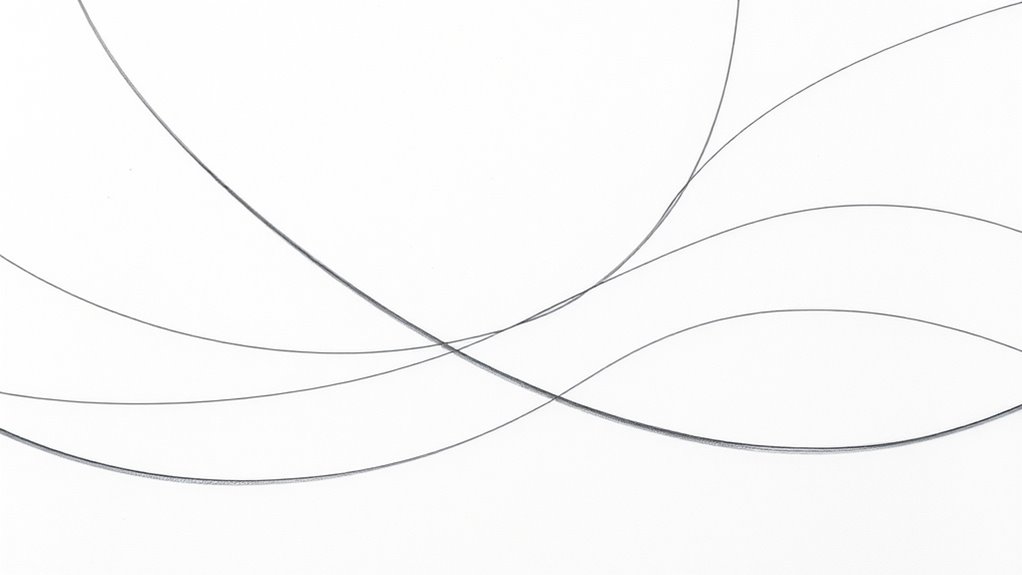
To master form drawing, focus on simple lines and curves that lay the foundation for exploring shape, movement, and space. Use spontaneous gesture exercises to capture energy and rhythm, helping you develop natural flow. Understand how lines interact—overlapping, crossing, or maintaining distance—to create depth and harmony. Regular practice simplifies complex ideas and sharpens your perception, building confidence. Keep exploring these basics, and you’ll discover more ways to enhance your artistry.
Key Takeaways
- Practicing varied lines and curves enhances hand-eye coordination and sharpens focus on form details.
- Using simple shapes and spontaneous gesture lines fosters intuitive understanding of spatial relationships.
- Concentrating on line quality and movement develops mental clarity and deepens engagement with the drawing process.
- Regular exploration of curves and lines builds confidence, simplifies complex forms, and encourages creative flow.
- Breaking down forms into basic lines and shapes improves focus, perception, and the ability to translate ideas visually.
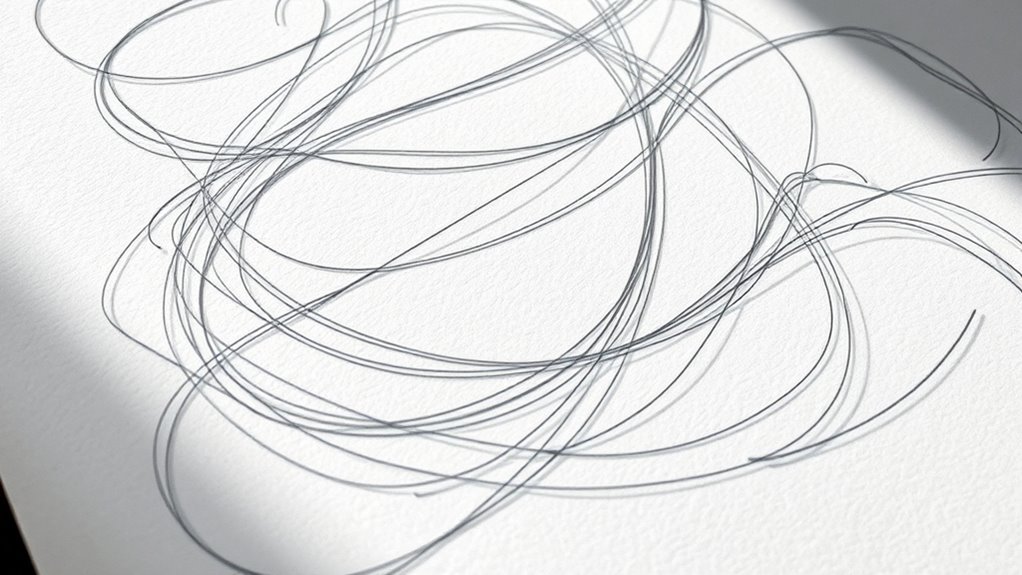
Have you ever wondered how simple shapes and lines can enhance your focus and creativity? In the world of form drawing, exploring basic gestures and understanding spatial relationships serve as powerful tools to *release* your potential. When you start with just a pencil and paper, it might seem straightforward, but the way you approach these lines and curves can *substantially* influence your mental clarity and artistic flow.
Gesture exploration is the foundation of effective form drawing. Instead of overthinking every stroke, you allow your hand to move freely, capturing the essence of motion and energy within the lines. This process helps you develop a natural rhythm, encouraging spontaneity rather than rigid perfection. As you experiment with different gestures—long, sweeping curves or quick, angular strokes—you train your mind to see the underlying movement in shapes. This practice improves your ability to translate complex ideas into simple, expressive lines, making your drawings more dynamic and alive.
Understanding spatial relationships is equally essential. When you draw, you’re not just creating isolated marks; you’re composing a visual dialogue between elements. By paying attention to how lines intersect, overlap, or maintain distance, you develop a sense of depth and proportion. For instance, placing a curve in relation to a straight line can evoke different feelings or emphasize certain aspects of your composition. Recognizing these relationships helps you create balance and harmony in your work, while also sharpening your ability to visualize three-dimensional space on a two-dimensional surface.
As you continue practicing, you’ll notice that these concepts reinforce each other. Gesture exploration trains your hand to move intuitively, while an awareness of spatial relationships guides your composition. Together, they foster a focused mindset, allowing your mind to stay present in each stroke, rather than distracted by perfectionism or doubt. This focus isn’t just about the act of drawing; it’s about cultivating a mental state that fuels creativity and clarity in all areas of your life.
Incorporating regular exercises that emphasize gesture exploration and spatial awareness can profoundly impact your approach to art and problem-solving. By simplifying complex ideas into fundamental lines and shapes, you develop a clearer understanding of structure and movement. Over time, this practice becomes a meditative routine that sharpens your focus, enhances your visual perception, and encourages you to trust your instincts. Ultimately, mastering these foundational skills turns your drawing sessions into a journey of discovery, where each line guides you toward greater insight and creative confidence.
Frequently Asked Questions
How Does Form Drawing Enhance Cognitive Development?
Form drawing enhances your cognitive development by improving your visual-spatial skills and motor coordination. As you draw lines and curves, you learn to interpret spatial relationships, which boosts your ability to understand and organize visual information. This practice also refines your motor skills, making your hand movements more precise and controlled. Over time, these improvements help you think more critically and solve problems more effectively.
Can Beginners Start Form Drawing Without Prior Art Skills?
Certainly, beginners can start form drawing without prior art skills. Embrace effort and exploration to build artistic confidence and boost creative exploration. Focus on fundamental lines and curves, practicing patience and persistence. Remember, progress comes from consistent practice, not perfection. By engaging actively, you’ll develop your skills gradually, transforming initial uncertainties into confident, creative expressions. Start simple, stay steady, and enjoy the journey of artistic discovery.
What Materials Are Best for Practicing Form Drawing?
You should choose materials with good material quality, like smooth, sturdy paper and reliable pencils, to enhance your practice routines. Using high-quality supplies helps you develop better control and precision. Opt for a variety of pencils (HB, 2B, 4B) to explore different line qualities. Consistently practicing with these materials builds confidence and skill, making your form drawing journey more enjoyable and effective.
How Long Does It Take to See Progress in Form Drawing?
You’ll start seeing progress in form drawing within a few weeks if you practice consistency and patience. Development varies for each person, but regular practice helps refine your lines and curves over time. Don’t get discouraged by initial results; steady effort builds skill. Keep focused, and you’ll notice improvement as your confidence and control grow through consistent, mindful practice. Patience is key to mastering this art form.
Are There Specific Exercises for Improving Focus Through Form Drawing?
You can dramatically boost your focus with specific form drawing exercises. Try mindfulness techniques like deep breathing before drawing, or attention exercises such as slow, deliberate line making. Focus on precise curves and lines, visualizing each movement clearly. These practices sharpen your attention and deepen your focus, making your drawing sessions more effective. Incorporate them regularly, and you’ll notice your concentration intensify, transforming your form drawing into a powerful mental discipline.
Conclusion
By mastering lines and curves in form drawing, you open your creative potential and deepen your understanding of shapes. Some might think it’s just about doodling, but it’s really a powerful way to develop focus, intuition, and artistic confidence. Don’t dismiss it as simple; embrace the process, and you’ll discover how these basic elements can transform your approach to art and design, making every stroke a meaningful expression of your unique perspective.