Nutricost Creatine Monohydrate Micronized Powder 500G is my best overall pick among the best creatine supplements because it pairs a standard monohydrate formula with 100 full servings and straightforward dosing. Jacked Factory Creatine Monohydrate Powder is the stronger value alternative when its current price per 5 g is lower, while Thorne Creatine suits buyers willing to pay more for premium positioning. The main choice is between economical powders, convenient capsules, and creatine HCl products that use smaller doses but have less supporting research than monohydrate. Buyers also need to compare actual grams per serving because a large capsule count can hide a modest daily supply. Continue reading for the full ranking and buyer-specific breakdown.

Turn the school run and nap time into listening time
- Thousands of audiobooks, podcasts and originals
- Listen on your phone, tablet or Echo — also offline
- Cancel anytime
Complete the kit


Key Takeaways
- Micronized monohydrate powders claimed the highest positions because they combine the most established creatine form with simple 5 g dosing and lower packaging demands than capsules.
- Nutricost 500G earned the overall lead through its balance of 100 servings, familiar monohydrate formulation, and uncomplicated daily use rather than a specialized claim.
- Jacked Factory is the value benchmark, but I would compare its current price per 5 g against Nutricost and Orgain instead of judging the tubs by sticker price.
- Capsule count was often misleading: Nutricost‘s 3,000 mg product requires four 750 mg capsules for only 3 g, while a powder can provide 5 g in one scoop.
- CON-CRET fills a distinct convenience role, yet its creatine HCl formula does not displace monohydrate as my default recommendation for research support and easy dose comparison.



| creatine supplement | Creatine type | Servings |
|---|---|---|
| Nutricost Creatine Monohydrate | Creatine monohydrate | 100 |
| Jacked Factory Creatine Monohy | Creatine monohydrate | 85 |
| CON-CRET Creatine HCl Capsules | — | — |
| Nutricost Creatine Monohydrate | Creatine monohydrate | — |
| MuscleTech Creatine Monohydrat | Creatine monohydrate | 80 |
| Animal Creatine Monohydrate Po | — | — |
| Bare Performance Nutrition BPN | Creatine monohydrate | 60 |
| Thorne Creatine Micronized Cre | Creatine monohydrate | 90 |
| Nutricost Micronized Creatine | — | — |
| Optimum Nutrition Creatine Mic | Micronized creatine monohydrate | — |
| Orgain 5g Creatine Monohydrate | — | 100 |
| Life Extension Creatine Capsul | — | — |
| Primaforce Creatine Monohydrat | — | — |
| Cellucor Cor-Performance Creat | Creatine monohydrate | 72 |
| Creatine Monohydrate Capsules | — | 60 |
More Details on Our Top Picks
Nutricost Creatine Monohydrate Micronized Powder 500G, 100 Servings
I rank Nutricost Creatine Monohydrate 500G as the best long-run supply because its 100 full 5-gram servings outlast both Jacked Factory’s 85-serving tub and MuscleTech Platinum’s 80-serving container. The micronized powder is designed to disperse more readily than coarse creatine, while the included scoop makes a standard daily dose easy to measure. It is a practical choice for buyers who already know they want plain creatine monohydrate and prefer fewer repeat purchases. The tradeoff is limited quality documentation in the supplied details: MuscleTech states third-party purity and banned-substance testing, while Jacked Factory identifies cGMP manufacturing. This Nutricost powder is also unflavored by default, so anyone who dislikes mixing plain powder may prefer CON-CRET capsules.
Pros:- Provides 100 standard 5-gram servings
- Micronized powder is intended for easier dispersion
- Large 500-gram supply reduces replacement frequency
- Included scoop simplifies portioning
Cons:- Supplied product data does not state third-party or banned-substance testing
- Plain powder must be measured and mixed
- No flavored version is listed
Best for: Regular lifters who want a 100-day supply of standard 5-gram creatine servings in one tub
Not ideal for: Drug-tested athletes seeking explicitly stated banned-substance screening, or travelers who prefer capsules over loose powder
- Creatine type:Creatine monohydrate
- Form:Micronized powder
- Total quantity:500 g
- Package weight:17.9 oz
- Serving size:5 g
- Servings:100
- Measuring scoop:Included
Our verdict“I would choose this for its large 100-serving supply, provided formal testing credentials and capsule convenience are not priorities.”
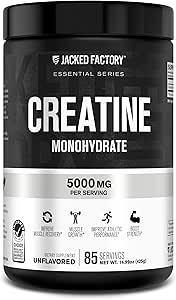
Jacked Factory Creatine Monohydrate Powder 425g – 85 Servings, Unflavored
I give Jacked Factory Creatine Monohydrate the cGMP-made powder role because it pairs a straightforward, single-ingredient formula with production in a cGMP-certified facility. Each scoop supplies the familiar 5-gram dose, and the unflavored format can disappear into a shake without changing its sweetness. Compared with Nutricost’s 500-gram powder, however, this 425-gram tub provides 15 fewer servings, making it less attractive for buyers focused on supply length. MuscleTech Platinum also has stronger stated screening credentials through third-party purity and banned-substance testing. Jacked Factory still lands above basic powders for buyers who value disclosed manufacturing standards, but it offers no flavor choice, requires mixing, and may cause gastrointestinal discomfort in sensitive users. Capsules such as CON-CRET provide a tidier alternative for travel.
Pros:- Supplies 5 grams of creatine monohydrate per scoop
- Made in a cGMP-certified facility
- Single-ingredient, unflavored formula
- Powder can be added to existing shakes or drinks
Cons:- Offers 85 servings versus Nutricost powder’s 100
- May cause gastrointestinal discomfort in some users
- No flavored option is listed
Best for: Shake drinkers who want single-ingredient, unflavored creatine made in a cGMP-certified facility
Not ideal for: People with sensitive digestion or buyers who want the longest possible supply from one container
- Creatine type:Creatine monohydrate
- Form:Powder
- Net weight:425 g
- Servings:85
- Dosage per serving:5 g
- Flavor:Unflavored
- Ingredients:Creatine monohydrate
- Manufacturing standard:cGMP-certified facility
Our verdict“I see this as a sound fit for buyers who prioritize cGMP production and simple mixing over maximum serving count.”
CON-CRET Creatine HCl Capsules for Women and Men, 90 Count
I place CON-CRET Creatine HCl Capsules in the bloating-averse slot because the concentrated HCl formula is promoted for absorption without the bloating or water retention associated with some creatine routines. Its capsule delivery also avoids scoops, gritty residue, and drink preparation. Compared with Nutricost’s capsules, CON-CRET supplies the same 750 mg per capsule but only half the bottle count: 90 versus 180. It also sits far below the 5-gram serving delivered by MuscleTech powder on a per-capsule basis, so buyers seeking gram-level intake may need multiple capsules. The strongest distinction is NSF certification and third-party testing, backed by vegan, gluten-free, and kosher credentials. I reserve this pick for convenience and dietary fit, since creatine HCl may cost more than basic monohydrate and the smaller bottle can run out sooner.
Pros:- Portable capsule form requires no mixing
- NSF certified and third-party tested
- Vegan, gluten-free, and kosher
- Creatine HCl format is promoted for use without bloating or water retention
Cons:- Only 750 mg is supplied per capsule
- The 90-capsule bottle has half the count of Nutricost’s capsule option
- Creatine HCl may cost more than traditional monohydrate
Best for: Vegan or gluten-free buyers who dislike mixing powder and prioritize NSF-certified capsule production
Not ideal for: Budget-focused lifters who want a standard 5-gram monohydrate serving with minimal cost per gram
- Creatine form:Creatine HCl
- Delivery form:Capsules
- Capsule count:90
- Amount per capsule:750 mg
- Dietary attributes:Vegan, gluten-free, and kosher
- Certification:NSF Certified
- Testing:Third-party tested
- Country of manufacture:USA
Our verdict“I would pick CON-CRET for certified, diet-friendly capsule convenience, not for the highest creatine quantity per dose.”
Nutricost Creatine Monohydrate 3,000mg, 180 Capsules (750mg Per Capsule)
I rank Nutricost Creatine Monohydrate Capsules as the high-count capsule pick because the 180-capsule bottle contains twice as many capsules as CON-CRET’s 90-count package. Both provide 750 mg per capsule, but Nutricost uses familiar creatine monohydrate and lists a 3,000 mg serving, which works out to four capsules. That is convenient for buyers avoiding powder, yet it also exposes the main compromise: matching a 5-gram scoop from MuscleTech or Jacked Factory requires roughly seven capsules. Anyone who struggles with larger pills may find that routine cumbersome. The formula earns additional credit for being gluten-free and non-GMO, while production in an NSF-certified, GMP-compliant facility adds manufacturing reassurance. I place it behind CON-CRET for broader certification details, but ahead on bottle count and monohydrate familiarity.
Pros:- High 180-capsule bottle count
- Uses standard creatine monohydrate
- Gluten-free and non-GMO formula
- Made in an NSF-certified, GMP-compliant facility
Cons:- Four capsules are needed for the stated 3-gram serving
- Roughly seven capsules are needed to approximate a 5-gram powder serving
- Capsule size may be difficult for some buyers to swallow
Best for: Frequent travelers and powder-averse buyers who want a high-count bottle of standard creatine monohydrate capsules
Not ideal for: People who have difficulty swallowing capsules or want a full 5-gram dose in one scoop
- Creatine type:Creatine monohydrate
- Form:Capsules
- Capsule count:180
- Amount per capsule:750 mg
- Stated serving amount:3,000 mg
- Capsules per stated serving:4
- Dietary attributes:Gluten-free and non-GMO
- Facility standards:NSF certified and GMP compliant
Our verdict“I recommend this to capsule users who favor bottle count and monohydrate simplicity over low pill volume.”
MuscleTech Creatine Monohydrate Powder, Platinum Pure – Unflavored, 80 Servings
I put MuscleTech Platinum 100% Creatine first because it combines the standard 5-gram monohydrate dose with third-party purity and banned-substance testing. That screening gives it a clearer quality case than Nutricost’s 500-gram powder, whose supplied details do not list comparable testing. The micronized, filler-free formula also keeps the focus on creatine without added sugar. Its lead is not based on quantity: at 80 servings, it trails Jacked Factory by five and Nutricost by 20. It is also unflavored and must be mixed, so CON-CRET is easier to carry and take without a drink. Still, I rank MuscleTech highest because its balance of dosing, formula simplicity, and disclosed screening addresses the priorities shared by the widest range of buyers, especially those who want powder with stronger purity documentation.
Pros:- Provides 5 grams of micronized creatine monohydrate per serving
- Third-party tested for purity
- Screened for banned substances
- Contains no fillers or sugar
Cons:- Its 80 servings trail both Nutricost and Jacked Factory powders
- Unflavored powder may be unappealing in plain water
- Requires measuring and mixing with a beverage
Best for: Performance-focused buyers who want a standard 5-gram powder with third-party purity and banned-substance screening
Not ideal for: Buyers prioritizing the largest serving count, flavored creatine, or a travel-friendly no-mix format
- Creatine type:Creatine monohydrate
- Form:Micronized powder
- Servings:80
- Dosage per serving:5 g
- Flavor:Unflavored
- Fillers:None
- Sugar:None
- Quality testing:Third-party purity tested
- Sport screening:Tested for banned substances
Our verdict“I rank this first for buyers who value a conventional 5-gram dose and documented purity screening more than maximum supply length.”
Animal Creatine Monohydrate Powder, 300g
I rank Animal Creatine Monohydrate Powder as the best everyday powder because its micronized, unflavored formula fits easily into a daily shake or other beverage without adding sweeteners. The 300-gram tub supplies 60 standard 5-gram servings, a practical middle ground between smaller capsule bottles and the 90 servings offered by Thorne Creatine. Animal also provides third-party testing, although competitive athletes may prefer the more clearly identified NSF certification of Thorne or Informed Sport credential of BPN Pure Creatine. Its simple vegetarian formula suits buyers who want creatine without extras, but that simplicity brings limitations: there are no flavored choices, powder still requires mixing, and its 60-serving supply runs out sooner than several rivals. I see this as a dependable routine pick rather than the strongest certification-led option.
Pros:- Micronized powder mixes readily into varied beverages
- Free from fillers, flavors, and sweeteners
- Third-party tested and made in the USA
- Vegetarian and gluten-free formula
Cons:- Only 60 standard 5-gram servings, fewer than Thorne
- No flavored version for buyers who dislike plain powder
- Third-party testing program is not identified in the supplied data
Best for: I recommend it to active adults who want an unflavored, filler-free powder that can disappear into an existing daily drink.
Not ideal for: I would skip it for drug-tested athletes seeking a named sport certification or buyers who want a longer 90- to 100-serving supply.
- Net Weight:300 g
- Standard Dose:5 g
- Standard Servings:60
- Higher Dose Option:10 g
- Servings at 10 g:30
- Flavor:Unflavored
- Dietary:Vegetarian and gluten-free
- Made In:USA
- Third-Party Tested:Yes
Our verdict“I would choose Animal for straightforward daily mixing, but certification-focused competitors have stronger credentials.”
Bare Performance Nutrition BPN Pure Creatine Monohydrate Powder, 60 Servings
BPN Pure Creatine earns my best Creapure pick role by pairing German-sourced Creapure monohydrate with Informed Sport certification. That combination gives competitive athletes clearer sourcing and banned-substance screening than Animal Creatine, whose supplied data mentions third-party testing without naming the program. Each 5-gram serving also matches the amount provided by Thorne, so buyers do not need to calculate a partial or doubled dose. The tradeoff is versatility rather than formula quality: BPN comes only as an unflavored powder and offers 60 servings, while Thorne stretches to 90. It also requires a drink and shaker or glass, unlike Nutricost or Optimum Nutrition capsules. I place it below longer-supply choices for general buyers, but its traceable raw material makes it particularly persuasive for athletes who value sourcing and sport-specific screening.
Pros:- German-sourced Creapure creatine monohydrate
- Informed Sport certified for competitive-sport confidence
- Full 5-gram serving without dose adjustment
- Unflavored format can be added to an existing drink
Cons:- Shorter supply than Thorne’s 90-serving container
- No flavored alternative
- Less portable than capsule-based options
Best for: I recommend it to tested athletes and Creapure-focused buyers who want a documented 5-gram powder serving.
Not ideal for: I would skip it for buyers who dislike mixing powders or want more than 60 servings per container.
- Supplement Form:Powder
- Creatine Type:Creatine monohydrate
- Serving Size:5 g
- Servings:60
- Total Powder:300 g
- Ingredient Source:Creapure
- Source Country:Germany
- Certification:Informed Sport
Our verdict“I would pick BPN when Creapure sourcing and Informed Sport certification matter more than flavor or container size.”
Thorne Creatine Micronized Creatine Monohydrate Powder, 90 Servings
I give Thorne Creatine the best NSF-certified supply role because it combines 90 full 5-gram servings with NSF Certified for Sport status. BPN Pure Creatine offers another athlete-oriented route through Informed Sport and Creapure sourcing, but Thorne provides 30 more servings per container. That longer supply reduces reorder frequency for daily users, while the micronized powder is designed to disperse more readily than a coarse formula. Thorne also positions the product for cognitive support alongside muscle growth and endurance, broadening its appeal beyond strength training. Still, buyers receive only an unflavored powder, so anyone sensitive to texture or tired of mixing may prefer Optimum Nutrition capsules. The supplied data also does not identify Creapure sourcing, giving BPN the clearer ingredient-origin story. I rank Thorne highly for its recognized sport certification and useful container size.
Pros:- NSF Certified for Sport
- Ninety full 5-gram servings
- Micronized powder intended for easier mixing
- Positioned to support both physical performance and cognitive function
Cons:- Available only in an unflavored powder format
- Requires measuring and mixing for every serving
- Creapure sourcing is not identified in the supplied product data
Best for: I recommend it to competitive athletes and consistent daily users who want NSF certification with a 90-serving supply.
Not ideal for: I would skip it for buyers who want capsules, flavored creatine, or specifically documented Creapure sourcing.
- Supplement Form:Micronized powder
- Creatine Type:Creatine monohydrate
- Serving Size:5 g
- Servings:90
- Total Creatine:450 g
- Flavor:Unflavored
- Certification:NSF Certified for Sport
Our verdict“I would choose Thorne for a long-lasting NSF-certified powder, especially when sport screening outweighs format convenience.”
Nutricost Micronized Creatine Monohydrate, 500 Capsules
Nutricost Micronized Creatine Capsules are my best bulk capsule supply, with 500 capsules and 125 stated servings in one bottle. They remove the scooping, residue, and drink preparation associated with Animal or Thorne powders, making them easier to carry to work or the gym. Nutricost provides 750 milligrams per capsule and 3 grams per stated serving, which mathematically requires four capsules; by comparison, Optimum Nutrition supplies 2.5 grams in two capsules. Nutricost gives buyers more total servings, but the higher pill burden can become tiresome, particularly for anyone targeting 5 grams daily. The supplied specification listing one capsule as the serving size also conflicts with the stated 3-gram serving and 125 servings from 500 capsules, so I would verify the bottle directions. Its non-GMO, gluten-free formula is appealing, though it lacks a named banned-substance certification.
Pros:- Large 500-capsule bottle with 125 stated servings
- No measuring, powder residue, or drink mixing
- Non-GMO and gluten-free
- Made in a GMP-compliant, FDA-registered facility
Cons:- A 3-gram dose requires four 750-milligram capsules
- Supplied serving-size data conflicts with the capsule count and stated dose
- No named sport or banned-substance certification
Best for: I recommend it to powder-averse buyers who want a large capsule supply and do not mind taking four or more capsules.
Not ideal for: I would skip it for buyers who struggle with multiple pills or need named banned-substance certification.
- Supplement Form:Capsules
- Listed Serving Size:1 capsule
- Creatine per Stated Serving:3,000 mg
- Creatine per Capsule:750 mg
- Capsule Count:500
- Stated Servings:125
- GMO Status:Non-GMO
- Gluten-Free:Yes
- Manufacturing Standards:GMP compliant, FDA registered
Our verdict“I would choose this Nutricost bottle for bulk capsule convenience only if taking several pills per dose is acceptable.”
Optimum Nutrition Creatine Micronized Creatine Monohydrate Capsules
I assign Optimum Nutrition Creatine Capsules the best lower-dose capsules role because two capsules deliver 2.5 grams, letting buyers split or build their intake without handling powder. Nutricost’s 500-capsule option provides 3 grams across four capsules, so Optimum Nutrition achieves nearly the same stated amount with half the pills. It also carries banned-substance testing, a meaningful advantage over Nutricost for athletes. The lower dose is a mixed benefit, however. Anyone aiming for the 5 grams supplied by one serving of Thorne or BPN must take four capsules, reducing the effective supply from 150 labeled servings to 75 5-gram doses. Capsules also limit dose adjustments to 1.25-gram increments and may be awkward for people who dislike swallowing pills. I see this as a portable, no-mix choice for modest dosing, rather than the most efficient route to a full 5-gram daily amount.
Pros:- Provides 2.5 grams in only two capsules
- No shaker, liquid, or measuring scoop required
- Tested for banned substances
- Large bottle containing 150 labeled servings
Cons:- A 5-gram intake requires four capsules
- Only 75 full 5-gram doses per bottle
- Fixed capsule increments offer less dosing freedom than powder
Best for: I recommend it to travelers, gym-bag users, and lower-dose buyers who want banned-substance-tested creatine without mixing.
Not ideal for: I would skip it for buyers targeting 5 grams daily who would rather take one scoop than four capsules.
- Supplement Form:Capsules
- Creatine Type:Micronized creatine monohydrate
- Serving Size:2 capsules
- Creatine per Serving:2.5 g
- Creatine per Capsule:1.25 g
- Labeled Servings:150
- Capsule Count:300
- Testing:Banned-substance tested
Our verdict“I would pick Optimum Nutrition for portable 2.5-gram dosing, but powder is more efficient for a 5-gram routine.”
Orgain 5g Creatine Monohydrate Micronized Powder, Unflavored, 100 Servings
Orgain Creatine Monohydrate earns this spot because its single-ingredient formula pairs a full 5-gram serving with broad dietary compatibility. I place it ahead of Nutricost Creatine Monohydrate Powder for buyers who want dairy-free, soy-free, gluten-free, GMO-free, and no-added-sugar labeling stated in one package. Its 100-serving tub also lasts longer than the 90-serving Thorne powder. Micronization should make the unflavored powder easier to distribute through shakes or other drinks, though it still requires scooping and mixing; Life Extension Creatine Capsules are tidier for travel. My main reservation is the lack of a listed third-party certification, which gives Cellucor an advantage for tested athletes. This is a clean, long-supply choice, but shoppers wanting flavored creatine or capsule convenience should pick another format.
Pros:- Full 5-gram serving of creatine monohydrate
- 100 servings provide a long daily supply
- Free from dairy, soy, gluten, GMOs, and added sugar
- Micronized, unflavored powder can be added to varied drinks
Cons:- No third-party testing certification is listed in the supplied data
- Powder requires measuring and mixing each day
- No flavored version for buyers who dislike plain supplement powder
Best for: I recommend it for allergen-conscious daily users who want a 5-gram powder with a 100-serving supply and no added sugar.
Not ideal for: I would skip it for tested athletes seeking a listed third-party certification or travelers who do not want to carry and measure powder.
- Serving size:1 scoop (about 5g)
- Servings:100
- Net weight:17.64 oz
- Supplement form:Micronized powder
- Flavor:Unflavored
- Primary ingredient:Creatine monohydrate
- Allergen features:Dairy-free, soy-free, and gluten-free
- Additional dietary features:GMO-free and no added sugar
Our verdict“I would choose Orgain for a long-lasting, allergen-conscious powder, but Cellucor is the stronger pick when certification carries more weight.”
Life Extension Creatine Capsules
Life Extension Creatine Capsules occupy a more wellness-oriented position than the athlete-focused powders in this lineup. I see them as the better match for aging adults interested in muscle, metabolic, and cognitive support without weighing powder. The 120-capsule bottle is also easier to store and transport than Orgain’s 100-serving tub. Yet Primaforce gives buyers clearer dosing information: it lists 3,000 milligrams and four capsules per serving, while Life Extension’s supplied data does not state either figure. That omission makes daily cost and pill burden harder to judge. Capsules may also cause digestive discomfort for some users, and they give up the adjustable dosing of powder. I rank this as a convenient aging-focused option, not the strongest choice for athletes who want a plainly documented 5-gram serving.
Pros:- Capsule format avoids scooping and mixing
- Positioned for muscle, endurance, cognitive, and metabolic support
- Non-GMO and gluten-free formula
- Made in the USA
Cons:- Creatine amount per serving is not stated in the supplied data
- Required capsules per serving are not specified
- Capsules may cause digestive discomfort for some users
Best for: I recommend it for aging adults who prefer portable capsules and want creatine positioned around muscle, endurance, cognitive, and metabolic support.
Not ideal for: I would skip it for dosage-focused athletes because the supplied product data does not state creatine per serving or capsules per dose.
- Quantity:120 capsules
- Supplement form:Capsules
- Primary ingredient:Creatine monohydrate
- Formula type:Creatine monohydrate supplement
- GMO status:Non-GMO
- Gluten status:Gluten-free
- Manufacturing country:USA
Our verdict“I would pick Life Extension for an aging-focused capsule routine, provided the label confirms a dose that fits the buyer’s daily target.”
Primaforce Creatine Monohydrate Capsules (3,000mg) 240 Capsules
Primaforce Creatine Monohydrate Capsules make the most sense for buyers who deliberately want a 3-gram daily serving rather than the 5 grams supplied by many powders. The dose is transparent, and 240 capsules equal 60 four-capsule servings. Compared with the vegan 5G Creatine Monohydrate Capsules, Primaforce requires the same four-pill routine but delivers 2 grams less per serving. That makes it less attractive for shoppers targeting 5 grams, yet useful for those who prefer a smaller fixed dose. I also give it credit for production in NSF- and GMP-certified facilities, a quality detail not listed for Life Extension’s capsules. The tradeoffs are real: four capsules per dose can feel tedious, and no vegan capsule claim is provided. This is a precisely labeled capsule option, not the highest-dose choice.
Pros:- Clearly stated 3,000mg dose per serving
- Capsule format avoids powder mess and measuring
- Manufactured in NSF- and GMP-certified facilities
- Gluten-free and GMO-free
Cons:- Four capsules are required for each serving
- 3-gram serving is lower than the 5-gram servings offered by several alternatives
- Vegan capsule status is not stated
Best for: I recommend it for athletes who want a fixed 3-gram dose, dislike powder, and value NSF- and GMP-certified facility manufacturing.
Not ideal for: I would skip it for buyers targeting 5 grams daily or anyone who finds swallowing four capsules at once inconvenient.
- Creatine per serving:3,000mg
- Serving size:4 capsules
- Total capsules:240
- Calculated servings:60
- Primary ingredient:Creatine monohydrate
- Facility certifications:NSF and GMP
- Gluten status:Gluten-free
- GMO status:GMO-free
Our verdict“I would choose Primaforce for a documented 3-gram capsule dose, while 5-gram users get more creatine per four pills from the vegan 5G option.”
Cellucor Cor-Performance Creatine Monohydrate for Strength and Muscle Growth, 72 Servings
Cellucor Cor-Performance Creatine ranks highest in this batch for athletes who place certification ahead of maximum serving count. Its NSF Certified status and banned-substance positioning provide a clearer quality signal than Orgain, whose supplied data lists dietary exclusions but no third-party certification. Each serving delivers 5 grams of micronized creatine monohydrate, matching Orgain’s dose and supporting easy blending with an existing supplement stack. The compromise is quantity: 72 servings trail Orgain’s 100 and Thorne’s 90, so frequent users will replace the container sooner. It is also unflavored, and powder is less convenient than Life Extension’s capsules when traveling. I do not treat the caffeine-free formula as a flaw for everyday creatine use, but shoppers seeking a combined stimulant pre-workout will need another product. This is the certification-led choice for competitive routines.
Pros:- NSF Certified for a stronger quality signal
- Positioned as free from banned substances
- Full 5-gram creatine serving
- Micronized powder mixes readily with other supplements
Cons:- 72 servings provide a shorter supply than Orgain and Thorne
- Unflavored-only format may not suit buyers who mix with water
- Powder is less portable and tidy than capsules
Best for: I recommend it for competitive and tested athletes who want a 5-gram micronized powder backed by NSF certification and banned-substance screening.
Not ideal for: I would skip it for value-focused daily users who prioritize the largest serving count or want creatine combined with pre-workout stimulants.
- Servings:72
- Creatine per serving:5g
- Creatine type:Creatine monohydrate
- Supplement form:Micronized powder
- Flavor:Unflavored
- Certification:NSF Certified
- Substance screening:Free from banned substances
- Stimulant content:Caffeine-free
Our verdict“I would pay for Cellucor when athlete-facing certification matters more than getting the most servings per container.”
Creatine Monohydrate Capsules – 5G, 60 Servings, Vegan, Non-GMO, Gluten-Free
5G Creatine Monohydrate Capsules are my capsule pick for vegan buyers because they combine plant-based shells with a full 5-gram dose. Primaforce also requires four capsules per serving, but it supplies only 3 grams; this option delivers more creatine without adding pills. The vegan, vegetarian, gluten-free, and non-GMO positioning also gives it a clearer dietary role than Life Extension, whose capsule material is not stated in the supplied data. Manufacturing in a USA cGMP facility adds another useful quality marker. Convenience has limits, though: swallowing four capsules every day may be harder than stirring one scoop of Orgain, and the 60-serving pack lasts well under Orgain’s 100 servings. Its single-ingredient approach also excludes electrolytes or other workout ingredients. I rank it as the strongest vegan capsule fit, not the best bulk value.
Pros:- Full 5-gram serving in capsule form
- Vegan plant-based capsules
- Gluten-free, non-GMO, and free from artificial additives
- Made in a USA cGMP facility
Cons:- Requires four capsules for every 5-gram serving
- 60-serving supply is shorter than several powder alternatives
- Single-ingredient formula offers no supporting workout ingredients
Best for: I recommend it for vegan or vegetarian buyers who want a full 5-gram creatine dose without measuring powder.
Not ideal for: I would skip it for pill-averse users and bulk buyers who want more than a 60-day supply from one package.
- Serving size:4 capsules
- Creatine per serving:5 grams
- Total capsules:240
- Servings:60
- Creatine form:Micronized creatine monohydrate
- Capsule material:Plant-based
- Dietary suitability:Vegan and vegetarian
- Dietary exclusions:Gluten-free and non-GMO
- Manufacturing:Made in USA in a cGMP facility
Our verdict“I would choose this for a vegan 5-gram capsule routine, but Orgain offers a longer supply for buyers comfortable with powder.”

How We Picked
I ranked these products around form of creatine, labeled grams per serving, supply length, dosing effort, and formula simplicity. Monohydrate received priority because it has the deepest research base, while micronization counted as a usability benefit rather than proof of better results. I also compared how easily each product reaches a common 3–5 g daily intake. Products with transparent serving math and fewer obstacles to consistent use moved higher. Claims about strength, endurance, or cognition did not earn extra credit without a meaningful formulation difference.
Value was based on usable creatine per container, not capsule count or tub size alone. I separated products into clear roles so a premium powder, bulk option, beginner pick, and capsule choice would not be treated as interchangeable. Powders generally ranked above capsules because they deliver more creatine with less swallowing and simpler cost comparisons. Capsules gained ground when portability or taste-free use could justify their higher dose burden. The final order reflects the strongest mix of evidence, practical dosing, and buyer value.
| creatine supplement | Creatine type |
|---|---|
| Nutricost Creatine Monohydrate | Creatine monohydrate |
| Jacked Factory Creatine Monohy | Creatine monohydrate |
| CON-CRET Creatine HCl Capsules | — |
| Nutricost Creatine Monohydrate | Creatine monohydrate |
| MuscleTech Creatine Monohydrat | Creatine monohydrate |
| Animal Creatine Monohydrate Po | — |
| Bare Performance Nutrition BPN | Creatine monohydrate |
| Thorne Creatine Micronized Cre | Creatine monohydrate |
| Nutricost Micronized Creatine | — |
| Optimum Nutrition Creatine Mic | Micronized creatine monohydrate |
| Orgain 5g Creatine Monohydrate | — |
| Life Extension Creatine Capsul | — |
| Primaforce Creatine Monohydrat | — |
| Cellucor Cor-Performance Creat | Creatine monohydrate |
| Creatine Monohydrate Capsules | — |
Factors to Consider When Choosing Best Creatine Supplements
The best creatine supplement is usually the one that makes a research-backed daily dose easy to repeat. I would narrow the field by choosing a creatine form, checking the real serving math, and deciding how much convenience is worth paying for. Powder, capsule burden, formula transparency, and cost per gram matter more than dramatic front-label promises. The factors below help separate meaningful differences from packaging language.
Choose the Creatine Form Before the Brand
Creatine monohydrate is my default choice because it has the longest research history and makes comparisons across brands simple. Micronized monohydrate uses smaller particles, which may mix more smoothly, but it remains the same creatine form. Creatine HCl products such as CON-CRET can appeal to buyers who dislike large scoops or report digestive discomfort with monohydrate. A smaller HCl serving does not automatically produce better strength or muscle outcomes. I would try monohydrate first unless a practical issue keeps interfering with daily use. Paying more for another form makes sense only when better adherence offsets the added cost.
Check Grams per Serving, Not Container Count
A bottle with 500 capsules can appear generous until the label reveals how many capsules make one serving. Nutricost’s 750 mg capsules, for example, require four capsules to provide 3 g and more to reach 5 g. I calculate total grams of creatine, divide that amount by my planned daily dose, and compare the resulting number of days. This prevents a 3 g serving from being treated as equal to a 5 g serving. It also exposes products that advertise a high count while requiring several units each day. For a fair price comparison, I use cost per 5 g rather than cost per scoop, capsule, or container.
Match Powder or Capsules to Your Routine
Powder usually offers better value and makes a 5 g dose easier to obtain, but it requires a drink, a scoop, and occasional mixing. Capsules avoid flavor and residue, making them useful for travel, offices, or buyers who do not want another mixed beverage. Their weakness is the number of pills needed for a full daily amount. Large capsule servings can also run out faster than the front label suggests. I favor powder for home use and regular training, while capsules make more sense when portability drives consistency. Buyers who struggle with pills should skip capsule products even when the bottle looks compact.
Separate Useful Quality Signals From Marketing
A short ingredient list makes it easier to see exactly what the daily serving provides. I give more weight to clear labeling, batch traceability, and credible independent certification than to claims such as pure, platinum, or performance. Dietary labels such as vegan, gluten-free, or non-GMO matter when they match a real personal requirement, but they do not make creatine more effective. Flavored blends can introduce sweeteners and serving ambiguity without improving the active ingredient. Unflavored single-ingredient powder is usually easier to mix into an existing routine. Buyers subject to athletic drug testing should prioritize recognized sport certification over broad quality language.
Know When Paying More Makes Sense
Creatine monohydrate is a commodity-like ingredient, so a higher price does not automatically buy better results. A premium can be reasonable for stronger quality documentation, sport certification, cleaner packaging, or dependable availability. It is harder to justify when the only differences are branding and an elaborate label. I compare the premium choice with a basic monohydrate powder at the same daily dose. If both provide transparent 5 g servings, the added cost should solve a specific concern rather than create vague reassurance. For most buyers, consistent dosing beats premium positioning.
Frequently Asked Questions
Should I Buy Creatine Monohydrate or Creatine HCl?
I would start with creatine monohydrate because it has broader research support, clearer dose conventions, and many affordable choices. Creatine HCl may suit someone who dislikes the amount of powder used with monohydrate or experiences recurring stomach discomfort. Claims that a much smaller HCl dose produces superior results are not enough for me to rank it above monohydrate. CON-CRET earns a place here for format flexibility, not because HCl is the stronger default. Buyers who tolerate monohydrate have little reason to pay extra for a less established alternative.
Is Creatine Powder Better Than Capsules?
Powder is better for buyers focused on cost, dose flexibility, and fewer pills. Capsules are better for travel, taste avoidance, and routines where carrying a tub is inconvenient. The active ingredient can be the same, so the format does not make monohydrate more powerful. I would check how many capsules are required to reach my chosen daily amount before buying. If that number feels tedious, a single scoop of powder is the more realistic long-term choice.
Is a 3 g Serving Enough, or Should I Choose 5 g?
Both 3 g and 5 g fall within commonly used daily maintenance amounts for creatine monohydrate. A 3 g serving may be adequate for many adults, though it can take longer to build muscle creatine stores than a loading approach. A 5 g serving is easier to compare across powders and may better suit larger buyers or anyone who wants one standard scoop. I would avoid assuming that more always produces better results once muscle stores are saturated. The practical difference is often supply length and capsule burden, not a dramatic performance gap.
Do I Need to Load Creatine When Starting?
A loading phase is optional rather than mandatory. A common loading method uses about 20 g daily, divided into smaller servings for five to seven days, followed by a lower maintenance dose. It can fill muscle creatine stores faster, but it also increases the chance of temporary water-weight gain or digestive discomfort. I prefer steady daily dosing for beginners because it is simpler and still builds stores over time. Buyers wanting faster saturation can load, provided the larger intake fits their health needs and routine.
Is Third-Party Certification Worth Paying More For?
Certification can justify a premium for drug-tested athletes, cautious buyers, and people who want added manufacturing oversight. It does not make creatine itself more effective, and the exact certification program matters more than a vague tested claim. I would verify that a recognized organization covers the specific product rather than relying only on brand-wide language. Recreational users may be comfortable with a transparent single-ingredient product from an established manufacturer. Competitive athletes have more at stake and should place certification above small price savings.
Conclusion
For the strongest all-around balance, I recommend Nutricost Creatine Monohydrate Micronized Powder 500G as the best overall choice. Buyers seeking the best value should compare current cost per 5 g and choose Jacked Factory Creatine Monohydrate Powder when it undercuts the other large powders. For a premium purchase, Thorne Creatine makes the most sense for buyers who place extra weight on brand positioning and a straightforward 5 g serving.
Beginners who want a familiar, uncomplicated powder should start with MuscleTech Platinum Pure. Capsule-focused buyers can choose Optimum Nutrition for a conventional monohydrate format, while CON-CRET Creatine HCl better serves those specifically seeking smaller-dose capsules and a non-monohydrate option. Buyers prioritizing dietary labeling may prefer Life Extension Creatine Capsules or the listed vegan 5 g capsules, provided the daily pill count and cost remain practical. My final choice for most people remains a single-ingredient monohydrate powder because it offers the clearest path to repeatable dosing without paying for format complexity.
Halloween Picks
halloween
As an affiliate, we earn on qualifying purchases.